
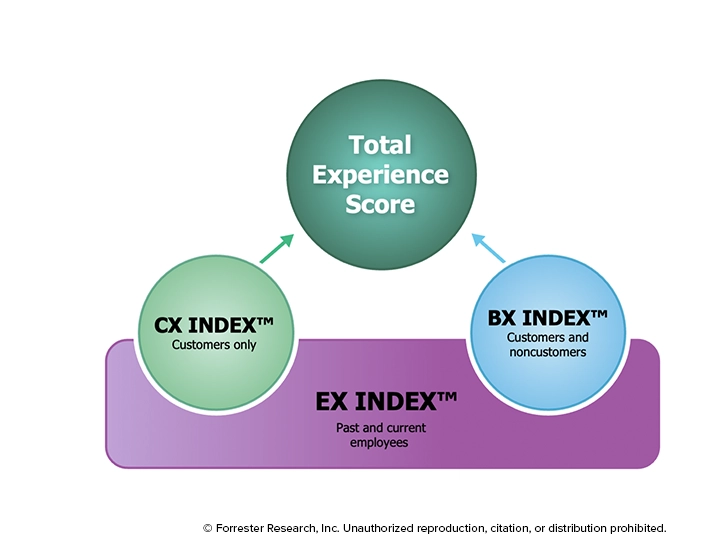
Forrester’s Total Experience Score combines our Brand Experience Index (BX Index™) and Customer Experience Index (CX Index™) to measure how well a brand wins and serves customers throughout the customer lifecycle. Forrester’s Employee Experience Index (EX Index™) measures the level of engagement of an organization’s workforce to do the work of winning and serving customers.
The BX Index, calculated for both noncustomers and customers who are aware of a brand in a specific industry, measures how successfully a company builds brand perceptions that attract new customers and retain them. In contrast, the CX Index focuses exclusively on customers who have interacted with the brand within the past 12 months and measures how successfully a company delivers customer experiences that create and sustain loyalty.
Together, these two scores form the Total Experience Score. Half of the Total Experience Score is calculated from the noncustomer BX Index score, and the other half is calculated from a combination of customer BX Index and CX Index scores. Separately, the EX Index generates a score for an organization responsible for a specific brand that we assign to an EX impact category — positive, neutral, or negative — in comparison with industry-peer organizations for which we have data in countries around the globe.
Forrester covers more than 400 brands across 11 industries in 13 countries. Forrester maintains control over all brand, industry, and market decisions. Companies cannot pay to be included or excluded from our annual benchmark survey, nor can they purchase favorable scores or ranking results. Forrester independently acquires a nationally representative sample in each market and does not use customer lists supplied by any company included in our annual benchmark survey.
The BX Index Process
Forrester’s BX Index was created in 2025 by combining our Brand Energy Index with our data on trust. The BX Index contains the three most important elements of brand perception — salience, fit, and trust — and links them with the outcome metrics of future purchasing, purchase preference, price premium, and advocacy. The influence the brand perception metrics have on the outcome metrics is weighted by industry and by whether a survey respondent is a customer or noncustomer.
Noncustomer respondents in the BX Index state that they are aware of the products or services of a brand but are not customers. Customers self-identify as a current user of the products or services of the brand — and have interacted with it in the last 12 months. If respondents qualify for multiple brands within an industry, they are randomly assigned to only one brand in that industry. Both customer and noncustomer respondents are asked about their perceptions of the respectively assigned brand. The customer and noncustomer BX Index algorithm is applied to each respondent’s answers to calculate the customer or noncustomer score. A brand’s noncustomer BX Index score is the average of all individual scores for noncustomers of that brand. The same applies to customers. A brand’s overall BX Index score is the average of all customer and noncustomer scores calculated for the respondents who answered for that brand.
The CX Index Process
The current CX Index methodology has been used for more than 10 years. The CX Index survey measures CX quality, customer loyalty, CX driver performance, and several other factors about the experience and the customer. The CX Index algorithm models the relationship between CX quality and customer loyalty. Because loyalty dynamics vary by industry, the CX quality metrics are weighted in the algorithm based on how much impact they have on loyalty in each industry per market.
CX Index survey respondents self-identify as a current customer who has directly interacted with selected brands in the past 12 months. If respondents qualify for multiple brands within an industry, they are randomly assigned to only one brand within that industry. Respondents are asked questions about the experiences they have had with an assigned brand. The CX Index algorithm is applied to each respondent’s answers to calculate a CX Index score. A company’s CX Index score is the average of CX Index scores given to the brand by each of its customers in the survey sample.
The EX Index Process
Employee sentiment — the perception that employees have about key aspects of their work experience — reveals how well an organization empowers, enables, and inspires its workers, directly contributing to employee retention, effectiveness, and innovation readiness, as measured in Forrester’s new EX Index. In early 2026, we analyzed sentiment data over the prior year from half a million people who work at more than 3,000 organizations. We focused our EX Index analysis and reporting on the 171 organizations across seven industries in 11 countries where we also have CX Index and BX Index data, revealing the relationship between EX and Forrester’s Total Experience Scores.
EX Index scores encompass 10 sentiment variables in three dimensions. The score is calculated using a weighted algorithm across 10 sentiment variables that all fit into one of three dimensions of EX: how employees are empowered, enabled, and inspired. These EX Index scores are further categorized into EX impact compared with industry-peer companies — in the countries across the globe where we have data for that industry — to determine whether their EX Index scores leave them with a positive, neutral, or negative EX impact. The lower the EX Index score relative to peers, the harder it will be for that organization to meet Total Experience Score goals and achieve growth targets, given the extra burden required of depending on a workforce that is less empowered, enabled, and inspired than those of their competitors’ workforces.