AI Will Reshape Customer Service Jobs In Dramatic Ways
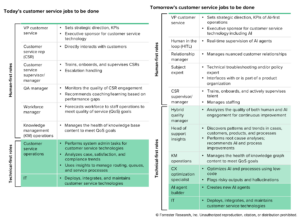
Forrester predicts that by 2030, AI will cause 49% of current customer service jobs to disappear. We already see contact centers streamlining their organizational structures to have fewer team leads. AI is replacing coaching and scheduling jobs. When this happens, the human workforce’s core mandate shifts from reactively interacting with customers directly to managing the AI that interacts with them. The jobs to be done will change. Specifically:
- Customer service leaders will use AI to shift strategy to customer value, not just operational excellence. Customer service (CS) leaders will carry more customer value creation and revenue growth. This shift is already happening: In the latest “State of Service” report from Salesforce, 85% of decision-makers say that service is expected to contribute a larger share of revenue this year.
- The scope of customer service rep work will expand and specialize. Instead of directly resolving customer inquiries, lower-tier customer service representatives (CSRs) will manage teams of AI agents, unblock them when they encounter issues that require a human judgment call, and give feedback to AI to optimize their outcomes. Higher-tiered CSRs will also specialize: Some will take on more technical subject matter or policy expert roles or shoulder more relationship management duties.
- Operational roles will enjoy a strategic boost with AI assistance. Customer insights gleaned from conversational AI and conversation intelligence will allow customer service to drive process and product innovation. Insight teams are starting to do detailed forensics on the exact performance and cost of operations, down to the cost of automating a specific intent.
- IT roles will expand to support the flywheel of innovation that AI is driving. Low-code tooling will make AI agent configuration and optimization accessible to citizen developers. It will unlock new “light technology” jobs to create AI agents as well as other jobs that manage the quality of AI outputs and processes. AI will also preserve traditional IT jobs responsible for integrating AI tools and agents into broader customer service infrastructure, back-office, and telephony systems.
Customer Service Jobs Will Evolve To Be More Data-Driven, Technical, And Specialized
Forrester Models The Impact of AI On Job Roles Within Two To Five Years
The biggest questions today: Which customer service jobs will be most impacted? How fast will these jobs shrink? And will normal attrition outpace leadership’s ability to reskill or upskill those that remain?
Forrester analyzed the potential impact of AI across customer service organizations. We made some assumptions about staffing ratios and containment rates. We used these inputs to create two models that reflect staffing scenarios on a two-year and a five-year time horizon. You can find our staffing models here. These models highlight important changes that customer service leaders should factor into their scenarios:
- High-volume contact centers will see proportionately more staff reductions. Based on our AI automation potential research, we expect organizations that experience monthly inquiry volumes in the hundreds of thousands or more — typically B2C organizations — to see the greatest reduction in staff. Organizations with lower inquiry volumes — typically B2B — will see a lower percentage of first contacts resolved by AI due to the longer-running workflows with more exceptions.
- CS leaders will need new ways to assess performance and customer impact. To predict future staffing levels, leading teams run simulation exercises that model increases in AI containment rates while keeping interaction volumes steady. They look at the broader impact that human interactions have on customer satisfaction, retention, and revenue. They also include salary projections to determine the real ROI from AI.
This workforce transition will be incredibly hard. You must understand the skills for each “job to be done.” Use this information to reskill or upskill your workforce. You will have to lean into change management. You will also have to rethink organizational structures and organizational ownership of AI operations. Reach out via inquiry to discuss the impact that AI will have on your customer service organization. Reach out for help on how to navigate the organizational disruption that comes with it.