

The B2C marketing status quo is under assault. AI advances and increasing market fragmentation have made an already challenging landscape even more complex. B2C marketing leaders must find ways to break through the noise, earn and retain customer loyalty, and defend the value of marketing in a fast-changing measurement environment.
It’s not an easy mission. Yet the fundamentals of B2C marketing — brand building, customer centricity, emotional resonance, and connection — will help marketing leaders prevail. Elevating human empathy while prioritizing strategic innovation can drive growth for bold companies and brands.
Forrester has identified several areas of opportunity for B2C marketing leaders in this era of innovation, uncertainty, and perpetual change. To succeed, they should ask themselves these key questions.
How Can I Build And Sustain A Strong Brand?
In a world chock-full of choice and transient digital interactions, a durable and trusted brand matters more than ever. Yet brand building is a long-term endeavor that’s often backburnered in favor of short-term tactics aimed at driving revenue. B2C marketing leaders must balance a guiding vision with continuously shifting consumer habits and preferences.
Today’s successful brands are dynamic brands that leverage technology in ways that deliver differentiated experiences. They also are cohesive, with brand promise and customer experience tightly aligned. Forrester refers to this alignment as the total experience. It encompasses the entire customer lifecycle — from prospective customers’ perceptions of your brand to how current customers actually experience it, as well as how likely they are to stay with you and recommend your brand to others.
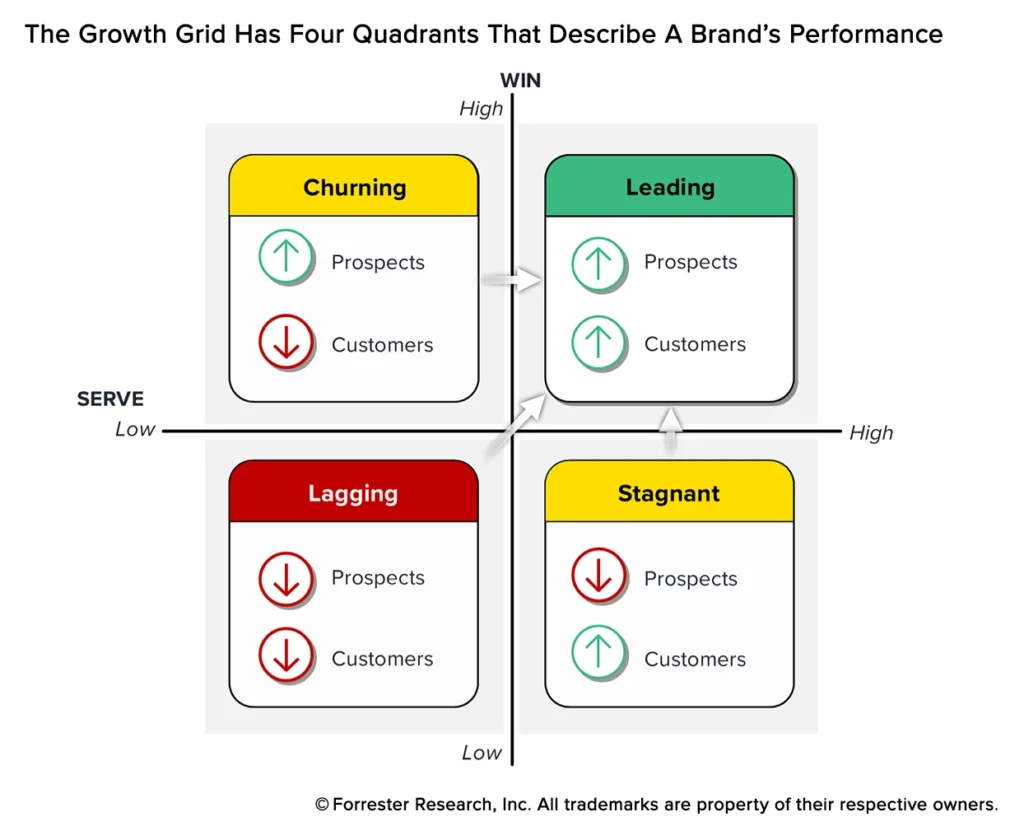
Forrester’s research shows that by improving brand equity and CX together, companies can achieve 3.5 times the revenue lift of improving one or the other on their own. Companies that want to grow revenue must align their initiatives along two vectors (as illustrated in the growth grid above): win new customers and serve existing customers to generate revenue from retention and enrichment.
To define and deliver a total experience, collaboration between brand and CX teams is critical. Together, the teams map and manage journeys, define messaging and success metrics, and turn data into insights that fuel delight, connection, and loyalty.
What Are The Elements Of A Good B2C Data Strategy?
High-quality consumer data has been a competitive differentiator since the earliest days of digital marketing. Now, with the acceleration of AI in B2C marketing, the ability to turn data into actionable insights, in ways that are meaningful, efficient, and trustworthy, can genuinely make or break a brand.
Simply amassing data is not a strategy. In fact, many companies are already drowning in data that’s siloed, hidden, and outdated. This data clutter not only obscures insight but also heightens security risks and reputational damage via data breaches.
How can B2C marketing leaders build an effective data strategy? While they can’t do it alone, they have a critical role to play. Marketing leaders hold the key to customer understanding and should represent customers’ expectations, behaviors, preferences, and interests in enterprise data strategy discussions.
The company’s business goals and priorities should be the starting point for a marketing data strategy. Marketing leaders should then:
- Inventory the data available across the company. Consider what data is available to use that’s outside of marketing’s traditional purview and that could help improve consumers’ experiences. For example, who would customers contact if they were experiencing issues with your service? Depending on your type of company, additional data sources might also include inventory and pricing.
- Tie data needs to concrete customer journey moments. Identify tactics that will help the business realize its goals and the customer data needed to execute. If your organization does not have this data today, develop a plan to collect zero- and first-party data to fill in gaps. Focus on customer experiences and how you can use data to address their needs and become more useful. For example, consider what inputs you need to create consumers’ next-best experiences and how technology, such as a real-time interaction management solution, can help you deliver those experiences.
- Align data needs to organizational privacy practices. Privacy is a multidisciplinary practice, but just 25% of privacy decision-makers say their organization’s privacy team collaborates with marketing, Forrester data shows. This is risky, since marketing is customer-facing by nature. Marketing leaders must ensure that their teams follow the company’s privacy practices and that marketing is an active participant in privacy discussions. Aim for practices that are compliant and transparent but not so restrictive that they hinder fluid customer experiences.
What Are The Best AI Use Cases For B2C Marketing?
AI is nothing new to B2C marketers. Nearly all B2C marketing organizations are using AI in some form, and Forrester data shows that AI offers the potential to build brand affinity through more personalized, intuitive, and innovative experiences.
Generative AI (genAI) has gained the most traction in recent years. Forrester’s 2025 survey data shows that 61% of B2C marketing organizations are either exploring or experimenting with genAI, while 27% have use cases in production. This far surpasses agentic AI use: 42% of B2C marketing and advertising leaders in the US say they already use agentic AI in marketing use cases. But agentic AI is rapidly evolving, and Forrester believes that it will take two to five years before organizations realize significant benefits from it.

How are B2C marketers succeeding with genAI? As comfort with it grows, use cases become more diversified. While many use cases touch on some aspect of consumer experience — for example, 62% of B2C marketing leaders say their organizations use genAI for content creation and optimization, 55% for campaign generation and optimization, and 45% for journey analytics — genAI has also gained traction in back-office functions such as financial modeling and RFP generation (both 59%).
B2C marketers must balance harnessing AI’s benefits with maintaining privacy and security. Strong data protection practices and rules around what can and cannot be entered into large language models are critical, both for the sake of the business and for maintaining consumer trust.
Strong foundational practices will be essential to build consumer trust as AI continues to advance and agentic AI becomes more prevalent. To help capture AI’s benefits securely, B2C leaders should:
- Continually audit processes and workflows. Review internal marketing processes and identify pain points and opportunities to apply AI in small and discrete workflows or steps. That can help curb shiny-object syndrome and will be essential to realizing benefits from new technologies such as agentic AI.
- Invest in AI readiness. Provide necessary training for marketing teams, and develop policies and guidelines governing what AI can and cannot be used for. Emphasize to team members that customer data and other sensitive information is off-limits for AI tools.
- Focus on the most beneficial use cases. Prioritize AI use cases that support customer objectives and marketing strategies. This will keep your efforts focused (while narrowing your realm of risk) and ensure that AI adoption generates business outcomes.
- Meet customers where they are. Consumers are decidedly less comfortable with, and less bullish about, AI than marketers, Forrester survey data shows. To earn and maintain trust, be transparent about your AI use, clearly highlight its benefits to users, and be willing to educate them on how to use it if needed. Always keep in mind that AI must run on high-quality data to produce high-quality outputs.
How Can B2C Marketers Adapt To AI Search?
AI presents another challenge for B2C marketing organizations in how it is transforming online search. Today, consumers may find the information or even buy the products they’re looking for without ever clicking through to your website.
The rise of so-called zero-click search means diminished control over the customer journey and loss of customer data and insights. With fewer website visits, brands lose out on valuable mid- and bottom-of-funnel data on consumer behavior. Metrics such as time on site and user engagement are harder to track, creating blind spots in SEO and marketing strategies.
How can brands stand out in a zero-click environment, especially as these dynamics are so quickly evolving?
- Respond to consumer needs: Upskill search marketers to structure and mine zero- and first-party data for customer needs so that you can create content that responds to their questions in AI search. Train marketers on keyword research tools that reveal what and how audiences are searching — for example, are they searching for “used” or “preowned” cars? Analyze various types of data, including organic and paid search signals and social listening data, to learn and anticipate frequently asked questions.
- Think about content structure: AI and search engines favor clear, factual, and easily digestible information. Focus on directly answering common customer questions within the first few sentences of your content. Rather than overindexing on keyword research, listen to and act on natural language expressed via text and voice across consumers’ search experiences.
- Diversify content with images and video: The sources that accompany AI answers often include images and even video, which appeal to Millennial and Gen Z audiences. Creating these sorts of visual assets can capture attention on search results pages, potentially helping attract click-throughs.
- Bolster adjacent marketing strategies: Expand your focus outside of AI search. Invest in a strong presence on the social media channels your customers and prospects visit, build relationships with credible third-party influencers, and look for speaking opportunities at industry events. These efforts can create a surround-sound effect that ultimately boosts your presence in AI search and elsewhere.
AI-powered search also changes the rules of search marketing measurement. Now that conversations, rather than clicks and rankings, determine success, search marketers need KPIs that signal the quality of consumers’ conversational search experiences.
New KPIs that measure brands’ saturation on AI-integrated search engine results pages and impressions in AI-powered conversations should complement current indicators of customer experience like bounce rate, engagement time, goal completion, and soft and hard conversions.
Do Loyalty Programs Still Matter?
Compared to generative AI and zero-click search, loyalty programs may feel old-fashioned. But they endure for a reason. Most global consumers belong to at least one loyalty program, Forrester data shows, and two-thirds of US online adults say they spend more with the brands whose loyalty programs they’re enrolled in. When thoughtfully designed, these programs go beyond retention tactics to create emotional connections, differentiate the brand, and drive long-term customer engagement.
How should B2C marketers design or redesign their loyalty program to be most effective? Aim to balance financial incentives with experiential benefits. While points and discounts drive short-term behavior, exclusive access, personalized experiences, and recognition foster long-term emotional loyalty and help bolster brand reputation. Programs like Amazon Prime and JetBlue’s Mosaic demonstrate how offering differentiated, members-only perks can reinforce brand value and create a sense of exclusivity that customers are proud to be part of.
Program structure also plays a critical role in shaping customer perception and engagement. Clear enrollment paths, tiered progression systems, and strategic partnerships can help brands reward loyal behavior and extend their reach. Transparency in program benefits, or selective opacity through invitation-only perks, can further enhance perceived value.
To maximize impact, B2C marketing loyalty programs should:
- Align benefits with brand and customer goals. For example, if the stated goal of a loyalty program is to enrich the customer relationship, offering discounts on products the customer is already buying won’t be effective. Your success will depend on your ability to offer benefits that specifically reflect short- and long-term business goals while delivering utility to the customer.
- Boost perceived value and attainability. Consumers will quickly lapse if they don’t care about the offering or if the benefits are too difficult to achieve. Measuring your program’s perceived value (for example, through voice-of-the-customer surveys) can help ensure that you’re offering benefits customers perceive as high-value, driving them to participate.
- Avoid excessive burden on the organization. If your loyalty program is costing you more to maintain than the value you gain in the form of customer retention, you’re not helping your business. Regularly revisit how well the program strategy is delivering on the program goals and review the results to be certain that the overall ROI makes it worthwhile.
Also think about how you deliver your loyalty program. Communications and offers should be in the channels where your customers spend their time — for example, social, email, or even print, depending on the members. They also should make good use of data to deliver highly relevant communications.
Elevate B2C Marketing And Fuel Growth
Balancing customer-first approaches with business needs enables B2C marketing leaders to turn the challenges they face into opportunities. An outside perspective can be valuable — and Forrester can help.
Forrester Decisions for B2C Marketing Executives helps leaders increase their brand loyalty and develop an agile marketing function to stay ahead of change and quickly pivot to evolving market and customer demands. With a combination of leading insights, proven tools, and continuous guidance, we help you envision and execute customer-centric strategies that set your business apart and foster increased loyalty across the journey.
Talk To Us
Find out how Forrester can help elevate your B2C marketing function.
Thank you!
Ready to learn more now? Give us a call:
Americas: +1 615.395.3401
EMEA: +44 (0) 2073 237741
Asia Pacific: +65 6426 7060