Are You Prioritizing The Right Customer Journey Improvements?
Many CX leaders risk investing where it doesn’t earn loyalty because traditional prioritization of journey drivers ignores that customers don’t stay loyal because you’re doing well; rather, they stay loyal when you are doing better than competitors in the things that matter.
This blog is part of a series on how customer journeys drive loyalty (scroll to the end for all resources).
Competitive Context Changes The Investment Decision
Looking only at your own performance answers “Where are we weak?” But weakness is not the same as competitive disadvantage. CX leaders must answer more urgent questions: “Where are we losing?” and “Where do we need to invest to differentiate?”
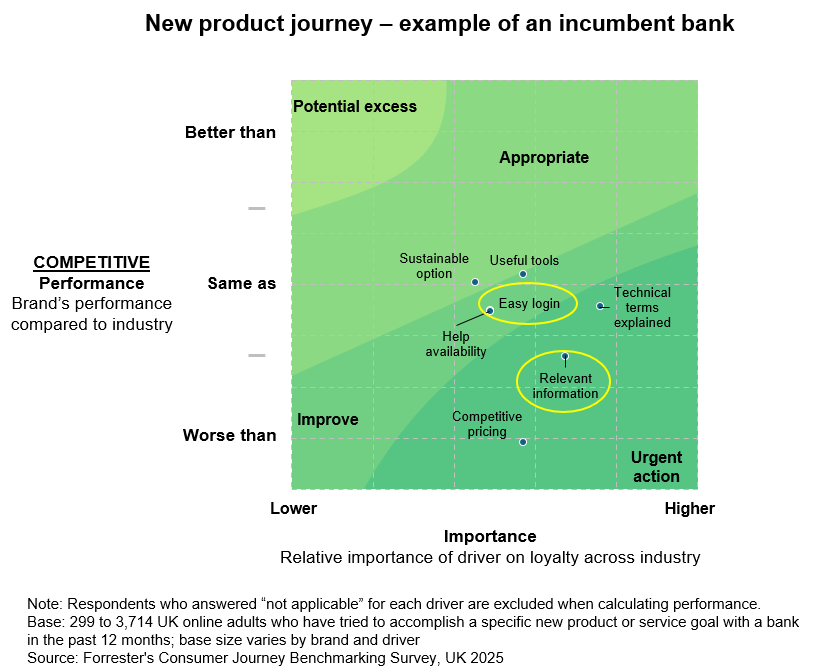
Let us prove it to you using data from Forrester’s 2025 journey benchmarking study. Below you’ll see data for one large incumbent bank, showing the seven most important drivers of loyalty in “getting a new product or service” journeys.
The difference is simple. Instead of asking how well the bank performs on each driver, the analysis asks how well it performs relative to competitors (y-axis).
- “Easy login” requires work despite being only the fourth-most-important driver. Why? Because the bank underperforms compared to competitors.
- “Relevant information” needs urgent work — not just because it is quite important but also because the gap to competitors is quite large.
Without Competitive Context, You May Fix The Wrong Problems
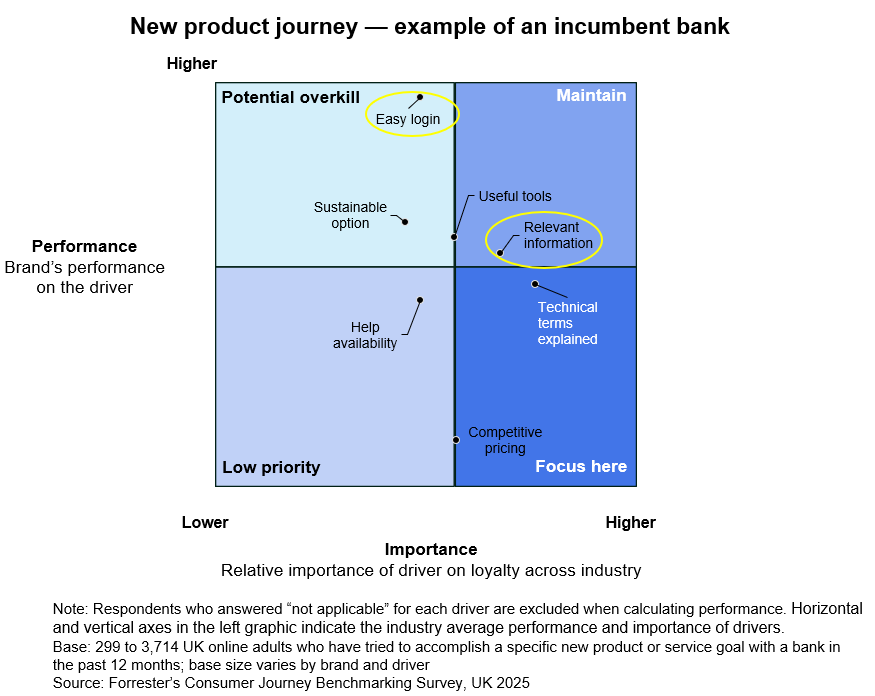
Had we relied on a traditional importance performance matrix, we would have concluded that neither issue required immediate investment. Relevant information would have fallen into the “maintain” quadrant and easy login into the “potential overkill” quadrant. The bank would likely invest in the wrong place and deprioritize issues where competitors have a meaningful advantage.
Put Competitive Prioritization In The Context Of Your Strategy For Each Journey
Competitive context is the key ingredient to be able to treat journey investments as portfolio management:
- Start with your strategy for each journey: Is it a hygiene journey that you want to stabilize, a table-stakes journey where you want to match competitors, and/or a signature journey where you want to race ahead of competition?
- Then, benchmark journey-level drivers to identify whether you perform on par with, below, or above competitors in key loyalty drivers.
- Finally, decide what to improve based on that information. For example, when you are trying to match competitors for table-stakes journeys, focus on those drivers where you are behind.
What Should You Do Next?
Don’t stop at combining journey strategy and benchmarking at the journey-driver level. Dive into our other key findings and recommendations for improving journeys in ways that drive loyalty:
-
- Get an overview of all findings in our blog Do You Improve What Matters To Loyalty In Customer Journeys? and get all details in the report Five Journey Practices That Strengthen Customer Loyalty (Forrester Decisions access required).
- Find out in our companion blogs about:
- If you are a Forrester client, request an analyst call.