

For years, B2B go-to-market (GTM) strategies relied on a common set of assumptions: Buyers would follow reasonably predictable journeys, engage directly with providers, and reveal their intentions through a stream of observable signals. Marketing generated demand, sales converted opportunities, product teams shaped offerings, and customer success drove adoption and retention.
Today, that model no longer reflects reality.
Buyers increasingly control their own journeys, relying on AI-powered research, digital self-service, peer networks, and independent sources of information to evaluate potential providers. As AI further reduces providers’ visibility into buying behavior, organizations are confronting what Forrester calls a GTM singularity: a point at which mounting pressures cause long-standing rules, norms, and practices to collapse and entirely new ones to emerge in their place.
The organizations that navigate the singularity will not simply adopt new technologies or tactics. They will rethink how their marketing, sales, product, and customer success teams work together to meet buyers where they are.
Why Are Traditional B2B GTM Strategies Failing?
Traditional GTM strategies are failing because linear funnels, functional handoffs, and isolated metrics no longer reflect how B2B buyers discover, evaluate, purchase, and adopt solutions.
Self-directed buying is not new. B2B buyers have long evaluated potential solutions by consulting peers, reviewing analyst research, consuming content, and comparing providers before engaging sellers. AI has accelerated this trend, enabling buyers to conduct deeper research, evaluate alternatives more thoroughly, and progress further through decision-making processes without direct provider interaction.
Approaches to B2B GTM strategy have not kept pace. Companies still organize activities around linear funnel models and functional handoffs that do not align with how buyers experience providers. The disconnect between buyers’ and providers’ processes leads to friction and frustration: Forrester’s research shows that 85% of buyers report dissatisfaction with at least one aspect of their chosen provider’s buying experience, highlighting the consequences of fragmented execution.
Meanwhile, fragmented GTM processes — separate plans, disconnected incentives, siloed metrics — contribute to inefficient spending, missed opportunities, and revenue shortfalls. In Forrester’s Marketing Survey, 2026, B2B marketing decision-makers reported, on average, only 85% achievement of their revenue plan. Executive misperceptions of GTM alignment — 92% of executives believe their GTM teams are aligned while just 57% of practitioners agree — allow inefficiencies to persist.
Closing the gaps requires a wholesale rethinking of how growth teams operate. Optimizing old models won’t be enough to navigate the convergence of changing buyer behavior, AI, and ongoing market volatility. Organizations need a new approach built around the realities of modern buying.
How Can B2B GTM Teams Succeed In The AI Era?
To thrive at a time when AI is changing both how B2B buyers search and how organizations work, leading organizations are embracing three foundational principles: AI augmentation, resilience, and collaboration.
- Augment Human Expertise With AI
Human-AI collaboration is becoming a baseline operating model for growth teams. AI can accelerate analysis, automate routine work, surface insights, and support decision-making at scale. But technology alone does not create value. Organizations must combine AI capabilities with human judgment, creativity, expertise, and relationship-building. The goal is not automation for its own sake but instead, to create better customer outcomes and enable teams to work more effectively. - Build Resilience Into GTM Operations
Static planning cycles and rigid organizational structures struggle to keep pace with rapidly changing markets. High-performing organizations are becoming more adaptive, continuously assessing customer needs, reallocating resources, and adjusting execution based on new signals. Rather than optimizing for stability, they optimize for responsiveness. - Make Collaboration A Core Capability
Modern buyers do not experience organizations through functional boundaries. They experience a single brand, a single provider, and a single customer relationship. Success increasingly depends on how effectively marketing, sales, product, customer success, operations, and leadership teams share information, coordinate decisions, and execute against common goals.

What Shifts Must Modern GTM Teams Make?
Operationalizing AI augmentation, resilience, and collaboration requires several important shifts to B2B GTM strategy:
Shift 1: From Visibility To Discoverability
Nearly all buyers (94%) now use AI in at least one stage of the purchasing process, Forrester’s latest Buyers’ Journey Survey shows. As buyers increasingly rely on AI-powered answer engines and digital self-service research, traditional visibility strategies have become less effective. Buyers may never visit a provider website, click on a search result, or submit a form before reaching a decision.
For GTM teams, the challenge is no longer simply appearing in search results — it is ensuring that buyers and AI systems can consistently find, understand, and trust your organization’s expertise wherever discovery occurs.
Leading organizations are investing in discoverability by creating authoritative content, strengthening digital trust signals, maintaining consistent brand representation across channels, and ensuring that information can be easily interpreted by both human buyers and AI systems.
Shift 2: From Capturing Demand To Building Preference
According to Forrester’s Buyers’ Journey Survey, 68% of buyers begin the purchasing process with a preferred vendor already in mind; that preferred vendor goes on to win 80% of the time. This means that by the time traditional demand-generation programs identify an opportunity, the most important influence may already have occurred.
Growth increasingly depends on shaping perceptions before buyers enter the market. That requires dismantling the persistent divide between brand and demand and shifting more of marketing’s focus from detecting demand to deliberately creating the conditions that make buyers more likely to choose your company.
Sales, product, customer success, and partner teams all contribute to this effort through the experiences they create and the trust they establish. Organizations that consistently build expertise, credibility, customer advocacy, and market presence are more likely to become the preferred choice when purchasing needs emerge.
Shift 3: From Measuring Engagement To Measuring Outcomes
Traditional measurement models were built around observable buyer behavior. Clicks, website visits, downloads, leads, and engagement metrics provided evidence that buyers were interacting with marketing programs and provider content. Now, AI-mediated buying journeys make many of those signals less visible and less meaningful.
Forward-looking organizations are responding by shifting focus from activity to impact. Instead of fixating on buyers’ engagement with a campaign, they increasingly focus on whether go-to-market investments actually improve business outcomes.
Outcome-oriented measurement emphasizes indicators such as buyer preference, customer value, revenue contribution, retention, growth, and business performance. This requires stronger alignment across functions because no single team owns these outcomes independently.
Shift 4: From AI Adoption To Human-AI Collaboration
Most organizations have moved beyond asking whether they should adopt AI and are now confronting the more important question of how to generate meaningful business value from it. The greatest gains will come not from AI alone, but from combining AI’s speed, scale, and analytical power with uniquely human capabilities such as judgment, creativity, relationship-building, expertise, and strategic decision-making.
As AI becomes embedded across go-to-market workflows, leading organizations are redesigning work around the complementary strengths of humans and machines. AI can accelerate analysis, automate routine tasks, and surface insights, while people provide context, critical thinking, and accountability. Organizations that intentionally cultivate this synergy can improve productivity, enhance customer experiences, and make better decisions.
Realizing these benefits takes more than technology investment. Organizations must equip employees with new skills, establish responsible AI governance practices, and create processes for validating AI-generated outputs. Most importantly, leaders should measure success by business outcomes rather than AI adoption metrics alone. Organizations that focus on outcomes instead of usage will be better positioned to capture AI’s full potential.
The Future Of GTM Is Connected
No single GTM function can execute these shifts alone. Marketing cannot solve discoverability without product expertise and customer validation, and sales cannot build preference independently of brand, customer experience, and product value. Measurement cannot evolve if functions continue to optimize separate metrics.
As AI becomes more entrenched in team-specific workflows, organizations run the risk of silos hardening. GTM leaders must forge a different path by developing GTM strategies that lay the foundation for joint plans and actions. They must build alignment into growth decisions rather than trying to align functions after decisions are made.
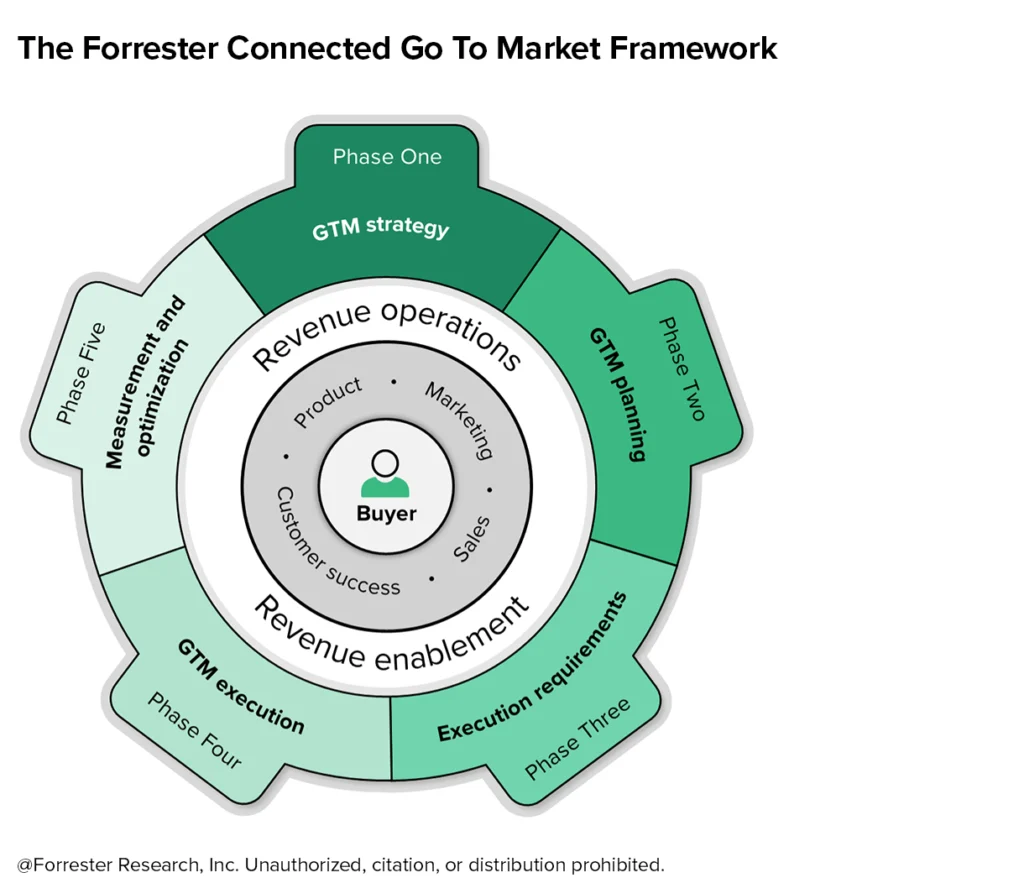
Connected GTM is an operating approach that aligns strategy, planning, execution requirements, execution, and measurement around shared customer and business outcomes.
A connected GTM approach considers the business value, inputs, and dependencies of five critical components:
- GTM Strategy: Establish a shared vision for growth, supported by a common understanding of customers, markets, priorities, and competitive differentiation.
- GTM Planning: Align investments, resources, and priorities across functions so that teams execute against the same objectives rather than competing agendas.
- Execution Requirements: Define what is needed to translate strategy into action and align data, technology, and workflows so that cross-functional teams can synchronize work.
- GTM Execution: Coordinate customer-facing activities and establish cross-functional governance to adapt quickly to buyers and new information.
- GTM Measurement and Optimization: Define shared outcomes and performance indicators that reinforce collaboration and business impact rather than functional optimization. Continuously evaluate performance to improve execution and adapt strategies over time.
Together, these capabilities create a more resilient growth engine capable of responding to changing buyer behavior, AI-driven disruption, and increased market uncertainty.
How Can Organizations Begin Building GTM Alignment?
Achieving GTM alignment rarely begins with a large-scale reorganization. Organizations often make the greatest progress by introducing shared practices that improve coordination across marketing, sales, product, customer success, and operations. Together, these practices set the foundation for a more connected approach to growth.
Prioritize Target Market Segments and Buyer Personas
High-performing organizations prioritize their best-fit customers and the outcomes they are trying to achieve. Mutually agreed-upon target market segments and buyer personas help product, marketing, sales, and customer success teams focus on the same audiences, make more consistent decisions, and create a more coherent customer experience throughout the lifecycle.
Measure Shared Outcomes Instead Of Functional Activity
Alignment is difficult when each team is evaluated using different definitions of success. Organizations that successfully connect GTM functions establish common measures tied to customer and business outcomes, creating shared accountability for value creation rather than optimizing for function-specific metrics alone.
Connect Strategy, Execution, And Optimization
Many organizations treat strategy development, execution, and performance measurement as separate activities. In contrast, connected GTM organizations create ongoing feedback loops that link planning, execution, measurement, and optimization. This allows teams to respond more effectively to changing customer needs, market conditions, and competitive pressures.
Build Customer Understanding Across Functions
Customer understanding cannot remain static or reside within one function. Connected GTM organizations continually share market intelligence, buyer behavior, product usage, customer feedback, and performance data so that every team can refine decisions as customers and market conditions change.
Make Customer Value The Organizing Principle
Connected GTM is not about eliminating functional expertise or giving every team an identical plan. It’s about enabling marketing, sales, product, customer success, and operations to make coordinated decisions based on whom the organization serves, what those customers value, and how the business can help them achieve their goals. When customer understanding guides strategy, planning, execution, and measurement, functional expertise becomes a source of collective advantage rather than fragmentation, allowing the organization to adapt more quickly and create more sustainable growth.
Forrester clients can access B2B go-to-market strategy research here.
Frequently Asked Questions
How have B2B buying dynamics changed in recent years?
B2B buyers are increasingly self-directed, rely on larger buying networks, consume information independently, and use AI-powered tools throughout the decision-making process. Many buyers establish preferences before directly engaging providers.
What impact does AI have on B2B buying?
AI helps buyers research faster, compare options, gain confidence in purchasing decisions, and access information through conversational interfaces and answer engines. These behaviors reduce direct engagement with provider-owned channels.
Why are traditional B2B lead-generation and attribution models becoming less effective?
Traditional lead-generation and attribution models depend heavily on observable engagement. As buyers conduct more research through AI-powered and third-party channels, providers receive fewer direct signals, making clicks, form fills, and sourced pipeline less complete measures of GTM influence.
What is the GTM singularity?
The GTM singularity is a period of fundamental change in B2B go-to-market practices as AI accelerates shifts in buyer behavior, organizational operations, and market dynamics. It requires organizations to become more augmented, resilient, collaborative, and customer-centric.
What is preference creation in B2B marketing?
Preference creation focuses on building credibility, trust, reputation, and market presence before buyers enter a formal purchasing process. It complements demand-generation efforts and helps organizations become the preferred choice earlier in the buying journey.
How should B2B GTM teams measure success in the AI era?
B2B GTM teams should complement engagement and functional activity metrics with shared measures of buyer preference, customer value, revenue contribution, retention, growth, and operational effectiveness. These indicators provide a more complete view of whether GTM investments improve customer and business outcomes.
What is a connected go-to-market strategy?
A connected B2B GTM strategy aligns marketing, sales, product, customer success, and other stakeholder groups around common goals, coordinated planning, shared accountability, and customer-focused execution.
How can organizations better align marketing, sales, and customer success?
Organizations can improve alignment through integrated planning processes, shared performance measures, common customer insights, cross-functional governance, and coordinated execution rhythms.
Talk To Us
Find out how Forrester can help elevate your B2B marketing function.
Thank you!
Ready to learn more now? Give us a call:
Americas: +1 615.395.3401
EMEA: +44 (0) 2073 237741
Asia Pacific: +65 6426 7060