Does NVIDIA Wield Too Much Power Over The AI Computing Ecosystem?
In September 2025, after speaking with 23 major vendors in the AI computing ecosystem, we published this statement: “Everybody we interviewed sees NVIDIA — the most highly valued company in the world, currently, at over $4 trillion — as the immovable force in the AI stack and thus the most powerful in the AI ecosystem. When we asked whether NVIDIA’s power posed a risk, the answers were either incredulous that we would even ask or clear that the answer didn’t matter: NVIDIA is both the enabler and the ecosystem anchor.”
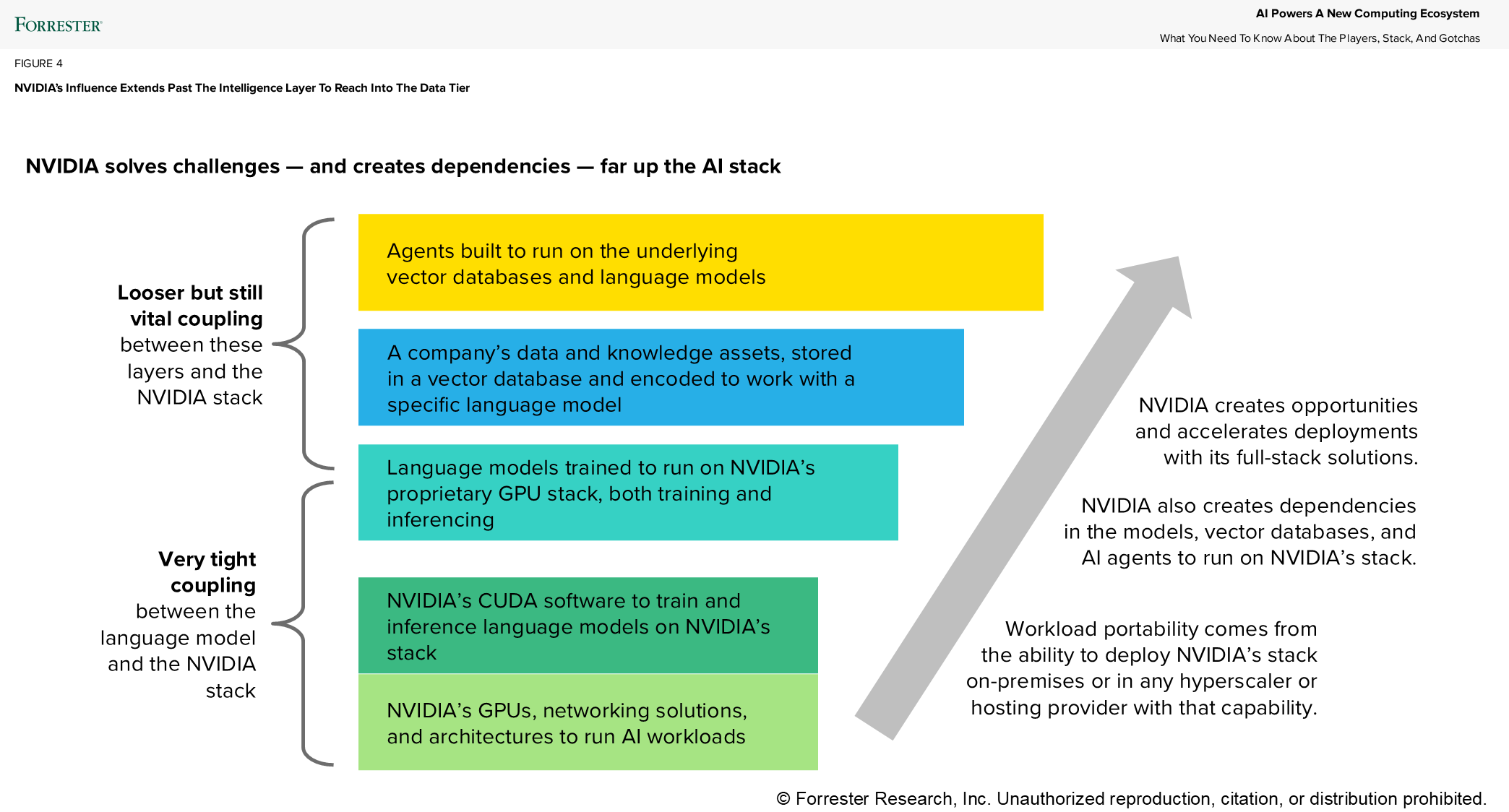
The analysis and picture at the end of this post presents the case. What does this power position mean after this month’s gyrations?
- Be wary of the concentration risk in your AI computing stack. NVIDIA’s CEO has no bearing on this today. Every enterprise needs to hedge its technology bets.
- Ask your vendors what they would do if NVIDIA’s chips were to suddenly go belly up. What is their exposure to NVDIA’s software and hardware? Are you comfortable with that?
- Demand more transparency and openness from NVIDIA’s CUDA stack. This middleware layer is becoming a public utility. It should be open sourced as is most of the Internet’s software.
- Step up to today’s reality: Not every AI workload needs NVIDIA power chips. NVIDIA still makes the most advanced chips, but you don’t need it – nor even want it – for inferencing, where cost, energy, speed and latency matter. Run power-efficient GPUs on the edge; AMD chips on hardware you own; and on good-enough GPU inferencing chips from Google and Amazon. Even good old-fashioned CPUs can carry much of the inferencing load.
Here’s the excerpt on NVIDIA from the report, “AI Powers A New Computing Ecosystem.”
NVIDIA Is The Power Base Of Your AI Computing Future
Everybody we interviewed sees NVIDIA — the most highly valued company in the world, currently, at over $4 trillion — as the immovable force in the AI stack and thus the most powerful in the AI ecosystem. Taiwan-based TSMC also benefits tremendously from NVIDIA’s success, with NVIDIA accounting for over a fifth of the chip manufacturer’s revenue. When we asked whether NVIDIA’s power posed a risk, the answers were either incredulous that we would even ask or clear that the answer didn’t matter: NVIDIA is both the enabler and the ecosystem anchor for AI workloads. While AMD and other chipmakers may claw back some market share and power for firms that are pursuing a silicon-neutral chip strategy, NVIDIA’s strategy of providing full-stack solutions and being available in every sovereign cloud and through every deployment scenario means it’s just easier to go with the chip giant (see Figure 4).
For strategists worried about the lock-in, be aware that NVIDIA powers the AI stack because it created the best full-stack solution available. It brings its portfolio to life through myriad distribution options, including its own NEMO cloud. Going with open-source software or an alternative independent chipmaker makes it your problem to train and inference models and encode your knowledge infrastructure to deploy AI agents that work. NVIDIA’s full-stack solution delivers:
- Cutting-edge GPUs to train and inference language models. NVIDIA’s weapons-grade processors are a matter of economic and political policy. Huawei’s Ascend series — including the 910b, 910c, and upcoming 910d — is gaining traction, particularly in China, as a response to US export restrictions. Hyperscalers are also investing heavily in proprietary AI silicon: Amazon with Trainium, Google with TPU, and Microsoft with Azure Cobalt. These developments signal a shift toward diversified silicon strategies, but NVIDIA remains the anchor of AI infrastructure for now.
- CUDA software to train and inference language models. This proprietary software is the link between raw processing power and the expertise engines in ChatGPT, Google Gemini, Salesforce Agentforce, and every other language model. NVIDIA came by this honestly by building the software stack for its gaming and image generation customers, where CUDA began and offered the best price/performance for those workloads. It extended CUDA’s reach and importance as machine learning workloads gained importance, a move that it parlayed into language model supremacy.
- Reference architectures and real data centers for AI workloads. NVIDIA’s networking gear and AI data center design capabilities are becoming the building blocks for hyperscalers and service providers. NVIDIA’s strategy here is to be distribution neutral: It will partner with the highest bidder in every country in every technology category: hyperscalers, systems integrators, software providers, and enterprises. This access neutrality keeps regulators and customers from sniffing around the lock-in that is building.
- A smart partnership strategy. NVIDIA controls the stack today, but it knows that the hyperscalers can displace it with proprietary silicon, country leaders’ support depends heavily on national interests, and true competitors like AMD and Huawei are rising. NVIDIA’s response is to anchor the ecosystem with support from partners in every layer of the stack: from the bottom, where its biggest customers are the hyperscalers, to the top, where systems integrators like Accenture and Infosys are building massive NVIDIA businesses. There’s room for partners to thrive because NVIDIA knows its place. In the words of CEO Jensen Huang, as reported in The Wall Street Journal: “ … we build everything, but we offer it to the world however they would like to take it. We want to enable the ecosystem.” We believe it.
NVIDIA’s Influence Extends Past The Intelligence Layer To Reach Into The Data Tier
Categories