Streaming’s Next Battle Is For Customer Relationships
The SVOD (streaming video on demand) industry is abuzz about Netflix’s engagement trends and declining viewership between first and second seasons. Why? Because it points to a bigger market question: What keeps streaming consumers engaged when their hit show isn’t on? While original programming, sports rights, and other exclusive content draw consumers to a given streaming service, durable engagement depends on how that content gets delivered.
Today’s streaming consumers are in open relationships with SVOD providers, moving between streaming services based on in-the-moment content availability. Maintaining engagement gets harder as consumers gain more entertainment choices. The newly published report, Forrester’s US Streaming Providers Total Experience Score Rankings, 2026, measures how effectively streaming providers win new customers and serve existing ones to drive growth. The headline: The streaming industry’s next growth challenge is giving customers a better reason to stay.
Content Gets Consumers In The Door. Relationships Determine If They Stay.
While consumers have more content choices than ever, streaming providers haven’t given them enough reasons to stay engaged between content events. Every gap between hit shows becomes a customer relationship test. And the streaming industry is failing this test.
When compared to the other industries for which Forrester tracks Total Experience Scores, streaming providers consistently underperform on the very attributes that keep customers around (see figure below). Streaming providers lag on making customers feel valued, rewarding loyalty, having transparent data policies, resolving problems quickly, and other relationship indicators. Among noncustomers, value perception, loyalty, budget fit, and pricing perceptions remain persistent weaknesses.
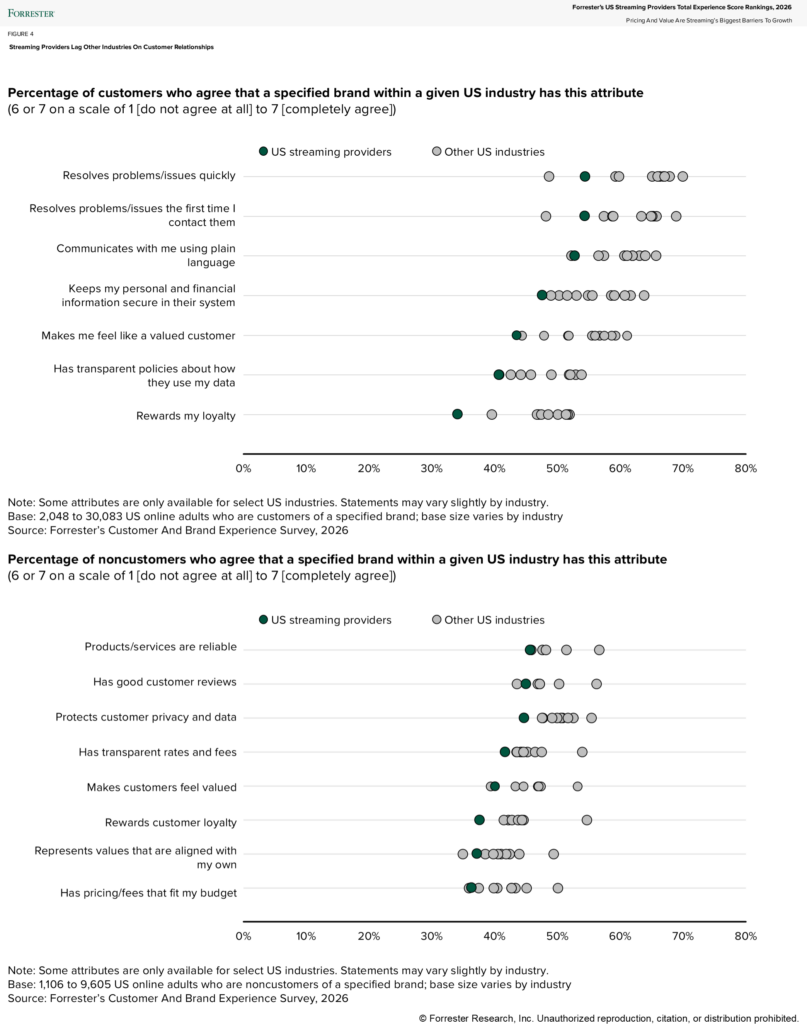
Today’s streaming providers are built on viewing moments. A series premiere, a season finale, a live sporting event, or a blockbuster franchise release drives engagement. The problem? This creates ephemeral relationships rather than enduring ones. SVOD consumers need a reason to keep paying for the service between content events. Streamers need to earn the next engagement, the next renewal, and the next price increase.
Disney Understands The Customer-Relationship Assignment
Disney’s new(-ish) CEO joined the company at an interesting time. Forrester’s Total Experience Score data shows that Disney+ has work to do. The service underperformed on value among noncustomers, pricing among noncustomers and customers, and content freshness among customers. Yet Disney’s latest vision for Disney+ appears aligned with the very problem our data uncovered.
During today’s earnings call, Disney CEO Josh D’Amaro put customer relationships at the center of Disney’s streaming strategy. He said that Disney’s “fundamental advantage is the depth of our fan relationships” and pointed to the company’s focus on “deepening our direct relationships with fans by creating a more connected Disney experience.” How? By making Disney+ the front door to that relationship.
Disney can connect streaming, sports, parks, cruises, merchandise, games, and fan benefits in a way few competitors can. That gives Disney more ways to stay present between major releases and more opportunities to make Disney+ useful even when the next Marvel, Star Wars, Pixar, or Hulu breakout isn’t new that week. The risk is clutter. Disney+ can become a more valuable relationship hub, or it can become a digital junk drawer.
Forrester’s Total Experience Score Reveals Why SVOD Relationships Break Down
The new (and first-ever) report, Forrester’s US Streaming Providers Total Experience Score Rankings, 2026, provides a data-driven view of streaming industry growth, customer retention, and customer acquisition. The report includes:
- An industry comparison showing where streaming lags other sectors on customer relationship attributes.
- A growth grid showing the providers that best balance winning new customers and serving existing ones.
- Provider-level rankings across total experience, customer, and noncustomer scores.
- Customer and noncustomer driver analyses that show which attributes most affect growth.
- Employee experience analysis that examines whether internal strengths are reaching customers.
Forrester clients: Let’s chat more about this via a Forrester guidance session.
Categories