What Matters Most For Banks Buying Enterprise Fraud Management Solutions In APAC, 2026
Real-time fraud decisioning is now table stakes for enterprise fraud management (EFM) in Asia Pacific. The harder challenge is finding an EFM solution that can keep pace with each organization’s operating model, regulatory obligations, and market-specific complexity.
How organizational profiles affect banks’ EFM solution choice
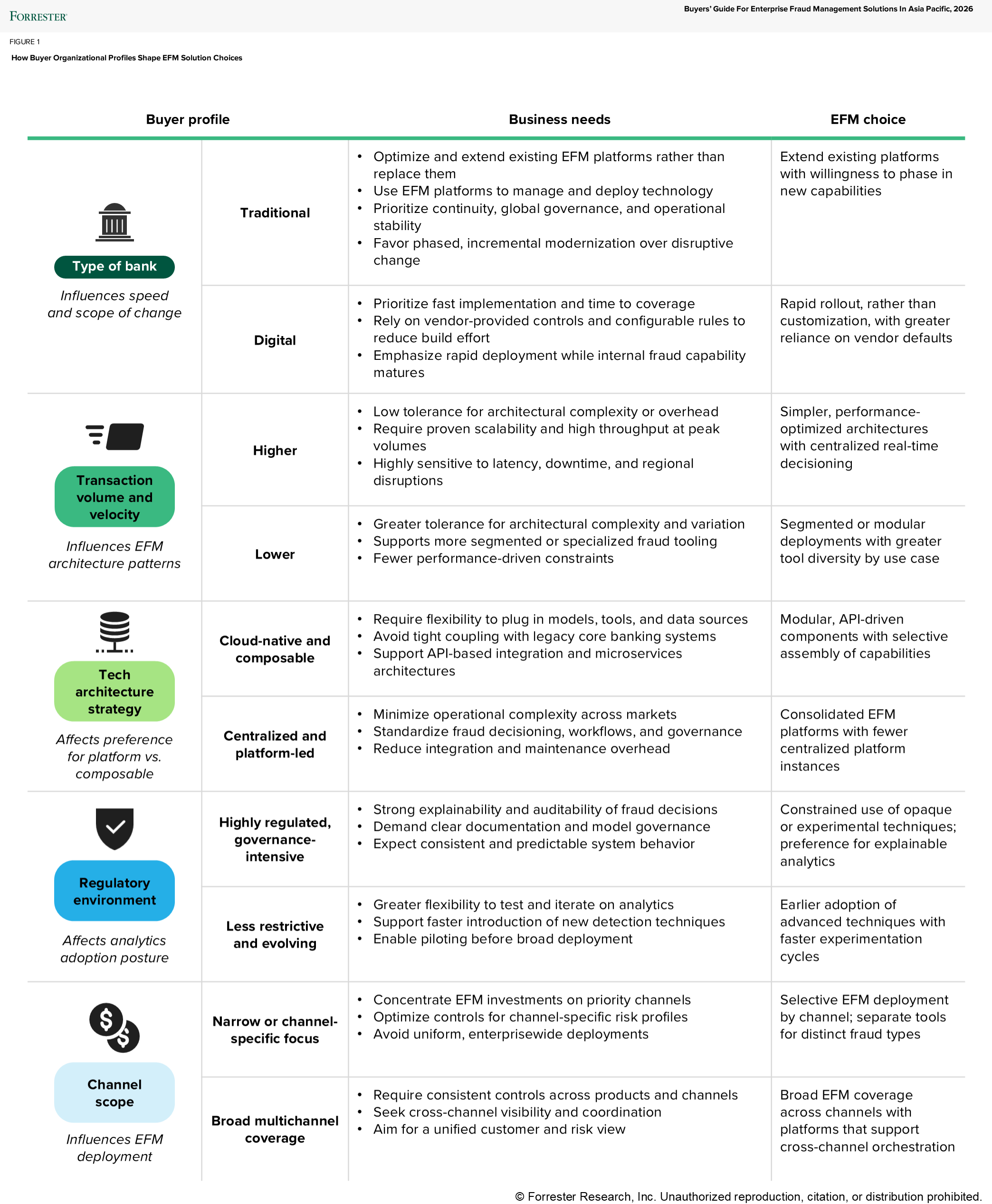
In our latest report, Buyers’ Guide For Enterprise Fraud Management Solutions In Asia Pacific, 2026, we explore why organizations make different EFM choices despite facing a similar threat landscape. Drawing upon customer interviews of leading EFM solution providers that we evaluated in a recent Forrester Wave™ evaluation, we find that these differences are not driven by vendor capability alone but also by each organization’s operating model, transaction environment, architecture strategy, and regulatory context. Understanding this interplay is critical for making informed, effective EFM decisions:
- Operating models determine how fast EFM strategies can evolve. An organization’s business model shapes its operating model, which in turn sets how fast its fraud strategy can evolve. There is no single approach to fraud transformation. Large financial services incumbents extend and optimize existing EFM platforms to protect stability, continuity, and global governance, accepting slower change for lower disruption risk. Digital banks, unburdened by legacy, adopt vendor-provided controls as the fastest path to coverage, buying time for internal fraud capabilities to mature.
- Scale and architecture constrain EFM design. Transaction volume, velocity, and enterprise architecture largely dictate what EFM solutions can look like. High-throughput environments require simplified, performance-optimized architectures with centralized real-time decisioning. Such organizations have low tolerance for latency that can potentially disrupt customer experience and inhibit fraud response. On the flip side, organizations with lower transaction intensity can support modular options that align to specific use cases. Broader technology strategy reinforces the split: Platform-led organizations gravitate to integrated suites, while cloud-native, composable organizations prefer API-driven components.
- Risk, regulation, and channel priorities determine where EFM is deployed. EFM deployment reflects an organization’s risk posture and regulatory environment. Organizations that operate in highly regulated markets will prioritize explainability, auditability, and predictable system behavior and in turn will avoid adopting complex or opaque detection techniques. The same risk lens drives selectivity: Rather than applying uniform controls enterprisewide, most buyers concentrate EFM investment on their highest-exposure channels and fraud types.
The figure below summarizes the report’s key findings, illustrating how organizational profiles shape EFM choices.
Read the full report or schedule a guidance session
To learn more, Forrester clients can read the full report or schedule a guidance session or inquiry for a deeper discussion.
Categories