Anthropic’s S-1 Hands Enterprise AI Buyers Better Leverage
Back in June, we argued that Anthropic’s proposed IPO would change the economics of enterprise AI, reasoning that a public listing brings discipline: Pricing would “get real,” capital would chase acquisitions, and Anthropic would trade capability for cost. The public S-1, filed October 26, has the numbers we lacked a few months ago, and it did change our minds on three of those calls. A bigger issue emerged when we compared its compute purchase commitments with the kind of revenue it earns. After reviewing the S-1, we think:
- Pricing will get “real” … by getting cheaper. Serving AI already makes Anthropic money. Its gross margin was 85% in the first half of 2026 by our math, up from 12% a year before, and the newest model cut customers’ cost per task about 40%. And as we explain below, it needs low prices to fill the compute capacity it has committed to.
- Anthropic won’t slow research to improve its margins. In June, we expected it to favor cost-efficiency over capability growth. But models released in the prior six months brought in more than 80% of third-quarter revenue, so it has to keep pushing the frontier to keep raking in the money.
- Public investors will get less say than we assumed. One founder’s share holds 50.1% of the vote, and a trust elects most of the board. The S-1 says that public shareholders generally “will not be able to affect the outcome” of votes, so the founders and the trust will set pricing and research priorities.
Anthropic Needs To Book Its Committed Capacity — Use That As Leverage
Anthropic went ahead and bought the compute, and now it needs your workloads. When you divide what Anthropic has agreed to pay suppliers ($265.6 billion) by the amount that customers have contractually committed to pay ($10.8 billion), Anthropic has about $25 committed to compute for every dollar a customer has locked in. Somebody’s usage has to fill that capacity, and most of it has to come from enterprise buyers. We doubt many buyers have priced the leverage that this gives them into their contracts yet.
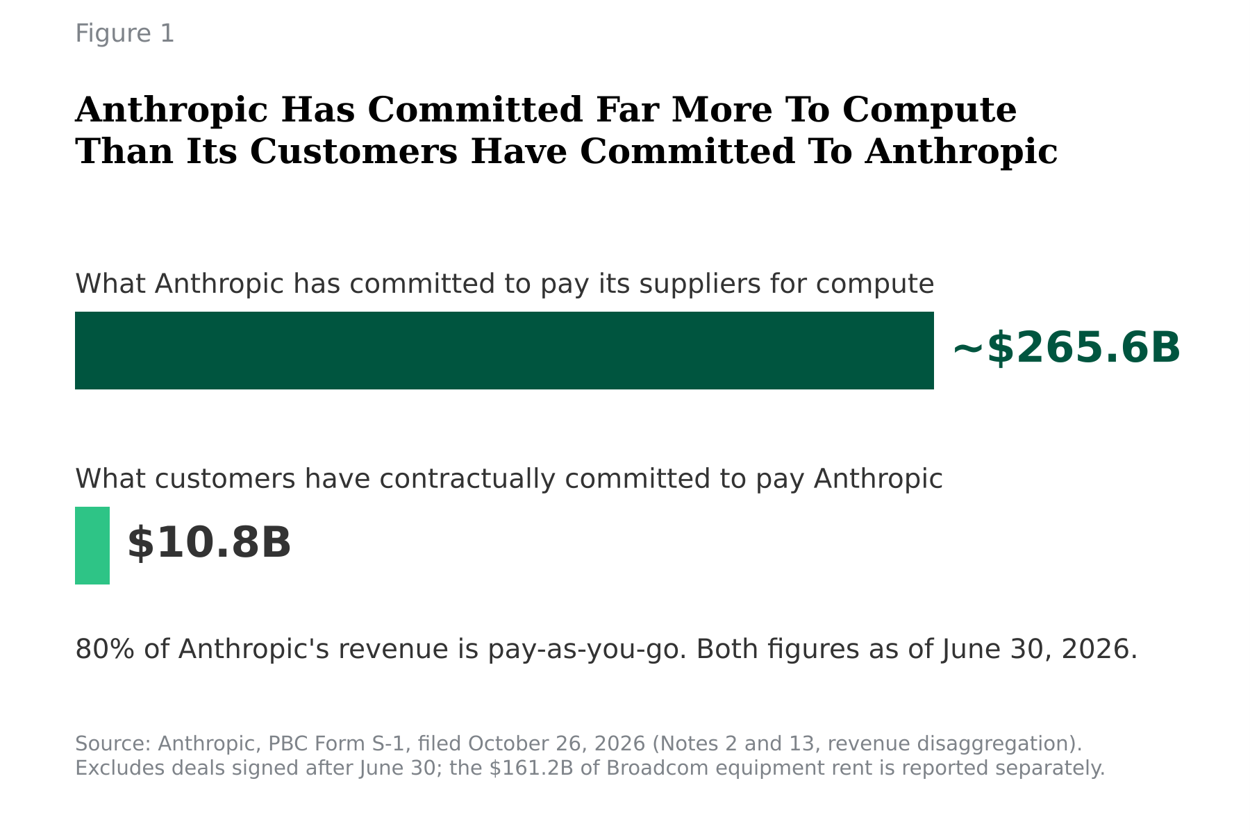
Large and growing fixed compute costs and variable revenue make Anthropic a volume business, not a premium-priced service. That is the complete opposite of how the market, including us, has been thinking about them up till now. For a tech leader, this means:
- Budget on the cost of a finished task, and expect it to fall. The S-1 says lower costs per task “drive greater usage,” and it lists open-weight models among its sources of pricing pressure. Measure what a completed task costs, and test it again with every release.
- Plan for fast model turnover. The S-1 says many customers have moved to Opus 5.5 since its September launch and that forcing older models out could lead to “contractual disputes.” Write notice periods for retiring a model into your contract, and build a harness that lets you adopt or reject a new model in days.
- Watch usage limits as closely as list prices. Anthropic says it has “changed, and may in the future change, usage limits […] ” so note that limits can tighten without any change to the price list.
Anthropic Signed The Long Contracts, So Make Your Shorter Contracts Pay
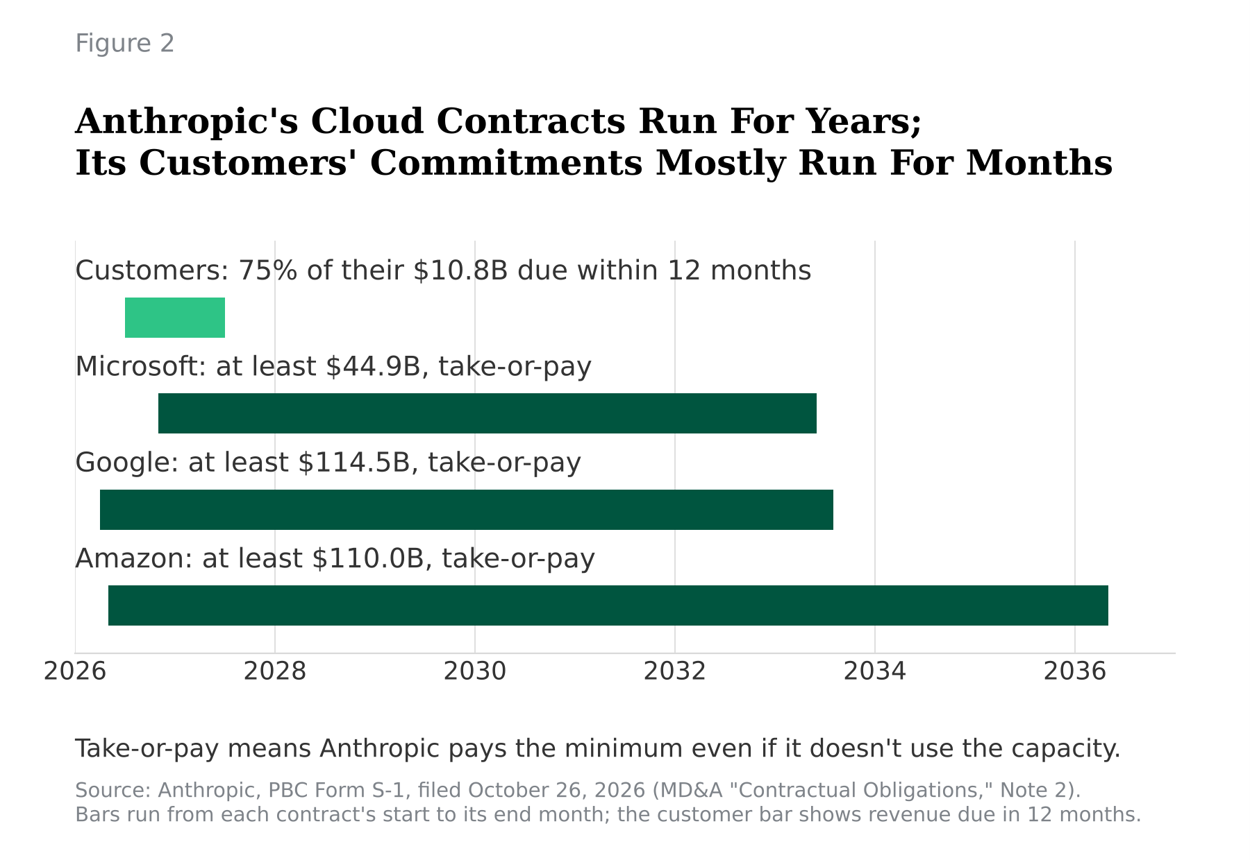
In June, we told you to resist long-term AI contracts, and we still do. Anthropic’s own compute deals with Amazon, Google, and Microsoft run to 2033 and 2036 and are payable regardless of usage (see the figure below). Sign a long commitment now, and you take a slice of that risk off its hands.
- Expect requests for committed spend. The filing says some enterprise contracts already include minimum spend commitments.
- Sell your commitment for protection. Get a lower price per task, price protection, the right to move to newer models at the same or lower cost, and step-down terms.
- Treat Anthropic as a durable vendor with a long bet. It generated $3.9 billion of operating cash in the first half of 2026 and holds $131.7 billion. The risk is a long slowdown that drains that cash while commitments into the 2030s come due.
- Work with a mix of frontier and open-weight models. It’s insurance, and it gives you something to negotiate with. Not every enterprise task is complex or valuable enough to require a frontier model; open-weight models offer the portability that SaaS model providers don’t.
Your Cloud Provider Has A Stake In Your Claude Bill
Buying Claude through AWS, Google Cloud, or Azure puts you across the table from a seller that gains from your Claude spend several times over, which gives it room to give some back.
- Assume that your cloud provider wants you on Claude. The three cloud marketplaces carried 48% of Anthropic’s revenue in the first half of 2026. Anthropic pays them a fee on those sales and buys compute from them, too, so expect a push toward Claude and ask what comes with it.
- Know that your cloud provider sits on every side of Anthropic. The clouds are its landlord, distributor, lender, shareholder, and competitor. Other suppliers fund their own sales, as well, as Broadcom does with a $42 billion loan “solely to finance” rent on its equipment. Ask how your service holds up if one of those deals is renegotiated.
- Negotiate Claude inside your cloud agreement. Price it into the bigger deal, and check whether marketplace spend counts toward the cloud commitment you already owe.
- Benchmark alternatives yourself. The same providers sell rival models, and the S-1 notes that they can see Anthropic’s pricing on their platforms, so their advice comes with an interest attached. Test the options on your own tasks.
Use The Leverage While You Have It
Our advice in June was to react but not overreact, and the S-1 puts an edge on it. Your usage and your signature are worth more than most AI contracts credit them with, so use them before your next renewal. Want to pressure-test your AI contracts? Book a guidance session with us.
Categories