Banking Payments Architecture, Real-Time Rails, AI, And Commercial Trends
Real-Time Payments, Orchestration Engines, And AI Fraud Detection Drive Capital Efficiencies
Commercial banking is undergoing a structural metamorphosis, shifting from rigid, batch-processed legacy systems to a model of autonomous, event-native finance. The convergence of ISO 20022-native data fabrics and agentic AI is transforming payments from simple capital transfers into high-fidelity data signals that power real-time corporate decision-making. By leveraging sidecar cores and programmable liquidity, forward-thinking institutions are finally achieving the “always-on” agility required to support modern global supply chains — effectively turning the banking ledger into an intelligent, embedded engine for commercial growth. The architecture has evolved, but is the trust at scale there to activate these payments capabilities? This is the key trending payments issue that will unfold during the course of the year.
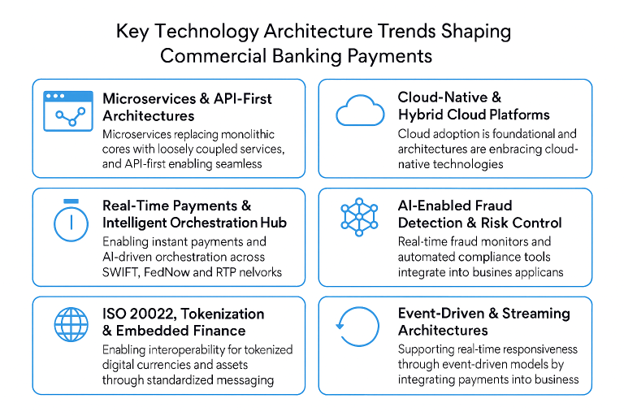
- Modern payment architecture trends are significantly reshaping cross-border, treasury, and B2B payments by reducing friction and increasing speed and transparency.
- Real-time and near-real-time rails, combined with ISO 20022 messaging, enable richer remittance data and faster reconciliation across borders, while cloud-native and API-driven platforms allow banks to integrate seamlessly with corporate enterprise resouce planning and treasury management systems.
- AI-enabled orchestration and smart routing help optimize payment paths based on cost, liquidity, and foreign-exchange exposure, improving working-capital efficiency for treasurers.
- Enhanced security models and standardized APIs make cross-border B2B payments more resilient and compliant, moving them closer to the speed, predictability, and user experience traditionally associated only with domestic payments.
Tokenized Deposits And Digital Assets Spur 24/7 Transactions And Settlements
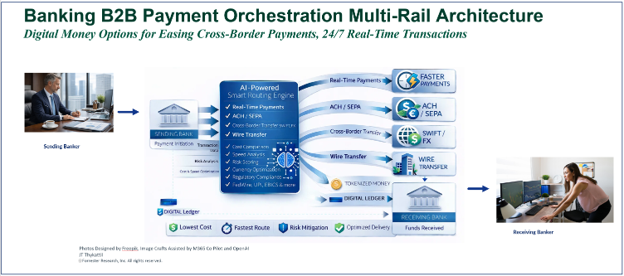
The transition toward tokenized deposits and regulated digital assets is fundamentally rewriting the mechanics of commercial finance, shifting the industry from a world of “batch-processed” windows to one of autonomous, 24/7 settlement.
- By representing commercial banking money as digital tokens on a distributed ledger, financial institutions are bypassing the “weekend traps” and time-zone delays inherent in legacy correspondent banking.
- Digital payments innovations enable atomic settlement, where the exchange of value and its corresponding data happens simultaneously and instantaneously, ensuring that a payment is only finalized if the asset is delivered and vice versa.
- The integration of smart contracts allows for “programmable liquidity,” where payments are executed automatically upon the fulfillment of specific contractual conditions (e.g., a bill of lading being digitally signed). This always-on architecture effectively eliminates settlement risk and allows corporate treasurers to optimize their global balance sheets in real time, turning the banking ledger into a high-velocity engine for global commerce that never sleeps.
- Paul van der Merwe, head of enterprise architecture and director at Standard Bank Group in South Africa, states that innovations in core banking, payments, and compliance are now by nature built on the latest technology and are expected to handle real-time demands.
Real-Time Payments Orchestration And Smart Routing
The 2026 commercial banking landscape is defined by a shift toward autonomous, multirail liquidity. At the core is payment orchestration, an intelligent routing layer that acts as the “brain” for the enterprise, dynamically switching between domestic real-time rails (like FedNow and RTP) and global networks based on real-time cost-benefit analysis.
- While SWIFT continues to provide the standardized “common language” via ISO 20022, it has evolved into a bridge for central bank digital currencies and tokenized deposits, enabling the transition from traditional messaging to atomic settlement.
- In this new architecture, payments are no longer just financial transfers; they are programmable, data-rich events where settlement and reconciliation occur simultaneously.
- These instant payment rails allow global treasurers to move capital across borders with the same speed and finality as a domestic instant payment, effectively eliminating the “liquidity trap” of traditional cross-border windows.
- Aditya Singh, chief architect and director at Capital One, is seeing firsthand that when his team pairs AI and machine learning, they can automate process transformation and take a curated and controlled risk-on approach to innovation.