Beyond The “SaaSpocalypse”: Introducing The Forrester AI Disruption Model
The 2026 narrative surrounding the “SaaSpocalypse” misses the bigger picture. While most commentary fixates on seat-based revenue compression (predicting that AI agents will kill off software licenses), that’s only one of nine critical disruption factors. As a global research firm that evaluates the entire technology landscape, Forrester has created a data-driven AI Disruption Model. This model, built on Forrester research and publicly filed information, cuts through the noise to bring transparency to market changes and a comprehensive framework for what comes next.
The Design Of The Forrester AI Disruption Model
The Forrester AI Disruption Model evaluates 17 technology and service categories spanning more than 200 markets. The framework analyzes structural market dynamics across nine critical drivers, including AI substitutability, labor intensity, commercial model, support for agentic workloads, switching costs, and regulatory friction. The central insight from the model is clear: AI’s effects won’t be distributed evenly. While some markets and vendors face extreme headwinds, others are poised for historic acceleration.
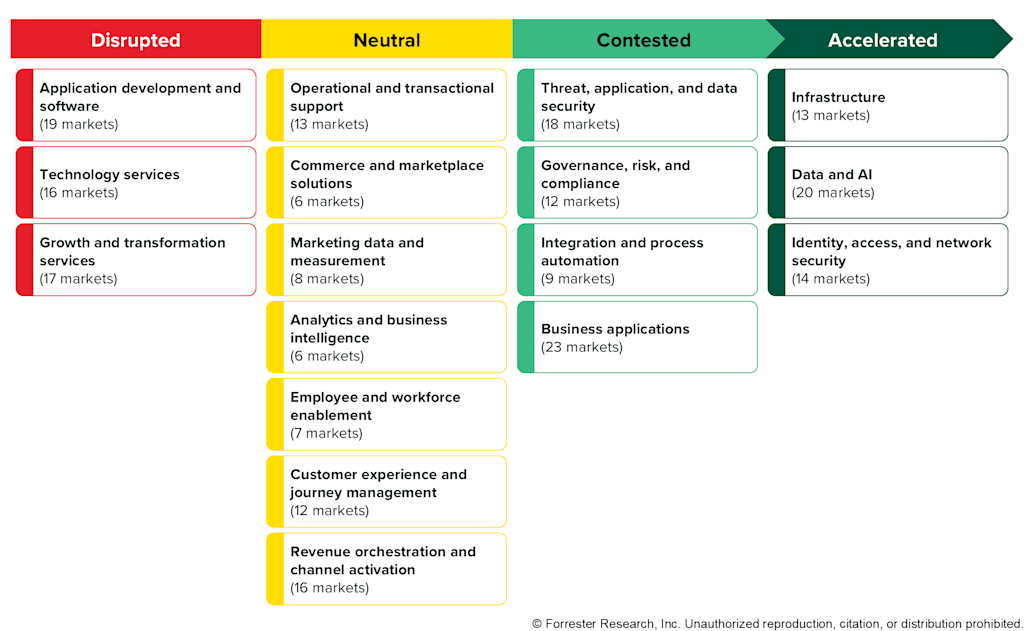
We break down markets into four categories: disrupted, neutral, contested, and accelerated:
- Disrupted markets — where AI reproduces core value. If AI can do something that a person or an existing software product can do, it will. Vendors and service providers in this bucket face pricing compression, seat erosion, and commoditization of their core capabilities or feature sets. The most severe disruption stemming from AI hits labor-intensive markets, such as technology implementation, custom software development, creative services, and corporate training. These markets are under immense pressure as AI takes over activities previously performed by human experts.
- Neutral markets — where value isn’t primarily informational. If vendors and service providers offer capabilities that are physical, focused on regulated markets, or protected by high switching costs, they’re less disrupted by the shift to AI. Neutral drivers keep AI progression at bay and value stable.
- Contested markets — positioned to move toward accelerated territory. Contested vendors and service providers see a balance of neutral and accelerated drivers that allow a pivot toward accelerated territory. They won’t sit back and wait to be disrupted but will shift investment capital and R&D to agentic workload and data, trust, and sovereignty support. Vendors in this category can infuse AI positively into their platforms but face execution, capital, and labor pivot challenges.
- Accelerated markets — sell picks and shovels for AI workloads. Providers of infrastructure, data, model, integration, or trust capabilities are the foundation of agentic workflows — and the future anchors of AI-powered business. Demand for these offerings scales directly with AI adoption: The more custom AI agents and targeted agentic systems enterprises deploy, the more technology these providers sell.
The Forrester AI Disruption Model Helps You Navigate The AI Overhaul
The challenge for enterprise tech buyers, vendors, and service firms alike is understanding how AI reshapes markets. Whether you’re a buyer trying to optimize your tech portfolio or a vendor defending your market share and future, the Forrester AI Disruption Model provides a blueprint to understand this shift.
Enterprise tech buyers should use the model as a procurement shield, isolating obsolete, debt-ridden tools to funnel investment toward scalable, agentic-ready vendors. For technology vendors and service providers, the model offers an actionable defensibility roadmap to evaluate exposure, protect core revenue, and pivot toward long-term growth before legacy models run out of steam.
Audit your tech stack and build an AI strategy today. For market category breakdowns, clients can access our full reports: The Forrester AI Disruption Model: How AI Disrupts Or Accelerates Technology And Service Markets and The Forrester AI Disruption Model: Category Analysis. To dive deeper into individual markets, clients can also schedule inquiries and guidance sessions.
Categories