It’s Time To Elevate Journeys Into Decision Systems
You already have journey maps. That’s not the problem.
Last week, in a portfolio discussion, a team reviewed a backlog of work that was worth millions. What was missing? A clear view of which customer journeys they were improving — or breaking.
When CX teams position journeys as tools or CX deliverables, they circulate journey insights but fail to influence the decisions that set priorities, allocate funding, and shape delivery. CX teams see the problem but can’t change the work. Business leaders see the problem but don’t know what to change. The work is already decided by the time journey insights appear.
Here’s what this looks like in practice: At one bank we studied, onboarding took 30 days, not because anyone designed it that way but because risk, IT, and sales each optimized their part of the journey independently, with no shared view and no real trade-offs. Once leaders saw the journey end to end, they made a call: Cut onboarding from 30 days to two to drive customer and company value. That wasn’t a CX initiative; it was a business decision.
Journeys As Decision Context — Not Deliverables
The shift is not about better journey maps or more insight. It’s about making customer context part of how decisions are made in the business.
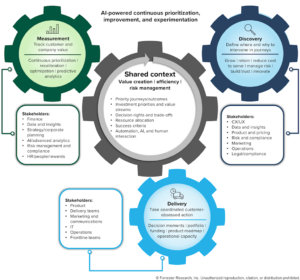
The firms that are getting this are not treating journeys as outputs anymore. They’re using them as decision context. They are elevating journeys into decision systems. Forrester defines a journey decision system as:
The operating model that embeds customer journey context into how organizations set priorities, allocate resources, and govern delivery across functions to drive customer and company value.
A journey decision system:
- Creates a common view of priority journeys, outcomes, value streams, decision rights, success criteria, and automation boundaries for leaders across the enterprise.
- Aligns journey atlases, journey maps, value stream maps, process maps, metrics, and strategy documents — rather than managing them as separate CX, ops, or strategy outputs.
- Surfaces journey context where decisions are made, rather than leaving them in standalone CX assets, meetings, or parallel governance.
- Defines where to intervene (discovery), applies journey context when decisions are made (delivery), and recalibrates priorities over time to align around shared value creation.
- Connects all the stakeholders that normally operate separately — finance, product, risk, operations, marketing — around a common view of value.
Get Started By Solving One Problem
Don’t fall into the trap of trying to map and manage everything. Instead:
- Start with one decision that’s failing customers. Find a clear customer pain point caused by fragmented decisions.
- Frame it around the problems leaders already care about — such as friction, duplication, cost, risk, and trade-offs — and let journey context inform decisions quietly.
- Embed journey context into existing forums that leaders already rely on — a portfolio review, funding discussion, roadmap meeting, quarterly business review, or risk forum — which create or can fix customer pain.
- Assign journey ownership to leaders who already control priorities, funding, and sequencing for the customer pain(s) you’re tackling.
- Invest in technology that embeds journey context into business decisions and agile workflows by connecting customer signals directly to portfolios, roadmaps, backlogs, and metrics.
If you’re a Forrester client, check out these two new reports: Journeys As A Decision System and Journeys As A Decision System: The Executive Guide. Why an executive guide? Because most C-level executives assume that journeys are an operational tool for CX or design teams — they’re wrong! Used correctly, journeys provide boardroom-level decision context, expose cross-functional trade-offs, and show what will break if you optimize one function at the expense of customer outcomes. You can also reach out for a guidance session or inquiry with me. Not a client (yet)? Look out for our upcoming CX Cast episode on journeys as a decision system.
Categories