The Agentic AI Race: Why The Tortoise May Beat The Hare
If you remember the childhood story of The Tortoise and the Hare, you already understand more about the future of AI agents than you might think. Right now, the AI market looks like a field full of hares. SaaS agents from vendors like Microsoft, Salesforce, ServiceNow, SAP, and Google are sprinting ahead, racking up users, generating headlines, and appearing in every product demo imaginable. These agents are easy to deploy, increasingly affordable, and excellent at helping workers summarize emails, draft content, and find information faster. But just like the famous hare, speed doesn’t guarantee victory.
Our latest research identifies four distinct paths emerging in the AI agent race: SaaS and horizontal agents (the hares), edge agents (the sloths), custom-built agents (the tortoises), and targeted agentic systems (the super-tortoises, if we’re stretching the metaphor a bit). Each has different strengths, growth patterns, and long-term potential.
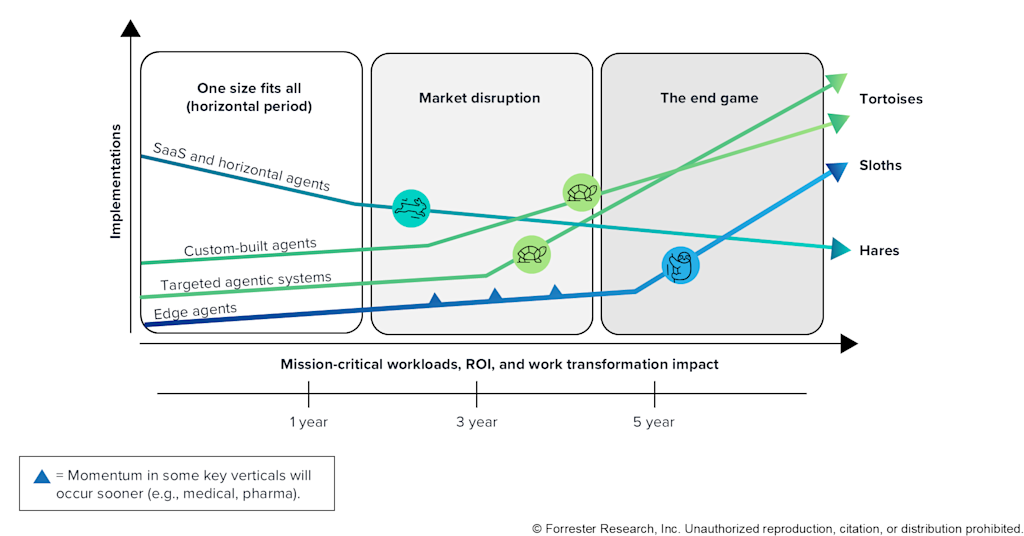
The hares will dominate the early market. Organizations facing skills shortages, budget pressures, and demand for quick wins will naturally gravitate toward packaged AI offerings. These solutions provide immediate value and require relatively little customization. The challenge is that many are built on similar foundation models and increasingly risk becoming interchangeable. Today’s competitive advantage can quickly become tomorrow’s commodity.
Meanwhile, the sloths are quietly waking up. Edge agents run close to where data is created: on factory floors, medical devices, and industrial equipment. They aren’t flashy, but they are efficient. Advances in smaller language models are making it possible to deliver fast, low-cost, highly secure AI without consulting more bloated cloud models. The result is better responsiveness, lower latency, and reduced operating costs.
But the real story may belong to the tortoises. These custom-built agents are designed around an organization’s unique processes, data, and business logic. They operate behind corporate firewalls, leverage private models, and tackle operational work with longer-running action, rather than focusing on simple productivity tasks. They close the “action gap” Forrester writes about. As concerns around data privacy, compliance, and ROI continue to grow, enterprises are recognizing that generic agents can solve small but not important problems.
Even more interesting are targeted agentic systems. These specialized, function- and industry-specific AI systems focus on domains such as procurement, legal services, healthcare, or finance. Rather than helping an employee complete a task, they coordinate multiple agents to execute entire business processes, ultimately taking on the full responsibility of a department. Over time, these systems will become the primary mechanism for transforming operating models and creating competitive advantage.
The lesson from the fable remains relevant: The fastest runner doesn’t always win. Organizations that focus exclusively on quick AI deployments may find themselves stuck in proof-of-concept purgatory. The winners will be those that combine all four approaches and build a hybrid agent ecosystem that balances speed, specialization, governance, and business outcomes. To get there, however, enterprises must think bigger about applying AI — not just saving a few minutes here or there, but designing new operating and business models. That’s where the AI discussion turns the ROI corner. In the agentic race, the hare gets the headlines, but the tortoise gets the ROI.
Forrester clients can schedule an inquiry or guidance session with me to get guidance on the changing AI agent landscape.
Categories