Why MuleSoft, Not Agentforce, Is Salesforce’s Most Strategic AI Asset
MuleSoft Agent Fabric is MuleSoft’s recent enhancement to deliver an agentic AI control plane. During the Dreamforce keynote, I noticed something subtle but significant. I didn’t see “MuleSoft Agent Fabric.” Instead, I saw “Agent Fabric” with the MuleSoft branding dropped and the Salesforce logo replacing the Mule logo in the UI.
Forrester sees agentic AI consisting of three planes: the build plane, the orchestration plane for runtime, and the control plane for governance. Long-term I believe the first two will converge: Where you build an AI agent often dictates where you can run it. But it will be impossible to shoehorn all your agents into one build-and-orchestrate platform, resulting in muti-platform sprawl for that part of the agentic AI stack. In contrast, the need for one central place to govern AI agents will push agentic AI control planes to be multi-platform – just like how API management governs APIs across any number of API runtime platforms. That makes the control plane more strategic than the other two. For Salesforce, its emerging agentic AI control plane is Agent Fabric.
AI Governance Is The Future Of API Management
Leading API management vendors recognize that the agentic AI control plane is the future of the market. I’m even inclined to rename the market “API and AI management” for my next Forrester Wave report of API management. MuleSoft and competitors Kong and WSO2 have built strong AI gateways to govern LLM and MCP connections. But like APIs, governance is more than just a gateway. Gravitee, Kong, MuleSoft, and WSO2 deliver deep analytics for MCP and LLM token FinOps. MuleSoft has expanded its API portal to include LLMs, MCP servers, and agent cards. Gravitee’s beta portal is slated to deliver similar soon. Both vendors are the first to deliver endpoint versioning for LLM, MCP, and A2A endpoints. Forrester clients can explore this more through Forrester’s vendor comparison tool for API management vendors, based on my evaluative research The Forrester Wave™: API Management Software, Q3 2026.
Salesforce’s Advantage Over API Management Vendors: The Full Platform
But there are two things MuleSoft, or rather Salesforce, has to augment its agentic AI governance that those other API management vendors lack: a broad agentic AI orchestration platform and context data to feed agents at runtime.
To be clear, it is not assured that Salesforce will deliver a viable AI orchestration + context platform. Today it is an amalgamation of Agentforce, Data 360, Headless Toolkit, AIforce, Informatica, MuleSoft’s iPaaS for deterministic workflows, Slack, and more. Bolted-together Frankensteins create friction through unduly complex user experiences and complicated SKU purchases. But at least it’s something.
This could go in one of two paths. The ideal path is that Salesforce unifies its Frankenstein into a holistic AI platform with minimal buying and UX friction under one brand. One can imagine a future where Salesforce’s agentic AI offering consolidates into three products – and I mean three real products engineered as such, not marketecture.
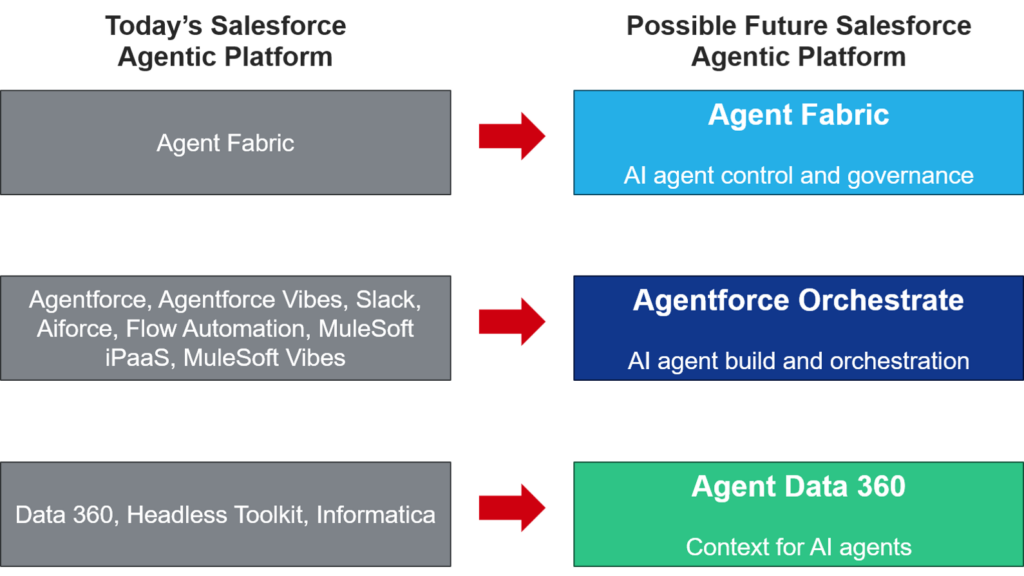
The more likely path is that Salesforce stumbles to deliver. The obvious problem is that bringing together disparate M&A products into something that works is difficult.
Notice in the above figure, though, that the control plane is the only layer isn’t currently a stitched-together Frankenstein. Unlike the rest of the platform, Salesforce’s AI agent control plane is already one holistic product: Agent Fabric. Between its strategic positioning for buyers, its holistic product design, its ability to extend Salesforce’s reach to agents in every platform, MuleSoft’s Agent Fabric, not Agentforce, is Salesforce’s most strategic AI asset.
AI agent control and governance is the most strategic element of the above for buyers. But AI orchestration is closest to where work gets done. Hence more economic activity flows through it, resulting in a larger TAM for tech vendors to chase after, especially in the near term. That may tempt Salesforce to chase after orchestration at the expense of Agent Fabric when it should be doubling down on Agent Fabric. This is especially likely so long as the Agentforce and MuleSoft business units remain siloed from each other.
Agent Fabric has a strong lead compared to the competition. Will Salesforce expand that lead or blow it? MuleSoft’s customers and competitors anxiously await to find out.
If you’d like to discuss Salesforce’s strategy more deeply with me, schedule a guidance session or inquiry.
Categories