Activate Advocates By Aligning Personality Profiles To Value Dimensions
Customer advocates who share their stories, help peers attain their goals, bolster answer engine results, and guide company go-to-market plans are worth their weight in gold. B2B postsale teams with sustainable customer advocacy programs recognize they aren’t on a one-way street. They ensure customers benefit from participating in company-owned communities and other customer-centered activities. They put participant value first and trust that advocate activities (solid references, success stories, reviews, and testimonials) will follow.
How do you help customer storytellers, community participants, and the loyal customers who take reference calls attain value? By developing a deeper understanding of your advocates’ motivation and preferences.
Understand Their “Personality” To Motivate Advocates
Interaction between engaged B2B customers and your company is on display at scale in company owned communities. Amy Bills and I are optimistic that the scale, analysis, and content generation that AI can lend to communities will turn them into must-have B2B investments. However, successful communities don’t happen overnight. Community managers know these online hubs require careful monitoring and ongoing moderation. In fact, this is true of all advocate engagement.
In our recently published report update (subscription required), we present a model for understanding how customers and advocates prefer to engage – what we call their advocate personality. Our research and analysis find that individual advocates tend to exhibit one of four personality types: Educators, Validators, Status Seekers, and Collaborators.
How Can You Determine The Most Meaningful Advocate Engagement?
Value looks different to each one of these personality types and an individual can exhibit or move through different personalities over time. To keep the task of creating value for each type manageable, we recommend using Forrester’s four dimensions of value to determine which types of activities and experiences would most appeal to different personalities. Creating engagement opportunities across all four dimensions also creates a much richer and enticing experience that can boost participation even further. Here are some examples that combine the two frameworks:
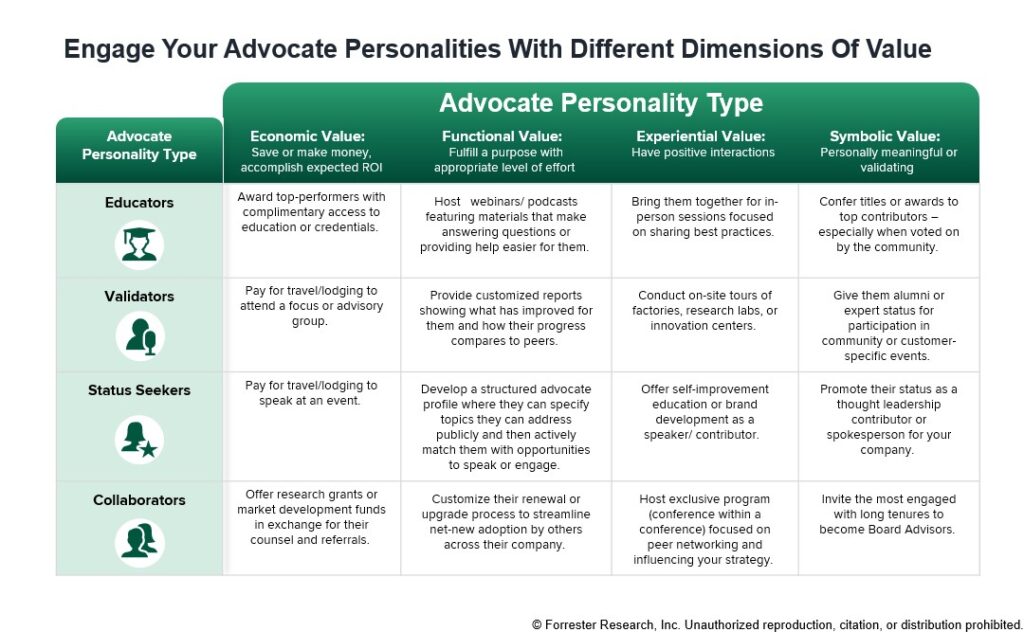
Using this approach ensures you are delivering upfront value to your B2B customers and advocates. It also helps to creatively develop different engagement opportunities and activities that appeal to the customer’s advocacy preferences and makes them more inclined to participate. Lastly, this approach helps to keep different program elements from blending together and failing to appeal to the specific personality type you want to engage.
If you are interested in exploring more examples or looking at other ways to use our advocate personalities to gain support for customer engagement programs, feel free to set up a guidance session or inquiry with us. We look forward to hearing more about your plans and to helping you to execute new programs.
Related Forrester Content