Agentic ERP Won’t Scale Until CIOs Control The Proof, The Price, And The Portability
Enterprise resource planning (ERP) vendors are rapidly packaging autonomous operations as the next “platform” mandate, but the real constraint on the rollout of autonomous operations will be enterprise control — whether technology leaders can verify agent actions, govern consumption, and preserve business meaning across a fragmented estate. And fragmentation is the ERP operating reality: According to Forrester’s Enterprise Applications Software Survey, 2026, only 7% of enterprise ERP decision-makers run just one instance. In a complex, multi-instance estate, agents will inherit regional variants, acquired systems, and conflicting definitions, which will expose the lack of governance that tech leaders could once tolerate when automation stayed human-supervised.
If tech leaders want to start reaping the promises of agentic ERP, don’t start with the agent catalog. Instead, start with the control model to form an understanding of how much autonomy you can prove, price, and protect with portability.
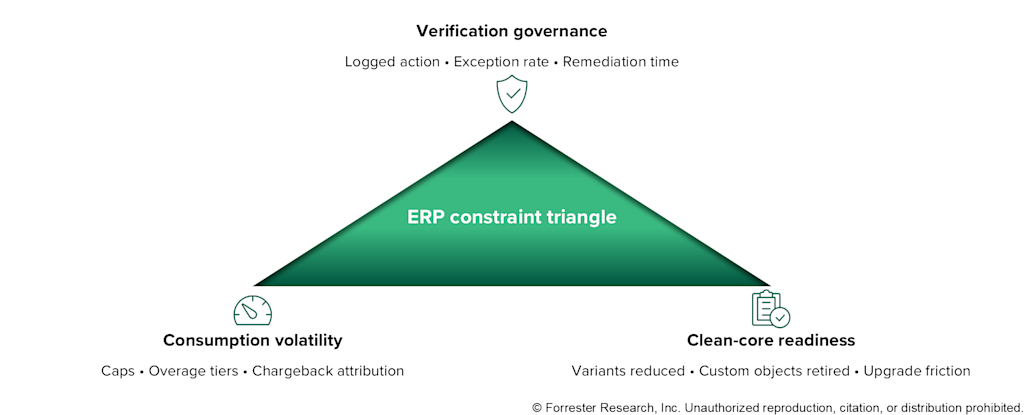
Control The Proof: Verification Is The New ERP Speed Limit
Agentic ERP creates a control problem. Each agent action needs evidence: who approved it, which identity executed it, what data it used, and who owns the outcomes when the result of agent actions reaches postings, reconciliations, or close.
That control problem lands on the weakest surface in most ERP estates: data management, control, and security. According to our data, 65% of ERP adopters rate data accuracy as complex, and 64% say the same of security and compliance. The risk is already visible. BodySnatcher (CVE-2025-12420) showed how broken agent authentication can enable privileged impersonation in ServiceNow, while Moffatt v. Air Canada (2024) confirmed that companies (not the vendor) remain accountable for AI-provided customer information.
Treat agentic ERP as a control design program first and an automation program second. Segment autonomy by transaction class: Expand advisory agents now, require full traceability for supervised execution, and delay autonomous execution until teams can prove exception ownership, audit evidence, and rollback.
To pull this off, you’ll need to move to that standardized core that you’ve been putting off, because agents will amplify variance across process, data, and controls. You’ll also need to put each automation candidate through a standardization gate first, and if you cannot standardize it, this means you can’t safely automate it.
Control The Price: The Meter Is The New Scope Control
ERP pricing is moving toward usage-based models, credit pools, and stacked meters. This moves risk from the vendor’s price book into your run rate. Most CIOs still negotiate renewals as fixed costs, but that habit will age badly as agent usage increases. Once agents enter daily work, usage can outrun budget governance. In fact, 30% of enterprise SaaS decision-makers already flag unpredictable usage-based pricing as an issue.
We can already see where controls are failing. Uber exhausted its AI budget in months after Claude Code adoption spread across engineering. Salesforce meters Agentforce through Flex Credits with overages. RISE with SAP buyers hesitate when they cannot independently monitor licensing and usage.
This means that tech leaders should never sign agentic ERP terms without buyer-side telemetry, hard caps, overage triggers, and finance-modeled consumption scenarios. Remember, if the vendor controls both the meter and the interpretation of the meter, you do not control the program.
Control The Portability: The Next Vendor Lock-In Is Semantic
Moving your data to a new vendor is no longer the hard part. The hard part is untangling how the old vendor defined your business. If your KPIs, business entities, and data relationships are designed around one vendor’s model, you remain locked in even after the data has been migrated. This is what we call semantic dependence. Open standards like MCP and Agent2Agent, which can lower interconnection barriers, now sit under the Linux foundation, but this is not enough (not even close) to make your business meaning portable.
Tech leaders need to become familiar with a new phrase: semantic portability. Going forward, you need to negotiate semantic portability into every renewal. This means requiring export rights for KPI definitions, entity models, and master data relationships before you bundle more intelligence into a vendor’s context layer. This is crucial, because what you cannot export today becomes your switching cost tomorrow.
Scale The Operating Model Before The Agents
The most effective CIOs will not chase the flashiest assistant. They will define ownership first: who approves agents, who owns expectations, who holds consumption budgets, and who stewards semantics. That model is what your CFO, auditors, and customers will experience.
Forrester clients can read The Top Trends Shaping ERP, 2026 and request a guidance session on your ERP roadmap, renewals, and operating model.
Categories