AI Has A Scaling Problem
According to Forrester’s State Of AI Survey, 2026, only 20% of AI decision-makers believe their organization has the technology in place to scale their AI initiatives. For sure, AI has moved into production in most organizations. Among respondents, 82% report at least one generative AI application in production, and 77% at least one agentic AI application. Yet only 11% report having many AI applications scaled at the business level and 14% at the enterprise level.
The harder part now is making each new and successive AI initiative faster, cheaper, and safer than the last.
On November 5th 2026 at Forrester’s Technology & Innovation Forum East in New York, I introduced an idea we’ve been developing called Technology AIQ, part of Forrester’s new AIQ framework that we will be launching in January 2027. Think of it as a way to assess whether your organization’s technology environment is ready to support AI at scale.
Scaling AI Means Getting Better At The Next AI Initiative
High-readiness organizations are already deploying more AI. They reported 2.4 times as many AI use cases in production across the enterprise as low-readiness organizations, and 72% reported end-to-end process improvements. However, only 42% report they can link their AI initiatives to the P&L. Higher readiness also does not mean fewer obstacles across the board. These organizations were more likely to cite employee readiness and governance and risk as barriers, while data infrastructure remained a barrier at broadly similar rates across readiness groups.
An organization can put more AI into production and still leave each team to secure access to the same data, build the same integrations, and work out the same controls. As AI spreads through productivity applications, enterprise applications, and custom agentic workflows, that duplication adds to the cost and complexity of running it.
The objective for tech leaders is to start a flywheel in which each initiative strengthens capabilities the next team can build on. That means making infrastructure available, making data easier to find and use, and making models, components, and integrations reusable. It also means establishing controls for agent access and the ability to trace what agents do and intervene when necessary. Finally, it means documenting where each initiative delivers value and where it is not delivering value yet.
Technology AIQ Assesses Your Readiness To Scale AI
Scaling AI requires a connected set of technology capabilities. The model we’re developing builds on Forrester’s High-Performance IT research and looks across three layers of your technology environment: the IT foundations you already run, the capabilities you need to extend for AI, and the AI-specific capabilities you need to establish.
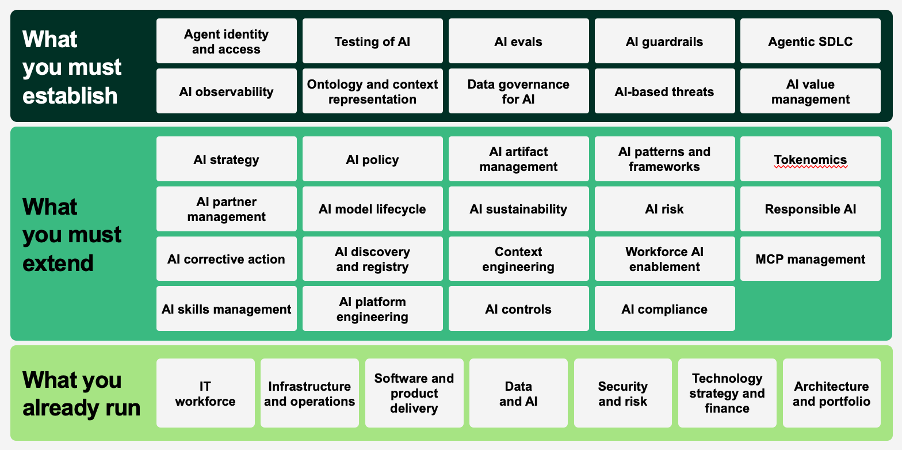
The Technology AIQ assessment looks at observable practices that help teams deliver AI repeatedly. Can the next team reuse a tested connector to a core system? Can it apply established controls for agent access and trace what an agent does in production? Technology AIQ helps technology leaders understand where their environment helps AI scale, where it creates friction, and what capability they should strengthen next.
Before you fund the next initiative on your roadmap, require your teams to state what they will reuse from the last one, what the initiative will leave behind for the initiative that follows, how it will document where it delivers value vs. where it does not yet. Forrester clients who want to discuss their readiness to scale AI can schedule an inquiry or guidance session with me.
Categories