App Security Is Evolving Fast: Here’s What Security Leaders Should Know
The application and product security landscape is evolving as threat actors demonstrate greater sophistication, placing increased demands on security programs. It’s not just the volume of attacks rising but the speed at which attackers are able to weaponize Common Vulnerabilities and Exposures, with the median time to exploit a vulnerability now under a day and AI producing more code to secure. Our new report, The Top 10 Application Security Trends For 2026, lays out the most important changes shaping application security. Some of the key trends we explore include:
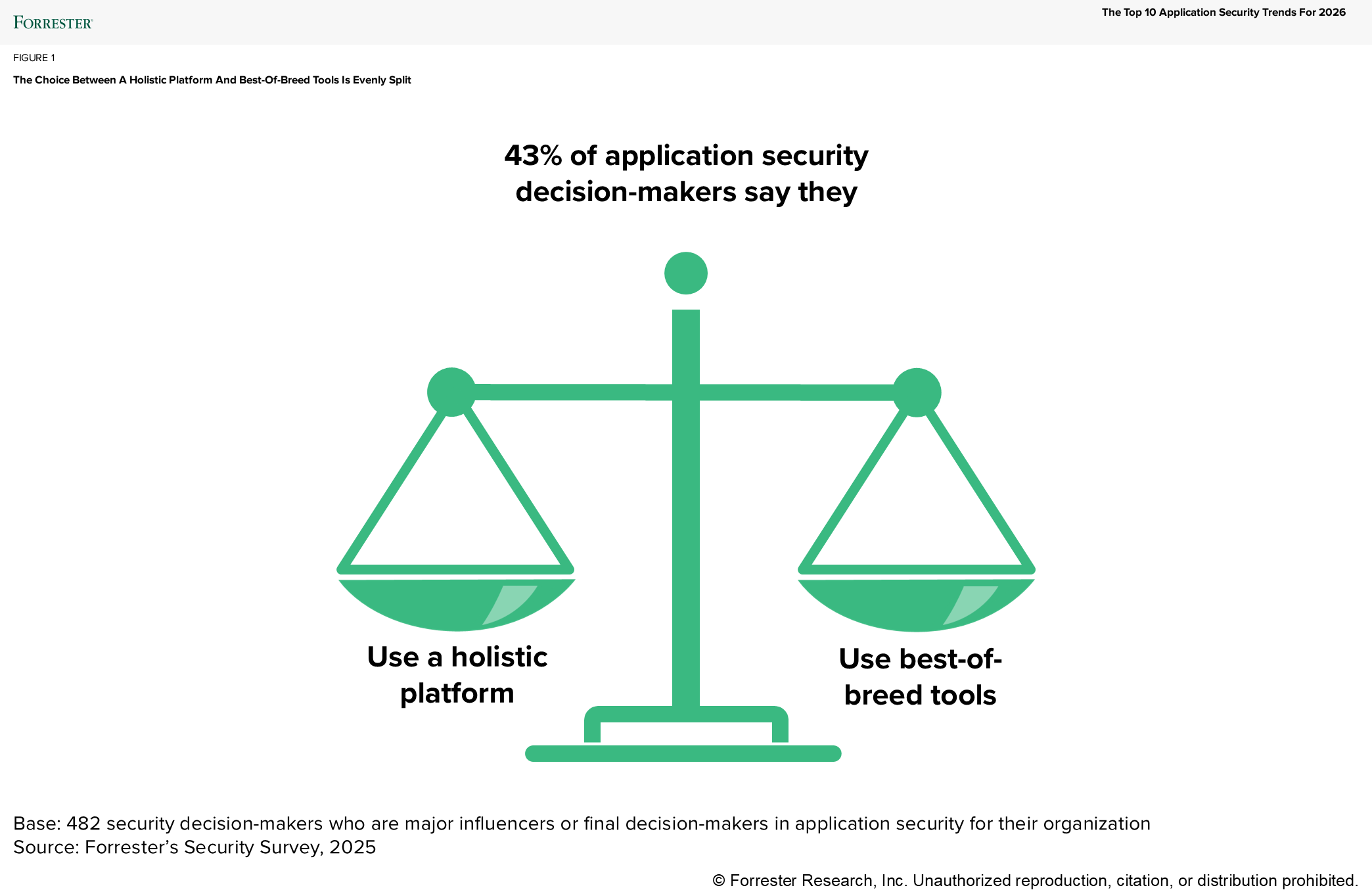
- Platform decisions are becoming more strategic. Organizations are rethinking the mix of fragmented tools they’ve accumulated across testing, protection, and governance. Security decision-makers are now split evenly between choosing holistic platforms and best‑of‑breed tooling — a departure from prior years when best‑of‑breed dominated. Unified experiences, consolidated data, and reduced operational overhead are top considerations for this move to platforms. Security leaders evaluating their next wave of investments must consider how integration, visibility, and total cost of ownership will influence long‑term program maturity, but don’t think you’ll get away with only purchasing a platform. There remains an important need for best‑of‑breed tools to address specialized risk scenarios.
- Agentic development is here, and security must evolve to keep up. Today’s development workflows infused with AI are producing and deploying more code than ever before, redefining how and where security fits into the software lifecycle. New tooling, workflows, and automation methods are accelerating output, but they also introduce increased opportunities for vulnerabilities to go unnoticed. This is due in large part to an overreliance on large language model-generated output, which is often assumed to produce more secure code than it actually does. The AI coding model providers recognize this and have started to provide security testing agents to build trust in their coding solutions (and potentially drive future revenue). For security leaders, this means tightening alignment with engineering, reinforcing early controls in the AI software development lifecycle, and implementing AI coding guardrails that match the agentic era.
- Protection models expand beyond traditional boundaries. Web application protection has broadened significantly, and new adjacencies are emerging. Vendors in this space are extending their capabilities to address new classes of threats and runtime behaviors, often born from modern application architectures and the change in traffic from automated sources including AI agents. Protection solutions are evolving to analyze more complex traffic patterns and defend against more varied forms of misuse, signaling a shift toward more adaptive, context‑aware defenses. Security leaders can no longer rely on static controls — they must anticipate a world in which application behavior, user patterns, and adversary techniques are all in flux.
To dive deeper into the 10 trends shaping the year ahead and what they mean for your strategy, read the full report, The Top 10 Application Security Trends For 2026, and schedule a guidance session with us today.