B2B Will Be The Proving Ground For Agentic Payments
The discussion about agentic payments often starts with consumer shopping. But agentic payments may create value sooner in B2B, where transactions already operate within defined workflows, approval rules, and commercial relationships.
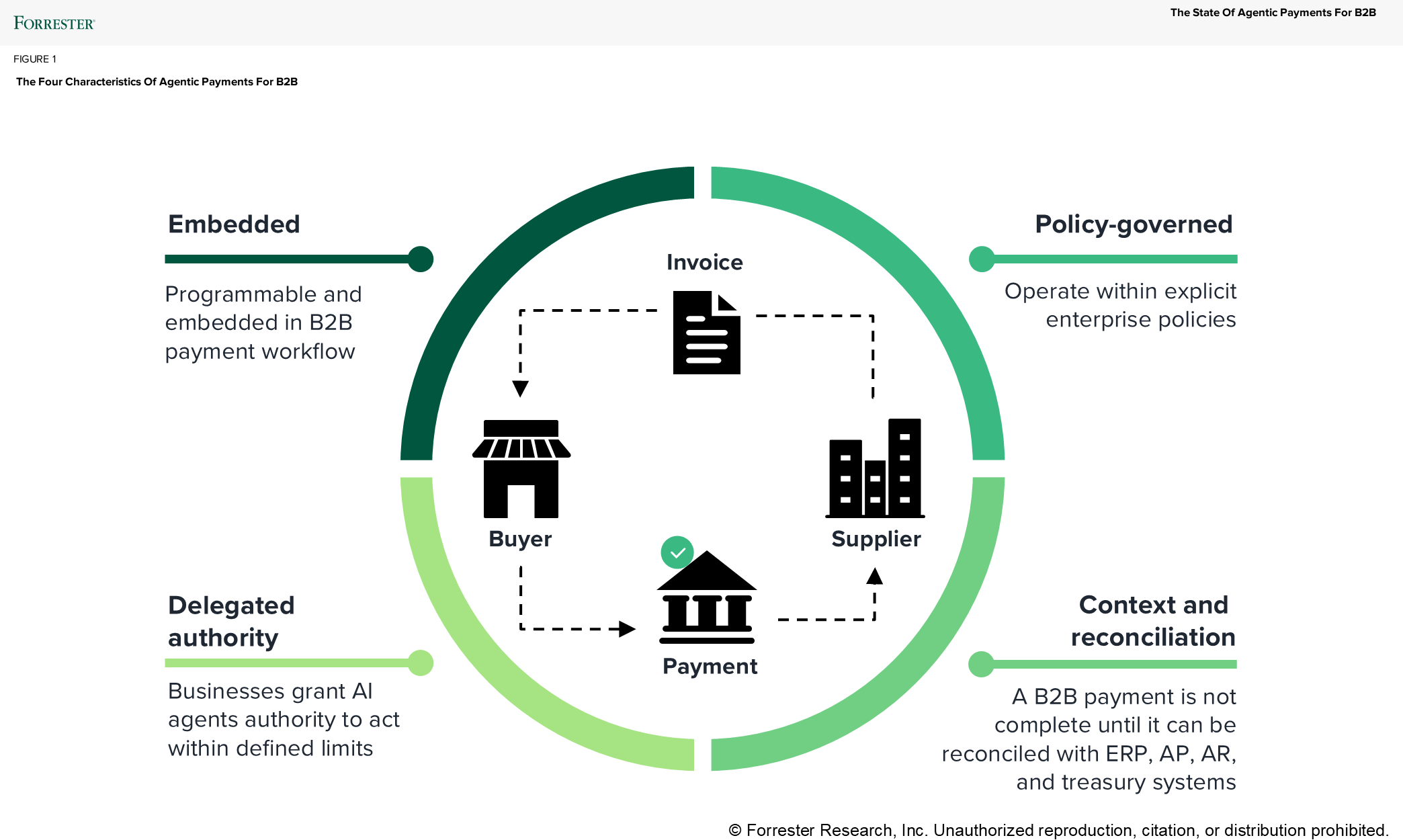
Forrester defines B2B agentic payments as:
Programmable, policy-governed payment flows in which AI agents act on behalf of businesses to initiate, authorize, execute, and reconcile transactions.
These agentic payments are not simply payments triggered by an AI assistant. They are embedded in procurement, accounts payable, treasury, and digital service workflows. Agents receive explicitly delegated authority, operate within enterprise guardrails, and retain the context needed to reconcile each payment with an invoice, contract, purchase order, or API call.
Three Use Cases Will Lead Adoption
The following use cases will likely generate demand from B2B firms:
- Automating finance operations. Agents can capture and code invoices, enforce policies, investigate exceptions, create payment batches, and execute approved payments. This moves finance beyond automating individual tasks toward controlled, end-to-end execution.
- Enabling machine-to-machine commerce. AI agents increasingly consume APIs, data, models, browser sessions, and other digital services. Agentic payments allow them to discover a resource, pay per use, and gain access without opening accounts, managing API keys, or waiting for monthly invoices.
- Optimizing working capital. Agents can consider cash positions, early-payment discounts, card rebates, supplier terms, and funding costs before deciding when and how to pay. Payment execution becomes a real-time optimization decision rather than an administrative step.
There Will Not Be One Protocol To Rule Them All
Agentic payments need more than an intelligent agent. They require protocols that make discovery, transaction intent, authorization, payment, and identity machine-readable.
Three protocol layers are emerging:
- Discovery protocols, such as MCP and A2A, help agents find and connect with tools, services, and other agents.
- Commerce protocols, such as ACP and UCP, translate the agent’s intent into pricing, ordering, and checkout workflows.
- Payment protocols, such as Stripe’s MPP, Coinbase’s x402, Mastercard Agent Pay for Machines, and Ant International’s agentic mobile protocol, enable agents to authorize and complete transactions. MPP and x402 illustrate two possible paths for machine payments. Both allow agents to pay for digital resources within an automated web interaction. But MPP is designed to support multiple rails — including cards, bank payments, and stablecoins — while x402 provides crypto-native settlement using USDC.
Companies should therefore avoid betting on a single protocol. Instead, they should build a layered architecture that separates discovery, commerce, identity, execution, and settlement. When agents have bounded authority to execute well-understood transactions faster, more intelligently, and under tighter control, agentic payments will turn governance into code and execution into a continuous, machine-driven capability.
Forrester clients can read the full Forrester report, The State Of Agentic Payments For B2B, to explore the emerging use cases, protocol landscape, technology stack, and actions that finance and technology leaders should take. Forrester clients can set up an inquiry or guidance session to discuss these topics with us.
Related Forrester Content
Categories