For Service Providers, AI Giveth And AI Taketh Away
In Q2 2026, service provider revenues were up a little, bookings were mostly flat, and revenue/employee were up nominally. The technology services industry has struggled to grow over the past two years as AI accelerates service delivery, thus undermining their core engine of growth – headcount and billable hours. Beginning late last year, providers began to dig out of that hole to scale AI-powered delivery and reprice contracts to do more work with fewer people. To help technology leaders better understand the market dynamics for technology services, we analyzed the Q2 2026 earnings announcements of a group of leading public companies (see Figure 1).
Figure 1 Service Providers’ Financial Results In Q2 2026
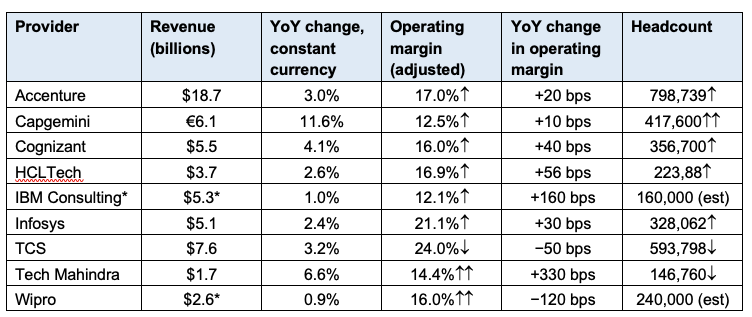
If this all sounds like doom and gloom for the service sector, well, it is for some of the firms. Large teams with large pyramid delivery structures are disrupted when AI can absorb coordination overhead and compress execution work. Our recent evaluation of AI-powered disruption in over 200 technology and service markets puts technology services near the top of the disruption list. But the service provider sector has been disrupted and adapted before. The shift to cloud and SaaS undermined a huge revenue source for providers, but they adapted with new partnerships and a lighter-weight service line for cloud migration and configuration. They are adapting again with new partnerships, industrialized service delivery, products, and new risk-sharing commercial models. We found four interesting strategies in the Q2 quarter’s earnings announcements as providers:
- Shift pricing from labor to results – an established trend now amplified by AI. With AI-powered delivery now firmly established as the service model, providers are gaining confidence and committing to outcomes as a key commercial model (see Figure 2). HCL Tech CEO C Vijayakumar noted: “Because of AI, there is more of a shift towards output and outcome-based pricing than input-based pricing … we are also very strongly advocating and providing solutions which are more outcome-based solutions for our clients.”
- Get closer to the frontier AI vendors. Service providers are scrambling to convince Anthropic, Google, and OpenAI that they are ready to implement their AI products. Accenture expects to more than double bookings from its emerging AI and data partners against FY 2025. TCS announced a partnership with Anthropic, which included a dedicated business unit, early model access, and 50,000 licenses. Wipro built its Applied AI Center of Excellence for Claude Models, which trains 10,000 people. And IBM validated OpenAI for regulated industries in a co-innovation partner commitment. In all model builder-provider relationships, tech leaders should test the partnership qualities by assessing how many product features they need to show up in the model builder’s product.
- Scale forward-deployed teams as the path for AI business transformation. Service providers have jumped on the FDE bandwagon to identify AI use cases that matter. Cognizant CEO Ravi Kumar speaks for the sector when he says: “We introduced two new certified roles, frontier certified engineers who audit workflows and build intelligent agents, and frontier business operators, who manage blended human digital teams to deliver outcomes. We plan to scale this Cognizant Forward team to 5,000 frontier certified engineers and 10,000 frontier business operators.” Now that technology and model providers are bringing FDE squads, the number of parties involved in a project has multiplied.
- Commit to AI-powered managed services and expect to share the spoils. Capgemini signed an agentic global business services engagement targeting 50% to 54% productivity improvement over seven years (a cumulative 7% improvement each year). Cognizant signed a deal with an insurance brokerage, which was priced based on a projected 50% productivity improvement (9.5% annually) over five years. TCS went further and named a time-to-deliver discount for project work (which is often completed in one year or less). CEO K. Krithivasan said, “In most places, the productivity gain pass on [to the client is in the] 10% to 15% range.” Now that these numbers are public, use them as benchmarks for similar deals.
Figure 2 What Tech Service Executives Are Saying About Alternative Pricing Models
| Provider | Quote | What it means for technology leaders |
|---|---|---|
| Cognizant CEO Ravi Kumar | “Our mix of fixed price and transaction-based work has grown for 3 consecutive years. [We are] moving from delivering projects to underwriting results.” | Cognizant has been the clearest communicator about its strategy to shift away from time-and-materials pricing. Tech leaders should anticipate that at renewal time, the service provider may propose an alternative pricing model. Decide what premium you will pay for the provider to take on delivery risk and be accountable for outcomes. |
| TCS President and COO, Aarthi Subramanian | “We are seeing output commitment-based models, outcome-based models where we are committing through the AI program to deliver a business outcome, in a fixed duration.” | Three archetypes now coexist: output commitment, outcome commitment, and fixed-price, fixed-capacity. Match the construct to the certainty of the work — outcomes where results are measurable and attributable and capacity models where scope is still being discovered. Using one construct across a portfolio will misprice most of it. |
| Accenture CEO Julie Sweet | “In things that our clients have been buying in services for a long time, it’s going to take a while to change the buying patterns. It’s much easier to go into new categories or to provide new kinds of value and switch to non-FTE models.” | Accenture acknowledges that they’ll have to buy platform businesses such as the recently acquired Dragos, runZero, and Ookla, that price on subscription rather than headcount. If a deal includes a product and services, be prepared to price them separately so you can terminate service without losing the product. |
| Infosys CFO Jayesh Sanghrajka | “We are not going to underwrite uneconomic productivity assumptions. We would prefer to not pursue those deals further.” | Speculative deal-making may not get the buy-in of your top service providers. A shift away from pricing labor by the hour requires rigorous and a balanced risk quantification from both sides. |
Categories