Questioning Your AI ROI? Start With Your AI Strategy
“How do we measure the ROI of AI?”
“AI costs are going up, how do we prove the ROI?”
These questions – coming mostly from IT – start more of my client engagements than any other. As usage of AI credits ramps up and token costs roll in, it’s IT that foots the bill and CIOs who are on the hook to justify the spend.
When I dig into AI ROI challenges with a client, I always uncover a strategy problem at the heart of them. Without knowing why you are investing in AI, where in your business it needs to show up, and having a plan to invest and measure the value, IT is left trying to prove the ROI of workforce enablement and individual worker productivity investments. You are going to have a hard time proving that helping employees write emails, schedule meetings, or produce PowerPoints actually lands in your P&L.
Lack of ROI becomes a scapegoat for bad or missing strategy that would force the hard choices about what to focus on and what to deprioritize.
Our new report, Your Enterprise AI Strategy, addresses these pain points. It comes out of nine months of collaboration across Forrester and interviews with more than 40 leaders at 25 organizations, plus hundreds of client engagements. And our freshly updated report, Introducing The Forrester AI Value Matrix: A Framework For Measuring What Matters, tells you what that right value looks like.
Your AI Strategy Must Answer Why, Where, When, And How
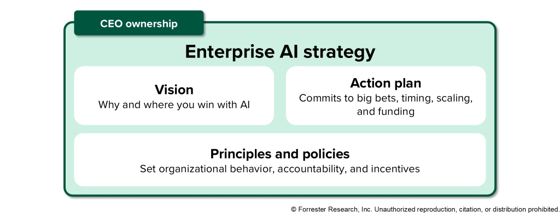
“Your Enterprise AI Strategy” introduces a three-part model where:
- Vision sets why and where you win with AI. Saving a bit of money isn’t a vision, and neither is handing every employee a copilot. CITGO’s CEO helped write his company’s AI strategy, spelling out the expected outcomes in plain business language: reduce cost per barrel, raise production output, improve safety, each with a KPI target the board could hold him to. A vision also says where you won’t play.
- An action plan commits to big bets, timing, scaling, and funding. Planning is what moves a firm from hundreds of use cases to a handful of investment portfolios, the way PepsiCo got to “four or five big bets.”
- Principles and policies set how the organization behaves. They’re the part most companies skip, because they force executives to decide who gives something up so others can gain, who pays for the change, and what people can expect for their jobs and skills.
Source: Forrester, Your Enterprise AI Strategy
Only The CEO Can Hold An AI Strategy Together
CEO ownership is what binds all three together. At BNY, CEO Robin Vince drove the vision that took the bank from a common AI platform to AI agents it calls digital employees.
We’ve found that when the CEO owns the strategy, the company makes the hard decisions: which investments move the business substantially, and what gets deprioritized to pay for them. At an organizational level, only the chief executive can make those calls. With the CEO in charge, a CIO has the incentive to prioritize data and AI readiness for the CMO’s growth ambitions, and a Chief AI Officer no longer spends her day refereeing five executives who don’t report to her and don’t agree on what the business is after.
A Strategy Is Only As Bold As The Value It Targets
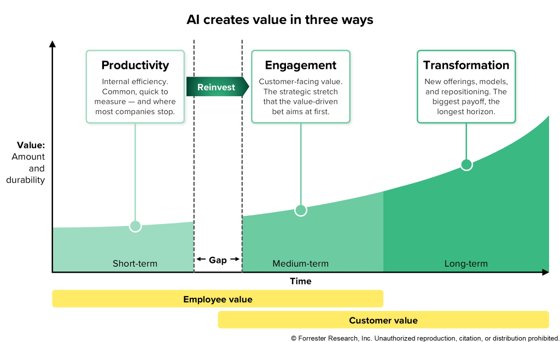
“The AI Value Matrix” provides a framework for value that crosses where AI value lands on your P&L with how that value is delivered (productivity, engagement, and transformation). It gives you a three-by-three grid of nine value types. Productivity is the easy, quick kind of value. Engagement, how AI changes the way customers deal with you, takes longer and lasts longer. Transformational value is slow and hard to get, but it’s the biggest payoff and the most durable.
Source: Forrester, Your Enterprise AI Strategy
AI strategy and value management work as a pair. Without a target value that’s large and durable enough, firms rarely find the wherewithal to create and execute a strategy bold enough for the disruption that’s coming (our AI disruption model lays that out for you).
Once you understand why and where AI needs to show up in your business, and how large and durable the value needs to be, you can put an AI value management plan in place that tracks the changes in business outcomes that create real, lasting advantage.
Read Your Enterprise AI Strategy and our updated AI Value Matrix together, then book an inquiry or guidance session with me. Bring your use case list and we’ll see what value it’s really aiming for.
Categories