Service Providers Are Acquiring Their Way To Relevance And Survival In An AI-Powered World
Service providers from Accenture to Wipro and beyond are on the acquisition march. As Darwinian creatures born to survive, providers have a long history of buying what they need. Today, that means they are buying asset-centric firms to survive AI disruption and gearing up for the complex work of AI transformation. We recently published a new report with our latest analysis of the acquisitions that 24 major service providers have made in 2025 and so far in 2026, delving particuarly into Accenture’s deals to showcase its strategic shift to a business model that blends services and products.
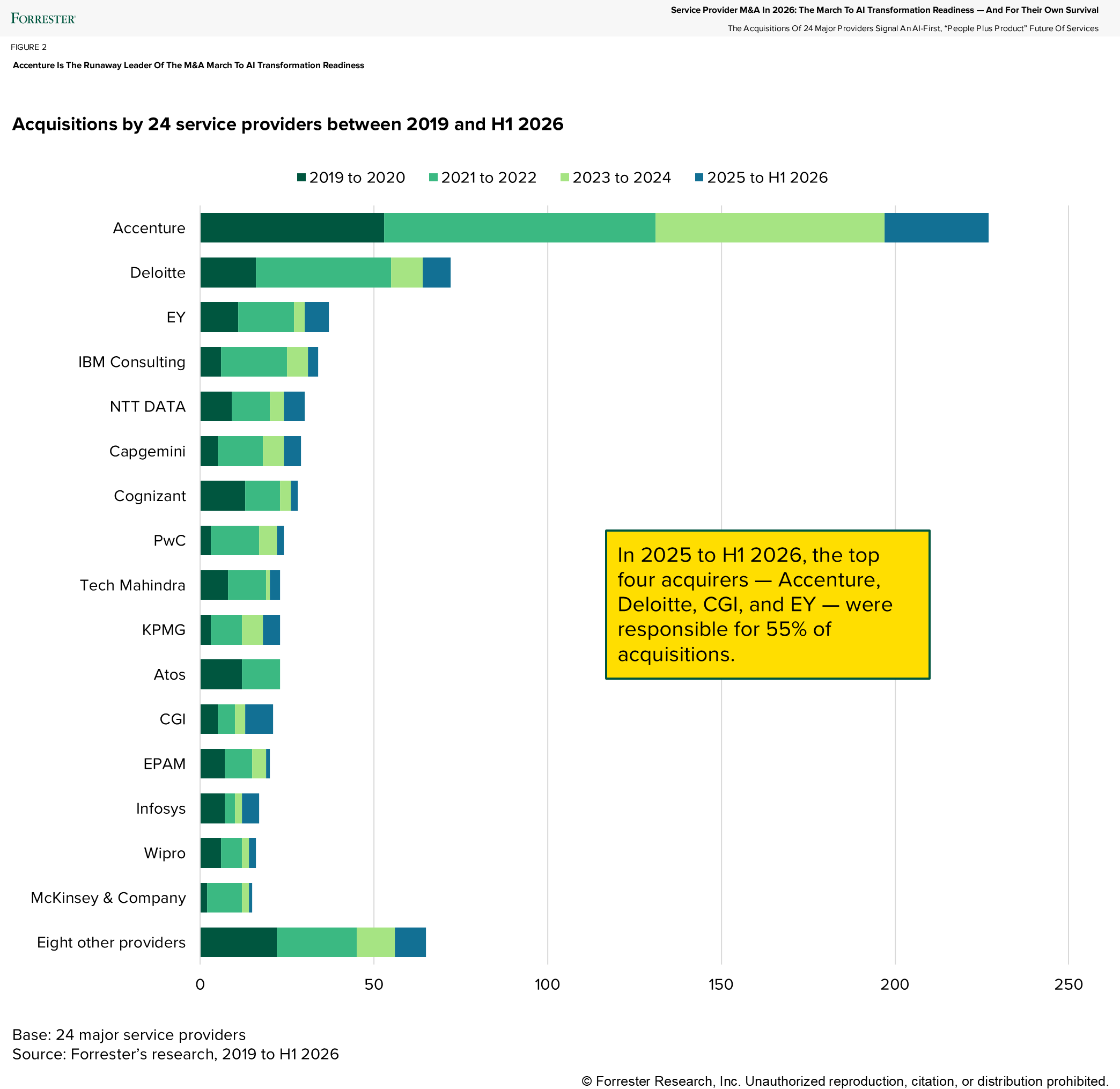
In the last few years, service providers have tilted their acquisition strategies toward recurring revenue and AI transformation readiness. In our review of 97 recent deals by 24 major providers, we found two trends. The first trend is a steady expansion into AI transformation services, including AI engineering itself, more data capabilities, training services for employees, and security and risk service foundations.
Accenture Is The Runaway Leader Of The M&A March To AI Readiness
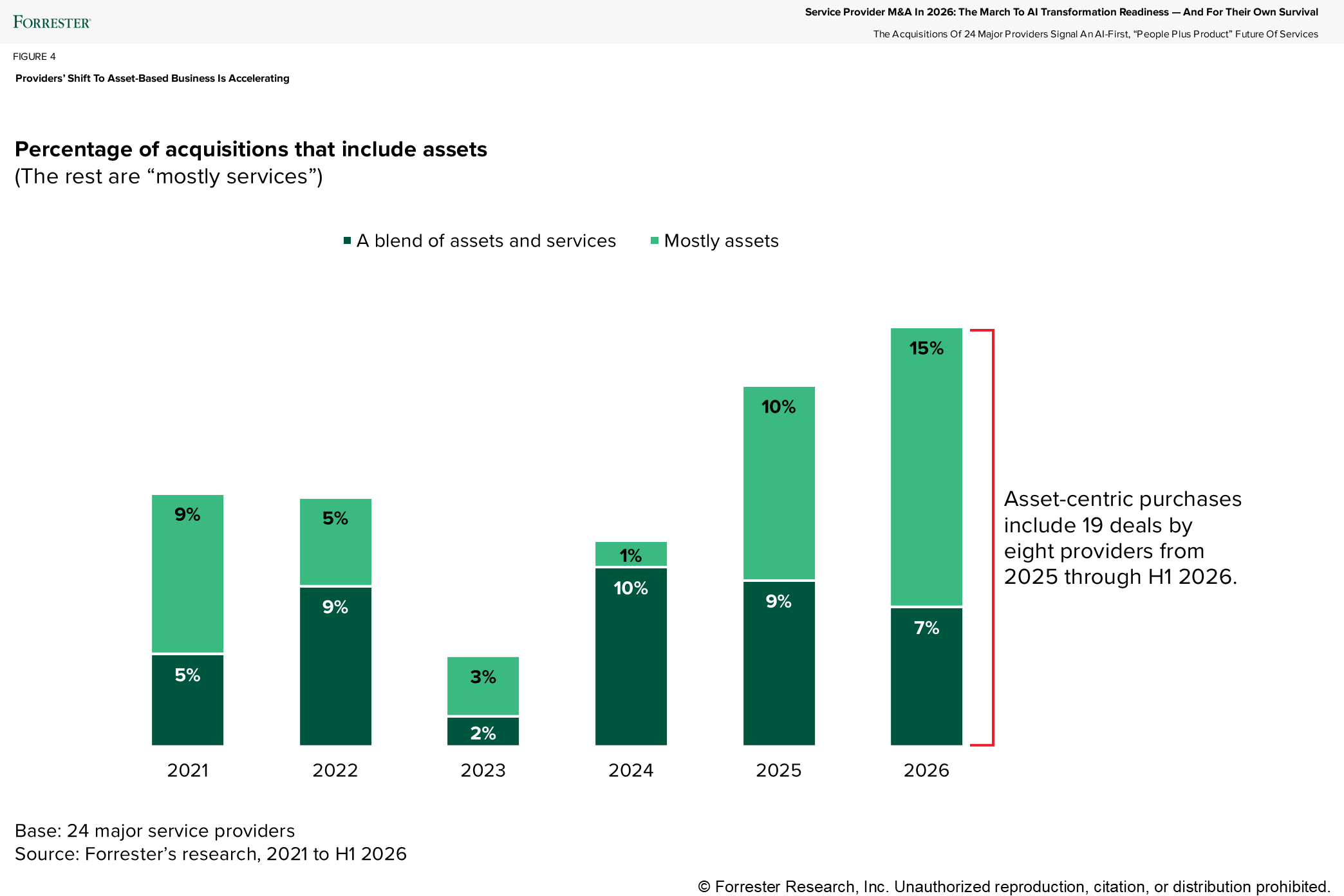
Providers Are Accelerating Their Shift To Asset-Based Business Models
The second trend is providers acquiring firms that have assets. The CEOs of these major service providers loudly proclaim their strategies to grow revenue without adding headcount. To drive this goal, they are increasingly buying software and intellectual property, not only billable people. This blended business model is the future in an AI-industrialized service economy, where a provider sells solutions (for implementation and for operations) and not just people. Both providers and technology execs will have to shift their sourcing, procurement, and engagement approaches to get the best result. If what you want is a plowed field, be prepared to pay for the tractor, not just the farmer. Here’s what the data reveals:
- One in five deals is centered on assets or a blend of assets and services. The percentage of deals that involve a platform or a product is on the rise (see figure below). Two-thirds of those purchases are solely or mostly made for the asset itself; the other acquisitions are a blend of assets and people. (The rest are deals primarily for the people and services they deliver.) When the acquired company has this blend of assets and services, it often means that they price and deliver solutions, sometimes pricing the solution for outcomes rather than by the hour of work. For example, when McKinsey bought India-based digital marketing service provider ET Medialabs, it gained both a platform and people that it can price based on the outcome of improvements in marketing campaign conversion.
- Asset-centric deals divide evenly between platforms and products. The 19 acquisitions since 2025 are evenly divided between platform-centric and product-centric businesses. A platform-centric business is one where the value comes from services delivered on top of or using the platform technology. Of recent deals, see, for example, Capgemini’s purchase of Singapore-based Cloud4C for cloud operations. A product-centric business is one where the product may be standalone. Accenture’s purchase of Dragos is the most pronounced example, but so is HCLTech’s purchase of HPE’s Telco Solutions business for its autonomous networking operations platform.
Providers’ Shift To Asset-Based Business Is Accelerating
Accenture Is A Bellwether In The Shift To Products + People Business
Accenture has a long history of growth through acquisition, funding inorganic growth of between 1.5% and 2% in the acquisition year. That makes Accenture’s acquisition strategy a roadmap for how it sees the future of services. The services behemoth recently jacked up its acquisition budget to $9 billion (having quietly raised $5 billion in debt to lower its cost of capital and help fund it). With this move, it’s clear that Accenture is moving aggressively to a products + people business model.
In a recent earnings report, Accenture CEO Julie Sweet put it this way: “Our acquisitions [are] a mix of services, services and products, and products,” with a stated rationale that the company is “[expanding the] addressable market, and [ . . .] shifting to more non-FTE commercial models.” The $9B is the capital expression of the Class A software pivot: Accenture is buying its way out of a headcount-linked revenue model. As with every service provider, when the core business monetizes headcount and AI compresses the need for people, it’s time to buy software products and proprietary data with recurring revenue. The spend is Accenture’s hedge against its own disruption.
This is reflected in Accenture’s recent purchase of Dragos, runZero, and NetRise for the operating technology security platform, a pure product business. Accenture intends to incorporate the product into its own solution set while keeping it independent as a standalone product. Its recent purchase of network analytics company Ookla is an entrée into network operations, another recurring revenue business.
Buyer Beware, But Also Be Aware Of The Value Of Products + People
As the technology sector matures into a proper supply chain, enterprises should be looking for full-service providers that bring the products and the services together (this is reflected in the forward-deployed engineer strategy of some technology providers, as well). But technology leaders should be mindful of two risks in the transition to any providers’ shift to a products + people business:
- The product, which may formerly have been standalone and serviced by many providers, could disappear into a single service provider’s business, making you captive to them as a sole-source supplier.
- There is a chance that the product becomes an investment dead end, leaving buyers stranded on a product that never advances. To mitigate these risks, ask for product roadmaps, a client advisory council, and some independence to bring in an alternative service provider to work with the product.
What Providers’ Acquisition Strategies Mean For Technology Executives
Companies depend deeply on the providers they hire. Forrester’s 2027 Budget Planning Guide for technology executives reveals that 24% of IT budgets in 2026 is dedicated to outsourced services. This means that they must care about key providers’ strategies, including their approach to acquisitions and track record of success (or quiet failure). Tech execs:
- Ask strategic partners: How will your acquisition strategy support my evolving needs? For your co-innovation partners, this should be an important and regular (at least annual) part of the relationship business review. You have needs — maybe an immediate need — that the provider should be listening to and addressing. Make their acquisition strategy part of your vetting process and annual master service agreement review. New leadership often signals a new acquisition strategy, so get ahead of that change.
- Ask specialist providers: If you get acquired, what will that mean for us? When the news drops that your favorite service provider has been snapped up by a giant, the first reaction from delivery teams is annoyance and concern: They are comfortable with the existing relationship and wonder how it will change. If the acquirer is an existing provider in your stable, ask it directly. If it’s not, ask for an introduction so you can immediately move to the front of the line to get the straight scoop on the acquirer’s plan. Procurement professionals have two additional responsibilities: 1) Write contracts that protect you against the provider being acquired and 2) investigate any changes in strategy that could affect the validity of the contract.
Categories