Wealth Management Firms: Seven Ways To Derisk Your Customer Relationships
Advisor-Led Models Are Prone To Relationship Risks
Traditionally, asset management firms and insurers focus on manufacturing the (investment or insurance) product and leave the acquisition and relationship management to advisors. The industry is built on that model and the resulting value-exchange system generously rewards client advisors, brokers, and agents for consistently generating sales, growing assets under management, and servicing the clients, day to day. While this division of labor (and roles) in a B2B2C works, it also leads to certain risks. Firms acting as product manufacturers become commodity providers while client advisors become relationship owners. Firms are constantly subject to risk from advisor departures, competitive poaching, advisor ageing, or career change, leading to advisor churn and the risk of losing client relationships and their assets.
Seven Ways To Derisk Customer Relationships
Customer retention is a strategic growth priority for wealth and asset managers, globally. According to Forrester’s Priorities Survey, 2026, among wealth and asset management firms prioritizing growth, 45% cite increasing customer retention and loyalty as a key action to advance that objective; however, sudden wealth advisor departures and customer switching risks may result in significant asset outflows that directly undermine it. To address this challenge, consider these seven tactical recommendations based on best practices in the industry:
- Invest in adviser retention first. The best client retention strategy starts with adviser retention, which means reducing the likelihood that top advisers leave. Leading firms strengthen adviser retention through better technology, administrative support, clear career and succession pathways, team-based books of business, and incentives that encourage advisers to build long-term enterprise value within the firm. At the same time, firms look for signs of potential advisor retention risk in metrics, such as advisor engagement, recent productivity, and internal collaboration.
- Adopt team-based relationship management and succession planning. Clients should know more than one person at the firm. A broader coverage team helps ensure that a transition feels like a change in the ‘lead advisor’ rather than a rupture in the relationship. For priority (UHNW) clients, firms often identify a backup advisor years in advance. That backup attends meetings, joins client dinners, participates in investment reviews, etc. Clients should already know the replacement before any transition occurs. Leading firms deliberately avoid single-owner client relationships and use a team-based approach involving multiple people in different roles, such as lead and backup relationship managers (RMs) or advisors; portfolio manager; and lending, insurance, tax or trust specialists.
- Institutionalize client knowledge. Client goals, family dynamics, preferences, investment objectives, risk tolerance, and life events should be captured in the CRM and planning systems so ‘successor’ RMs or advisors can continue the relationship without starting from scratch. This builds relationship resilience, continuity, and longevity. Leading firms are scrupulous about keeping customer interaction records up to date and use them not only to sharpen their service for each client at a time but also build the institutional muscle to serve all clients better all the time. Institutional knowledge also feeds internal private AI and small language models used for scalable AI-driven services.
- Position expertise as institutional, not individual. To reduce the potential risks from advisor departures, firms reinforce the value of their investment committees, CIO research, planning processes, specialist ecosystems, and digital platforms so clients see the institution as the source of sustained and differentiated value. This also impacts how wealth firms communicate with their clients. Rather than saying “John manages your portfolio,” the message would say, “Our investment committee manages your portfolio.” The value positioning should feel institutional rather than personal.
- Act quickly and proactively to ensure client retention in case of departure. Forrester’s investor segmentation identifies four distinct investor personas that have different preferences when it comes to engaging with or relying on advisors. Delegator and validator personas are most aligned to the advisor-led discretionary and semi-discretionary wealth management models; however, that also makes them prone to churn in case of advisor departures. Speed and personal outreach are crucial because departing advisors and competitors are likely to contact the affected clients at that time. In such situations, leading firms follow special protocols to ensure client retention and defend against potential poaching and client asset flight (see illustration).
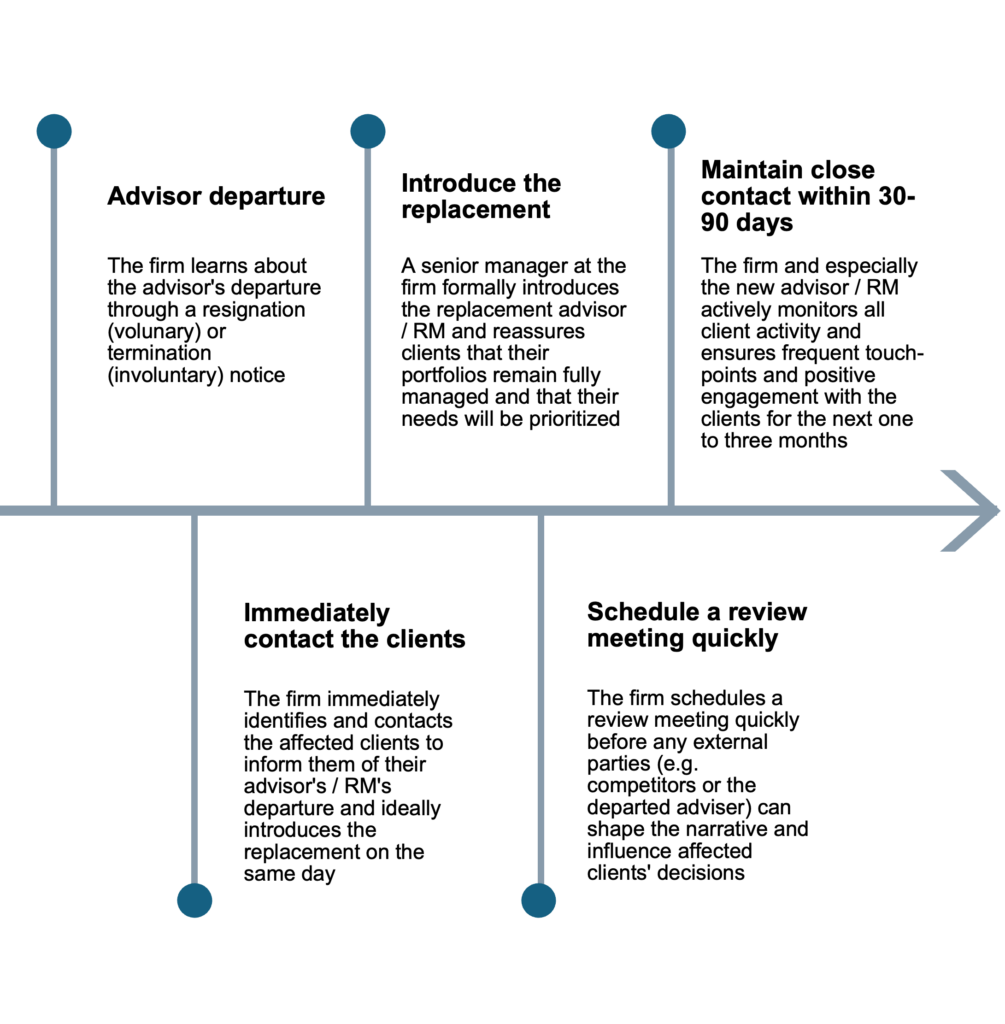
Sample protocol triggered by an unexpected advisor departure - Use predictive data analytics to identify key-person risk and prevent churn. Early signals from data gathered from multiple internal sources can be used to identify at-risk clients and households that may leave the firm due to adviser departure. Leading firms and wealth management platform providers are increasingly using AI-enhanced predictive analytics in relationship strength scoring and risk modelling — wherein the advisor departure-linked variable is a ‘key person’ risk scenario. Clients or ‘key persons’ that are deemed high-risk are then matched with next best actions and prioritized for outreach. Such analytic models typically use information like the length of advisor-client relationship, communication and meeting frequency, client satisfaction, prior transfer behavior, asset concentration, advisors’ client notes, advisor conduct and reviews, etc.
- Deepen client relationships with broader product and service coverage. The more integrated the relationship, the higher the switching cost. Leading firms deliberately try to ‘land and expand’ wealth client relationships with a combination of day-to-day banking, lending, trust, estate planning, tax, philanthropy, and family-office services to increase the firm’s relevance and — as a side benefit — reduce the dependence on any one adviser. The relationship strength is amplified by multiple teams at the firm and frequent touchpoints throughout the clients’ and his or her households’ entire financial needs spectrum.
Wealth management firms shouldn’t wait for advisers to depart and worry about the aftermath later. Forward-looking firms act to broaden and institutionalize customer relationships from their inception and derisk themselves through deliberate adviser-retention, succession, and transition strategies; team-based coverage; disciplined client relationship management to detect churn risk; and various mitigation protocols. If sudden adviser departures take place, the firm shouldn’t be caught off guard. Firms that proactively engage and serve clients institutionally, while enabling advisors to succeed, are more likely to retain their current customer relationships and beyond that — multigenerational relationships with the next of kin.
Schedule an inquiry or a guidance session with me if you’d like to discuss the implications for your organization.