Amazon Opens Its Supply Chain Empire To All — But Is It A Fit For Your Business?
Amazon’s AWS Playbook: Now Applied To Supply Chain Logistics
Per ShipMatrix, in 2025, Amazon surpassed the US Postal Service, FedEx, and UPS to become the largest parcel carrier in the US by volume. Globally, it delivers an estimated 13 billion packages every year.
After decades spent building one of the world’s most formidable logistics networks to serve its own business, Amazon is now opening that infrastructure to everyone. The strategy to launch Amazon Supply Chain Services (ASCS) harkens back to 2006 when the company first made Amazon Web Services (AWS) available to other businesses. By the mid-2010s, AWS was profitable, and it became Amazon’s primary profit engine. The playbook was to build world-class internal capabilities, then sell them as a service.
More Businesses Are Outsourcing Supply Chain Operations
Amazon’s move to open its logistics network underscores a larger industry trend of outsourcing supply chain operations for agility and cost savings, as Forrester predicted.
Amazon’s delivery promises (e.g., same-day or early overnight delivery for millions of items) are unrivaled in many markets. This supply chain service now may enable any business to “rent” Amazon’s logistics capabilities rather build its own. Leading brands such as 3M, American Eagle Outfitters, Lands’ End, and Procter & Gamble have already signed on as launch partners, each leveraging a portion of Amazon’s offering.
What Amazon’s Logistics Service Delivers
Amazon’s new offering bundles a full spectrum of supply chain capabilities into a complete service. Some businesses might replace their third-party logistics provider (3PL), freight network, and delivery partners all at once — and others may simply choose specific components. Key components of ASCS include:
- Global freight. ASCS offers businesses access to Amazon’s freight network across ocean, air, rail, and road. Amazon promises reliable capacity and speed options for moving goods — whether it’s raw materials heading to factories or finished products going to distribution centers. Early adopters like 3M and Procter & Gamble are using Amazon’s freight services to streamline global shipments.
- Warehousing and fulfillment. Companies can store inventory in Amazon’s warehouses and fulfill orders across channels using a unified inventory pool. This leverages the same high-speed picking, packing, and distribution systems Amazon uses for Prime. Retailers like Lands’ End are tapping this component to reach customers faster across their own sites, marketplaces, and physical stores.
- Last-mile delivery. ASCS also plugs businesses into Amazon’s seven-day-a-week parcel delivery network, complete with quick, two-to-five-day shipping across the US. American Eagle Outfitters is handing off direct-to-customer shipments from its website to Amazon for final delivery. Amazon’s logistics machine, which includes hundreds of fulfillment centers (and even its own airline), now effectively becomes any company’s delivery arm.
Raising The Stakes For Logistics Rivals
Per Forrester’s data, 70% of US online adults choose to buy on Amazon to quickly receive their purchase. Businesses that choose to use ASCS may be able to shorten delivery times from any digital property (not just Amazon’s marketplace). Amazon’s infrastructure and efficiency have the potential to set a new baseline for cost and service that impacts consumer expectations across all digital channels.
Recommendations For Digital Leaders
How should savvy digital business leaders respond to Amazon’s foray into offering supply chain logistics? Here’s how to navigate this shift:
- Evaluate the risks. Businesses may worry about becoming overly dependent on a vendor that also happens to be a competitor in many markets. Plus, it’s unclear whether Amazon will favor its own deliveries, or those from specific customers, if it sees capacity issues. Amazon’s vice president of supply chain services claims it doesn’t use data from its supply chain customers to make decisions for its own marketplace, but some merchants might prefer not to hand all their inventory, order, and delivery data to what is now the world’s biggest company by sales. If you do outsource to Amazon, scrutinize the terms around data usage and service levels. Understand how your data will be used and evaluate the risks of this exposure.
- Prepare for a new normal in delivery. Whether or not you partner with Amazon, anticipate that customer expectations for speedy and affordable fulfillment will keep rising. If consumers were previously comfortable holding Amazon (and only Amazon) to their high expectations for extremely fast (and potentially free) delivery, they may expect other merchants to meet that standard.
- Decide where you differentiate. Evaluate whether logistics is truly a strategic differentiator for your business or simply a cost center. If you can’t match Amazon’s speed and efficiency on your own, explore using partners like ASCS or other 3PLs to handle it so you can focus on what sets your brand apart. Of course, you need to compare Amazon’s costs to what other providers charge.
- Compare ASCS to traditional 3PL services. Use our chart to guide your decision-making as you explore this new offering. Note that ASCS is a new service, and this chart represents what we believe, based on what we know so far.
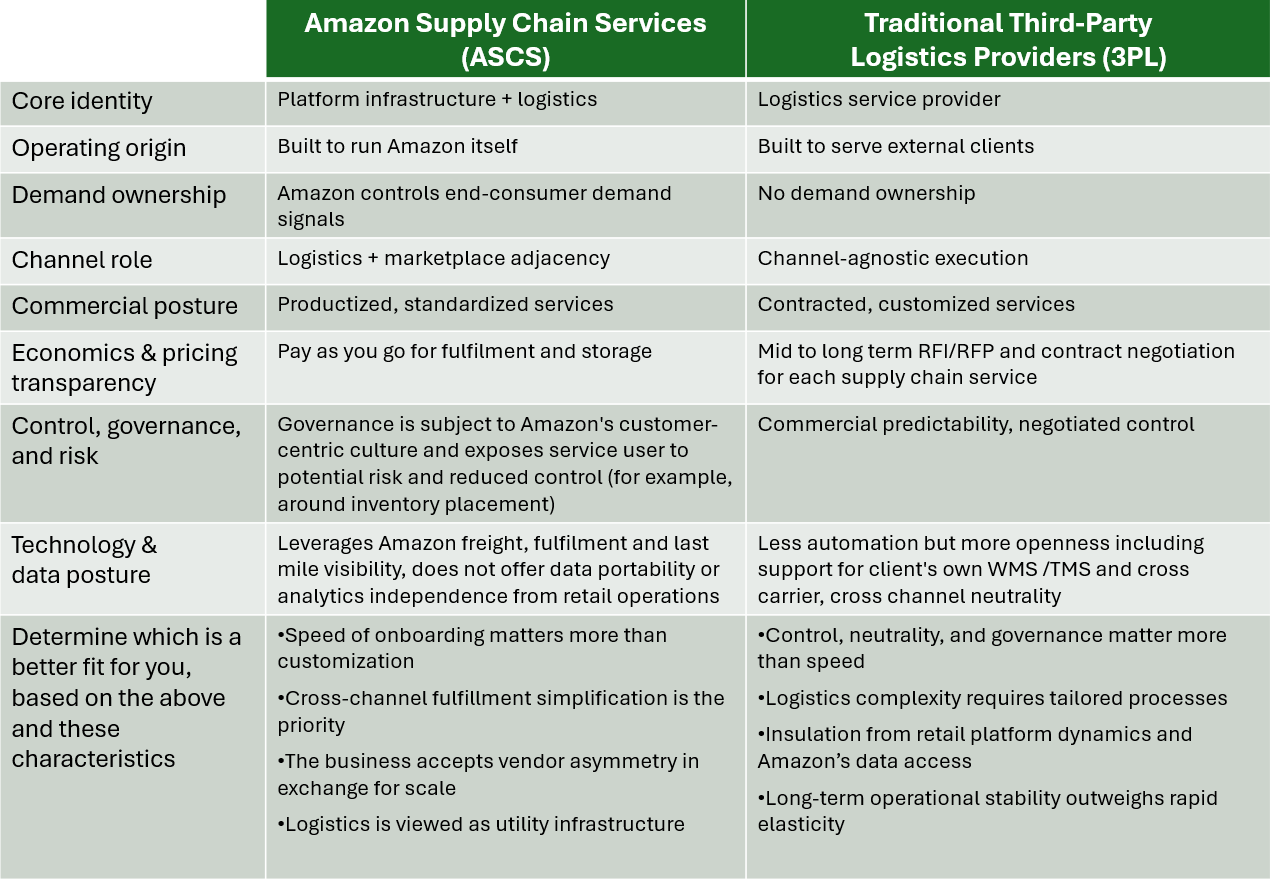
Digital leaders must carefully consider whether to join Amazon’s logistics revolution or double down on differentiating through other means. To discuss this further, schedule a guidance session or inquiry with us!