Back To The (Contextual) Future: It’s Still A Core Component In Consumer Personalization
First, for some context: AI is creating a resurgence for “context” in the industry lexicon. Large language models rely on context to understand intent, resolve ambiguity, and generate accurate responses. As consumers and organizations adopt new AI technology, context plays a key role in creating relevant customer-brand interactions. Organizations don’t need to know the most about their consumers or customers, they need to understand their circumstances and surface the right content or service across answer engines, search engines, chatbots, voice assistants, websites, apps, messages, emails, etc.
But using context isn’t new. In our 2014 report The Power Of Customer Context, Forrester introduced a novel idea: Organizations (specifically, marketing functions) should stop obsessing over campaigns, targeting, customer segments, media schedules, and transactions. Instead, they should focus on interactions, customer recognition, customer moments, contextual utility, value exchange, and engagement. Context continues to appear throughout CX, marketing, and advertising, from contextual ad targeting to context sitting at the heart of an anatomy of a moment to context being a component of our formal definition of personalization: the use of a customer’s history, preferences, behaviors, intent, and context to frame, guide, enhance, and anticipate interactions for relevancy and a mutual exchange of value between the customer and organization.
Context Can Further Consumer Personalization Tactics If Used Strategically
Despite over a decade of progress with organizations trying to glean more context and improve personalization tactics, consumers remain lukewarm about the personalized interactions they have with brands. In our new report, The State Of US Consumer Personalization, 2026, only 52% of US online adults say they like when companies personalize interactions, and fewer still are eager to share more personal information to enable those experiences.
Strategically, organizations are out of sorts. Contextualization requires understanding what a consumer or customer is trying to accomplish in a specific moment and using that to create useful interactions for them. But today’s organizations struggle because so many optimize personalization programs to business objectives rather than customer needs. Eighty percent of US B2C marketing executives agree that their personalization strategies focus on showing customers what the company wants them to receive rather than what customers want to receive — the total opposite of contextualization.
Legacy Forrester research described context as creating a value exchange, where organizations provide useful services and consumers receive utility in return. Today, it’s the same: Consumers just want personalized moments to be relevant and valuable.
While relevancy is straightforward (“Did it apply to me or not?”), value is nebulous. Consumers realize value in myriad ways, such as saving money, gaining convenience, making decisions, completing tasks, achieving goals, or receiving support. Forrester identifies four dimensions of customer value: economic, functional, experiential, and symbolic.
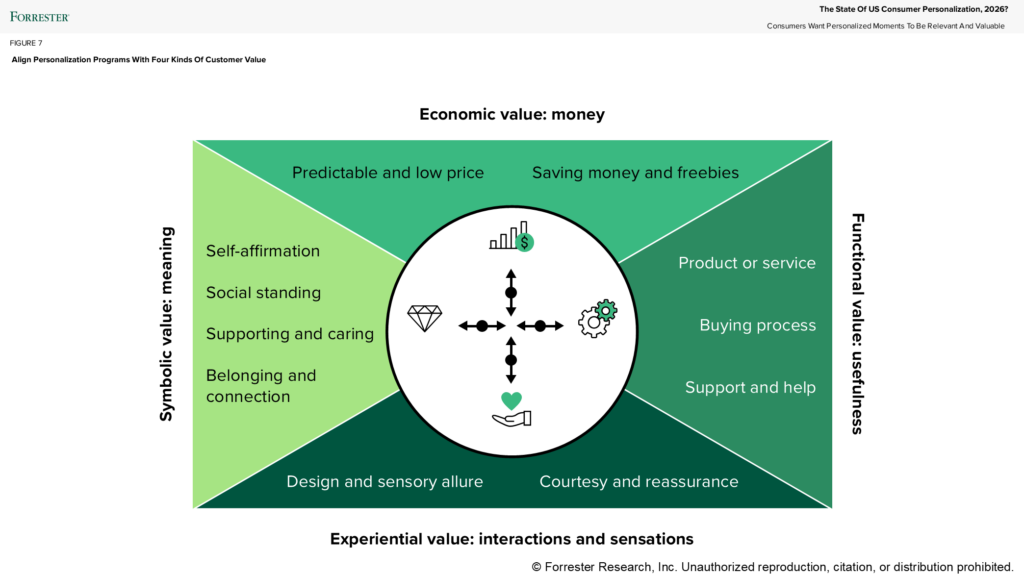
Technologically, consumer and organization use has rapidly evolved. Today’s technologies enable organizations to better hone in on relevancy and value (though customer data privacy regulation and consumers’ increasing awareness of data privacy work as opposing forces). Personalization capabilities now combine signals that were difficult or impossible to integrate previously, such as historical customer behavior, transaction history, loyalty status, real-time engagement signals, device and channel information, location and environmental context, and AI-generated predictions and recommendations. More advanced AI techniques push organizations to create interactions on the fly and serve bespoke content and services in real time, as needed.
But without a strategy, technology can only help so much with consumer personalization initiatives and using context to its fullest potential. Despite technology advancements, consumer expectations remain the same: a value exchange of services and utility back then versus relevance and value now — all hinging on first understanding the customer’s context.
For more, schedule a guidance session or inquiry with us. And check out our initiative blueprints: Design A Personalization Vision and Create A Personalization Execution Plan.
Related Forrester Content