Fortune 500 CEOs Move AI To The Center Of The Growth Agenda
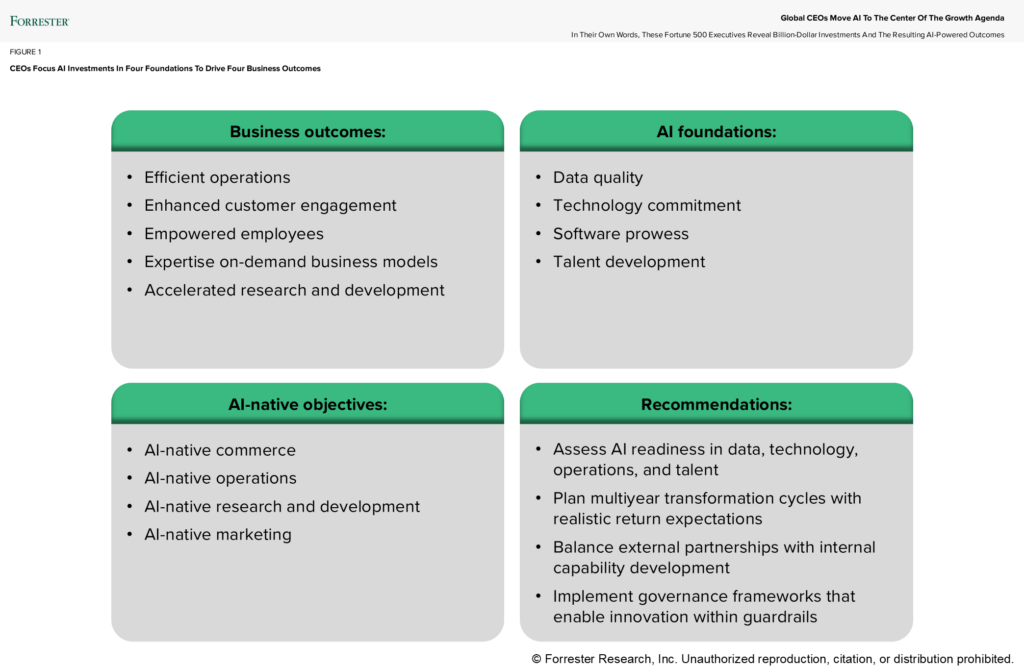
After three years of genAI investment, the CEOs of public companies have begun disclosing the investments and impact on their companies. We examined the Q3 2025 earnings transcripts of 20 public companies in retail, financial services, and manufacturing — including Walmart, Bank of America, Capital One, Lowe’s, Thermo Fisher Scientific, and Kraft Heinz — and zeroed in on CEOs willing to tell their AI stories. All quotes are from the companies’ earnings transcripts for calendar quarter Q3 2025. CEOs are investing pragmatically to achieve four outcomes: higher operational efficiency, better customer engagement, more empowered employees, and new AI business models fueled by on-demand expertise (see figure below).
Investments Are In The Billions Over Many Years, Past And Future
AI is another layer in the ongoing technology-fueled transformation of business. Firms that have built strong foundations over the past decade are at a distinct advantage, while others are investing heavily to play catch-up. Because these investments are material — billions of dollars over many years — CEOs are laying them out together with the benefits they bring. Four big buckets of capability underpin every AI scenario:
- Data quality. Without trustworthy data — both quantitative data and knowledge assets (content that grounds AI agents in your proprietary expertise) — AI will spew garbage that sounds true but is just as likely to be made up or worse. CEOs know this and are making investments, billions of dollars’ worth, and building operating models to continually collect, assess, correct, and put data to work. Bank of America’s Brian Moynihan reports, “The $3 billion we spent on data from 2014 to 2019 to get the data perfect in this company or [as perfectly] as we could; perfect is beyond reach. It takes that much work.”
- Technology commitment. Data is useless without the AI computing stack to support it. This new five-layer stack — infrastructure, intelligence, data, orchestration, and experiences — requires wholesale business transformation and the introduction of new capabilities. Capital One Founder, Chairman, CEO, and President Richard Fairbank is proud of its approach, saying: “All of these opportunities stand on the shoulders of our modern technology stack. There are a small number of large modern technology companies fully in the cloud, built on modern applications and data. We are one of them. Since the beginning of our technology transformation, our journey has been focused on bringing AI into the heart of the business.”
- Software prowess. AI is a foundational toolkit to help developers create simple software faster and complex software better. And software, particularly custom software, is the only way for a business to differentiate itself. Most CEOs talked about the impact of AI on their software operations. In a representative statement, recently retired Walmart CEO Doug McMillon said, “When AI is used for software development, more than 40% of the new code is either AI-generated or AI-assisted.”
- Talent development. Walmart’s McMillon went on to say, “We’re helping our associates build the skills they will need to thrive in an AI-powered workplace.” In a new Forrester jobs forecast, we project that AI and automation will displace 6% of the workforce by 2030 and will affect many more jobs than that. Firms are building competency into their talent model, training for familiarity with AI tools, awareness of new responsibilities, and acceptance of the impact on work, skills, and contributions.
A statement by Goldman Sachs CEO David Solomon sums it up: “Propelled by AI, this [One Goldman Sachs 3.0] is a new, more centralized operating model. This is a multiyear effort, and we plan to measure our progress across six goals: enhancing client experience, improving profitability, driving productivity and efficiency, strengthening resilience and capacity to scale, enriching the employee experience, and bolstering risk management.”
It’ll take billions in investment and wholesale commitment to enhancing existing capabilities with AI tools and using AI to generate entirely new business models. AI is no longer experimentation. It’s at the center of the next era of growth.
Categories