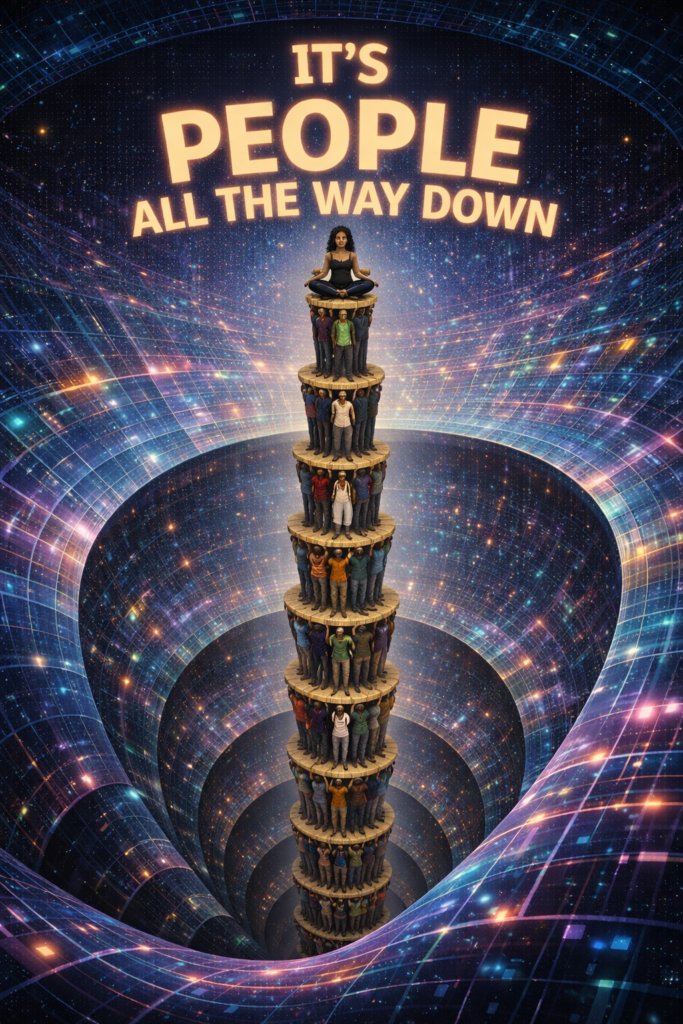
It’s People All The Way Down
Nope, not turtles. Not AI surfaces. Not AI agents. Not multiagent autonomous orchestration gobbledygook. Just people. Without a person at the end of the chain, it’s just machinery. (That is, unless the machinery breaks things in the real world and flights are grounded, bank transactions disappear, or cars start driving into each other.)
That there is always a person on the other side of the interaction is a point of view, my framing of reality. There are plenty of wizards and pundits and founders and super smart investor types who believe otherwise. They imagine a world where machines talk to machines and people just sit back and enjoy the ride. (Though how they think people will see purpose in their no-work, no-hassle, no-feeling-of-accomplishment lives escapes me.)
How does a belief that it’s people all the way down help you make sense of the AI world and make good decisions about what to do as a business or technology leader? At least these things:
- Advertising- and commerce-fee-funded AI tools have massive motivation to keep people front and center. If OpenAI is to achieve its ambition to replace Google as the front door to expertise on demand, it has to sell lots of ads. It has to make lots of referrals. It has to do lots of in-app sales. Do you imagine it would like the people who see things and buy things to go away?
- Agents talking to agents will quickly become the realm of operations geeks. If all the interactions happen in the background, then only a specialist — engineer, operations manager, compliance (in its broadest sense) administrator — needs to know or care about how it works or that it works. This raises the bar for CIOs who are being asked to staff and run the AI operations team: They care deeply about ensuring quality and performance. But if the end user can’t see how the tool helps them succeed, they’ll avoid it. Therefore …
- The user experience matters more than ever. How’s your linguistic design team doing? How about your “talk to the machine to make the purchase” team? Without deep intuition on people of every neurological bent interacting with information and services using their words and their gestures, you can’t possibly build AI-powered interfaces (“surfaces” seems to be the new cool-kid word for it) that meet people where they are. And if the AI interface isn’t super convenient …
- People talking to people will be more valuable than ever. Avoiding the AI to talk to a person will be as omnipresent as avoiding automated call centers is today. The role of people — financial advisors, salespeople, travel agents, care representatives — will be more important than ever (not “agent, agent, agent, no, not the stupid AI thing, a real person”). Reddit will be flooded with helpful tips on how to avoid the chatbot and get to a person. And that leads to the realization that …
- You’re being disintermediated in ways you didn’t expect. Do you understand that your customers are going to ChatGPT or Google Gemini or X’s Grok for answers and expertise instead of you? (Forrester’s data reveals that 78% of US adults under 35 years old go to an AI tool for financial advice.) They may wind up at your bank or your retail store or your doctor’s office, but they will come armed with expertise they should be getting from you. That leaves you holding the bag on the transaction without being able to shape the decision. Talk about disintermediation-fueled degradation.
Armed with a different point of view — that people matter more than automation — you are poised to tame AI and apply it to your business.
Categories