REAP: A Modern Application Disposition Model For An AI And Cloud Economy
Why Legacy Disposition Frameworks Fall Short
For years, technology leaders have leaned on familiar application disposition models to bring order to sprawling portfolios. These frameworks were fine when IT was mainly an order taker, and infrastructure and applications followed a predictable lifecycle. During that time, asset portfolios were relatively stable, cloud platforms were emerging, and large batch “transformation” projects were the norm.
Those times are a distant memory for most digital and IT organizations. The cloud era, application modernization, and “AI-first” principles are pushing legacy landscapes into high-obsolescence status. Agentic AI is inevitable, technical debt is compounding faster, and product‑centric delivery has fundamentally changed how organizations make technology choices, moving away from cost containment toward finding ways to reap the benefits of continuous digital investment.
The reality is simple: Older portfolio models were built for a different era. They provide categories but not clarity. CIOs need something more actionable today. To meet that need, Forrester has developed “REAP, A Superior Application Disposition Matrix.” Nostalgia is not a strategy — having a modern application disposition framework designed not for what we used to have but for the portfolios we have now and plan to acquire in the future is critical.
REAP Meets The Moment
Old models are functionally blind to dealing with AI readiness, product discovery, and technical debt. Executives and business leaders are asking deeper questions about risk, value, and volatility that point-in-time traditional frameworks struggle to address. REAP seeks to answer those questions:
| Traditional/Static | REAP/Dynamic |
| How do I make sense of my IT environment in an “order-taking” operating model? | How do I make sense of my environment as a full digital product management partner? |
| How do I plan for a “big bang” digital transformation? | How do I sustain an ongoing IT modernization plan? |
| How do I manage a portfolio of physical on-premises IT assets? | How do I manage a portfolio of dynamic cloud resources? |
The traditional portfolio framing collapses wildly different scenarios into static buckets that sound neat but leave decision‑makers guessing about adaptive strategies for today’s genAI-infused market. REAP is an acronym for reassess, extract, advance, and prune, starting with the two dimensions that matter most: business and technical fitness. It gives CIOs and product leaders a practical way to make decisions quickly, confidently, and continuously.
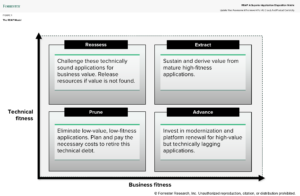
How Each Quadrant Changes The Game
- Reassess. This quadrant acknowledges what legacy models never did: Sometimes, technically strong systems fail to deliver business value. Maybe the product never found its market. Maybe conditions shifted. Maybe the team built the wrong thing very well. “Reassess” is not a passive “tolerate” bucket; it’s an active investigation. It demands engagement with product leadership and a willingness to redirect or retire when value isn’t materializing. You might “tolerate” a subpar application if you are IT order-taker with on-premises assets on a five-year depreciation cycle and little salvage value — not so in collaborative, cloud-first, product-driven operating models!
- Extract. When a system is delivering business value and technically stable, the job is to harvest value efficiently, not lavish more incremental investment. “Extract” reframes this quadrant as disciplined, ROI‑bound stewardship of a mature product. A blind “invest” recommendation might encourage gold-plating; “extract” puts a governance wrapper around optimization and aligns portfolio terminology with economic fundamentals.
- Advance. Much investment happens here — perhaps even a majority. Underpinning products and services evolve and failure to keep up is one reason why technical debt is a global crisis. “Advance” recognizes that modernization is not a one‑time “migrate” action but a continuous architecture function. It aligns with platform engineering and product‑centric delivery, embedding modernization into the lifecycle rather than treating it as a side project.
- Prune. The frequently heard term “eliminate” sounds clear but is anything but, especially when opaque dependencies and risky workloads hide beneath the surface. “Prune” is both more honest and more accurate. Removing an obsolete system is a careful, skilled act requiring dependency analysis, workload movement, decommissioning plans, and risk mitigation. REAP’s language acknowledges the intentionality, craft, and resources required to remove digital services safely.
REAP Isn’t Just A Framework — It’s A Governance Upgrade
Application disposition today requires more than classifications. It requires continuous assessment, clear investment logic, and an IT management graph rich with signals from architecture, engineering velocity, SLA performance, and product metrics. REAP integrates directly into this cycle of ongoing portfolio sensing and governance. It is built for the era of genAI‑driven insight, where agents can harvest signals across backlogs, documentation, incidents, and code changes to keep portfolios continuously aligned with strategy.
Why REAP Takes The Reins As The Modern Successor
REAP doesn’t reject the past; it transcends it. By grounding disposition in business fitness, technical fitness, and modern delivery realities, it moves beyond static grids to become a living model for portfolio wellness. In a world where technical debt continues to challenge many organizations and business agility depends on the health of your application estate, REAP provides the fluency and clarity that organizations desperately need.
If you strive to keep your portfolio lean, resilient, profitable, and aligned to strategic outcomes, don’t just categorize your applications — you REAP what you sow. Want to hear how our clients are reaping the benefits of this Forrester model? If you are a Forrester client, reach out, and we can share some best practices.
Related Forrester Content