Reviewing Australia’s 2025 GTIM: The Shifts In Public Trust That Mattered Most
The 2025 results of Forrester’s Government Trust Imperative Metric (GTIM) revealed that Australians are growing more cautious in how much confidence they place in their government as economic and geopolitical pressures intensify. This shift reflects a public reassessing not only what the government delivers but how consistently and empathetically it responds to rising uncertainty.
From 2024 To 2025: A Small Decline With Meaningful Signals
Back in 2024, Australia held a moderate GTIM, supported by expectations of transparency and consistent leadership. By 2025, the score dipped — a 1.6‑point year‑on‑year decline — driven by cost‑of‑living pressures, housing access challenges, and growing global tensions. The 2025 findings point to a gradual but significant shift in how Australians judge their government. Because trust moves incrementally, even small changes matter — and this year, election‑year dynamics and global tensions played a clear role.
What’s Driving Trust Down
Trust levers are the seven elements that shape public trust in the government and offer the best lens for understanding these shifts. Three trust levers stand out:
-
-
- Transparency is the most important trust lever. Transparency is critical to maintaining trust for Australian online adults — but only 17% say that the government communicates in a clear and transparent manner.
-
-
-
- Government organizations must be dependable. A quarter of Australian online adults believe that the federal government supports its people during and after crises, whether through its pandemic response or financial and mental health aid following natural disasters. Yet Australians see a gap in long-term structural reforms that safeguard their well-being.
-
-
-
- Empathy is critical to maintaining trust. Government institutions must demonstrate awareness of and responsiveness to people’s struggles. Yet only 17% of Australian online adults believe the government acts in the best interest of its people.
-
At the same time, trust in government is becoming increasingly uneven across demographic and geographic lines. Higher‑income and higher‑education groups and residents in states like New South Wales report stronger trust than people with lower incomes or those in Victoria or Queensland.
GTIM Matters Because Trust Drives Mission-Critical Behaviors
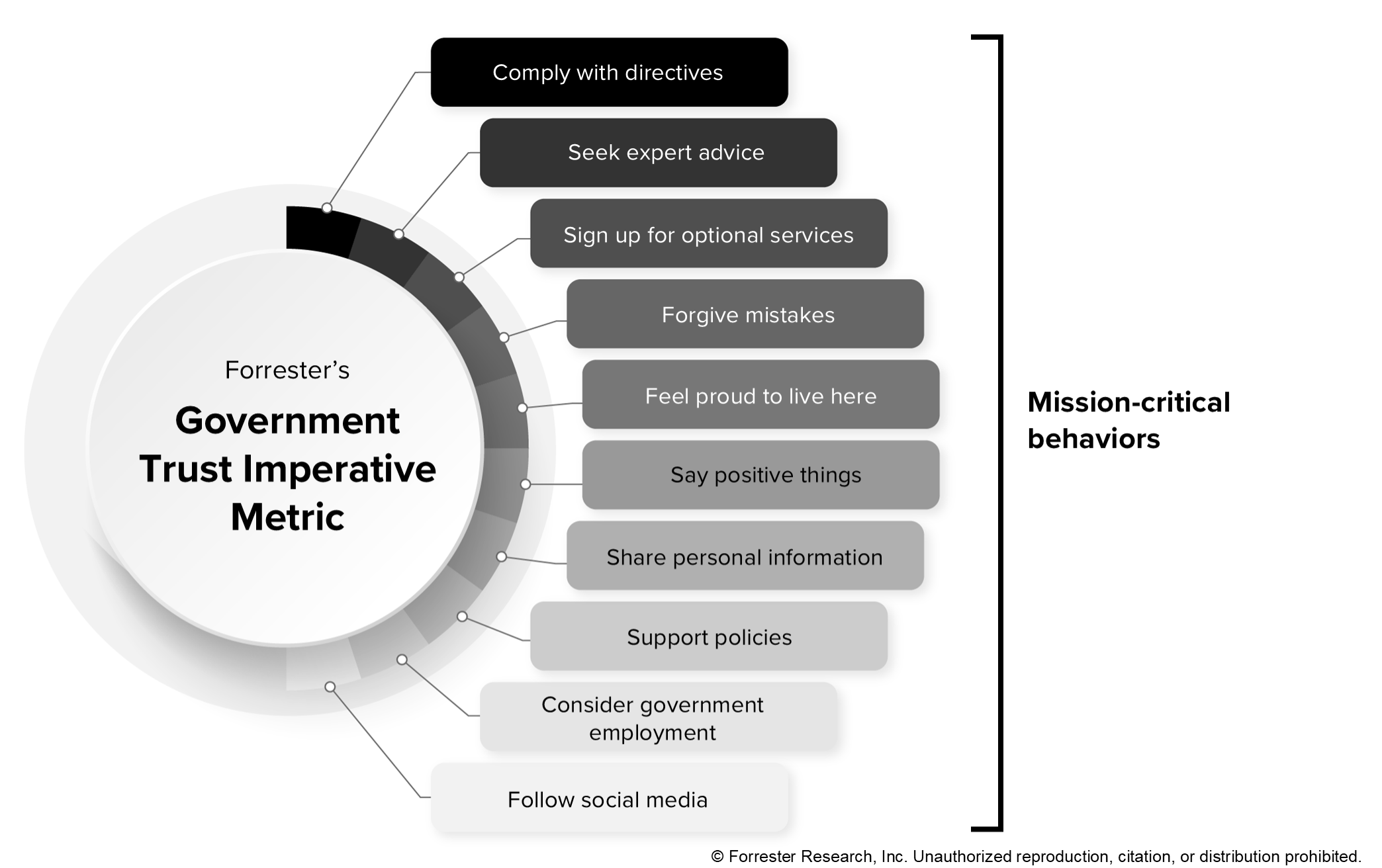
Forrester’s GTIM research continues to show that public trust directly shapes mission‑critical behaviors. Australians with higher trust are more willing to comply with directives, engage with services, share information, support new policies, and forgive mistakes. These behaviors aren’t abstract: Among Australians with high trust, half are likely to support the policies of current elected officials, compared with just 2% of those with low trust — a staggering 47-point behavioral gap. Similar gaps appear across other behaviors, such as feeling proud to live there, seeking expert advice from government organizations, and sharing personal information beyond minimum requirements. Even lower-effort actions like following government social media accounts show a 34-point gap.
What Government Leaders Must Focus On In 2026
Mission leaders can strengthen trust between the public, their elected representatives, and the institutions built to serve them by embedding trust‑building practices into daily operations, policy choices, and service delivery. The 2025 results point to three actionable imperatives for government leaders to turn more people into supporters — people who comply with government directives and advice and are more willing to share personal details about themselves and their circumstances:
-
-
- Double down on transparency initiatives. Clear and accessible communication is essential — only 6% of minimalists (people who follow the rules but hesitate to share personal details) believe the government is open and honest with its people.
-
-
-
- Prioritize initiatives that strengthen perceptions of accountability. Win over cynics — people who are willing to share personal information with government organizations but aren’t likely to comply with government directives — by publicly acknowledging mistakes and demonstrating corrective action through clear, accessible communication and independent oversight.
-
-
-
- Demonstrate a commitment to delivering high-quality public services. Only 4% of beneficiaries — people who don’t share personal information beyond what’s legally required or comply with policies — believe the government consistently delivers on this behavior.
-
For more details about Australia’s 2025 GTIM results and our trust model for government, read our reports The Government Trust Imperative In Australia, 2025 and The Trust Imperative In Government. For global insights, check out this blog where we compare what drives trust the most in the US, Singapore, and Australia. Forrester clients can also schedule a guidance session with me or my colleagues who contributed to this research.
Related Forrester Content
Categories