Stop Running Batting Practice In Sales: AI Role-Play Is The New Pitching Machine
Professional baseball stopped relying on “just throw it and see what happens” a long time ago. Sales training hasn’t.
For decades, hitters trained with live batting practice. Then pitching machines brought consistency and repetition. Today, elite teams are adopting AI-driven systems like the Trajekt Arc, technology that replicates the exact delivery, spin, and decision-making context of real pitchers. Now ask yourself: Which era does your sales training belong to?
Because too many B2B organizations are still running the equivalent of batting practice in how they prepare sellers.
Sales training is stuck in the past
The reality is uncomfortable, with dominant methods for seller readiness outdated and often ineffective:
- Manager-led role-play doesn’t scale and often backfires. Traditional role-play depends heavily on first-line managers who are rarely trained as coaches. These sessions can feel intimidating, inconsistent, and biased. In many cases, they erode confidence rather than build it, and they are nearly impossible to scale across large or distributed teams.
- Recorded pitch scenarios are artificial and passive. Video-based practice allows repetition but lacks interaction. Sellers aren’t forced to think on their feet, adjust messaging, or handle objections dynamically. The result is “practice” that feels disconnected from the reality of buyer conversations.
- Both approaches fail when it matters most. Buyers expect clarity, confidence, and value from the first interaction. Yet most organizations rely on methods that don’t replicate real pressure or variability. That gap between practice and reality is now a competitive liability.
This isn’t just suboptimal; it’s increasingly untenable.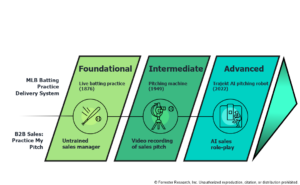
AI role-play is the Trajekt Arc moment for sales
Baseball didn’t evolve incrementally; it made step changes. Sales is now at the same inflection point:
- AI delivers realism that changes behavior. Modern AI role-play doesn’t feel like a script; it mirrors real buyer interactions with objection handling, personality variation, and negotiation complexity. Sellers stop “performing” and start practicing because the simulation actually feels real.
- It removes the biggest barrier to practice: people. One of the most consistent findings in our research is that sellers prefer practicing with AI over their managers. AI is not judgmental, not biased, and not evaluating them. That changes everything, allowing sellers to more authentically engage, experiment, and practice more frequently.
- It scales what has never scaled before. Organizations can now deliver consistent, repeatable, and personalized practice across hundreds — or thousands — of sellers. That’s something traditional role-play has never been able to achieve.
- It shifts enablement from knowledge to capability. Revenue enablement has long measured what sellers consume. AI role-play measures what they can actually do: how they ask questions, handle objections, and position value in real time.
This is not an incremental improvement. It’s a different training category.
The data is already clear: Top performers are moving
If you’re wondering whether this is early-stage or experimental, the answer is no.
- High-performing reps are four times more likely to use AI role-play.
- They are 2.5 times more likely to prefer AI coaching over manager-led role-play.
- They use it to personalize learning and improve coaching outcomes at twice the frequency.
In other words, the best sellers are already training differently … and that should tell you everything you need to know.
This is now table stakes
Let’s be direct: Continuing to rely on traditional role-play approaches is no longer a neutral decision; it’s a competitive disadvantage. Just as no serious baseball organization would prepare hitters without advanced delivery systems, no modern B2B sales organization can afford to rely solely on human-led role-play or static simulations.
The market has moved: Buyers are harder to engage; growth expectations are higher; differentiation is thinner. In that environment, execution quality — not just strategy — determines who wins. And execution quality is built through practice.
The real shift is cultural, not technical
One of the biggest misconceptions about AI role-play is that it’s a tool deployment.
It’s not; it’s a shift in how organizations think about practice:
- From episodic to continuous
- From performative to developmental
- From subjective feedback to objective evidence
- From training as content to training as capability
The organizations that get this right don’t treat AI role-play as a feature but as infrastructure.
Stop running batting practice
Baseball didn’t abandon batting practice because it was broken; it evolved because better options emerged, creating competitive advantage for first adopters. Sales is now at that same moment: AI role-play is not a nice-to-have, an experiment, or something to “pilot indefinitely.” It is the most effective way we have today to build seller readiness at scale.
The only real question is whether your organization embraces that shift … or competes against those that already have.
Need more help with best practices in sales learning and development? Book a guidance session with me here.