The Future Of (Enterprise) Software
I have spent much of this summer working with my colleague Joe Cicman on a deceptively simple question: What happens to enterprise software when AI makes software creation abundant?
Last week, Joe presented the first evolution of our thinking at Forrester’s Technology & Innovation Forum in Austin. Next week, I will bring the conversation to London at Technology & Innovation Forum EMEA. Our presentation is titled, “The Future Of Software.”
I will resist the temptation to reveal too much here. But the starting point is this: For decades, enterprises acquired software in three primary ways. They bought it, customized it, or built it. Those choices shaped technology budgets, vendor relationships, operating models, and the pace at which businesses could change. AI is now challenging that model by making software easier to generate, compose, and deploy.
That does not mean SaaS is dead. It does not mean every enterprise will build every application for itself. And it does not mean agents will simply replace the enterprise application estate. The reality will be more nuanced and far more interesting.
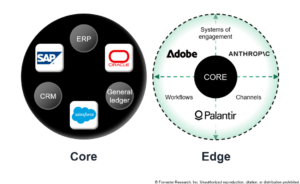
One important distinction is between the core and the edge of the enterprise software estate. The core contains the systems and trusted records on which the business depends. The edge contains the experiences, workflows, channels, integrations, and agents through which much of the business changes and engages with customers and employees. The core must evolve deliberately; the edge can evolve much more rapidly. AI will intensify that difference.
Agentic software development will further accelerate this shift. AI-powered agents are beginning to participate across analysis, design, coding, testing, and delivery. As their reach expands, enterprises will create more software, workflows, and business capabilities. But increased capacity does not automatically produce increased value.
This brings us to the question that has occupied Joe and me throughout the summer: If creating software becomes easier, what becomes scarce?
Our answer is stewardship.
Every generated capability still needs an owner. It must be secured, operated, funded, measured, evolved, and eventually retired. Creation costs may fall faster than ownership and stewardship costs. Without the right architectural boundaries, operating model, and governance, abundance can become sprawl.
So the future of enterprise software is not principally a story about replacing packaged applications. It is about changing software economics, redefining the relationship between the core and the edge, and elevating the human responsibility to decide what deserves to exist, grow, or disappear.
That is as much as I will say for now. If you are joining us in London at Technology & Innovation Forum EMEA on September 30 to October 1, 2026, I look forward to continuing the conversation there. Or if you’ve missed Austin and can’t join us in London, schedule an inquiry or guidance session with either me or Joe.
Categories