Agentic Commerce Exposes The Missing Dimension In Product Data
Your product data was built for filters, not questions
When shopping for real estate, a home listing can tell you the number of bedrooms, square footage, lot size, and age of the property. Those facts help narrow your search. But beyond dimensions and facts, homebuyers want to know, “Can my kids safely walk to school from here?” or “Can I work from home comfortably in this space?” The raw attributes are insufficient. Product data faces the same challenge. It was built to describe products, while shoppers and AI agents increasingly want answers about outcomes, fit, and real-world use.
Your product data is missing a (crucial) third dimension
On a retail website that sells outdoor gear, a product detail page (PDP) for a backpack can have lots of in-use lifestyle photos, up-close detail shots, dozens of attributes to describe its features, and perfectly accurate measurements (likely height and width). For a human shopping on the site, this might be more than enough product information, but if the backpack’s third dimension (its depth when fully packed) is missing, an answer engine still cannot confidently answer the question of whether it will fit under the seat on the shopper’s favorite airline.
Of course, the data gap isn’t literally a third measurement (and in fairness, many websites do include backpack depth). But this example highlights the gap between data and answers.
To facilitate answers, shift product data from attributes to applications
Conversational shoppers ask what they can do with a product, where it will work, and whether it fits their particular situation. Your data needs to support these answers.
Forrester’s research already finds that consumers primarily use answer engines to research and evaluate products. Among consumers who had used answer engines for retail purposes, 89% had used them to research products or services. Those research conversations will quickly expose the difference between an attribute and an answer.
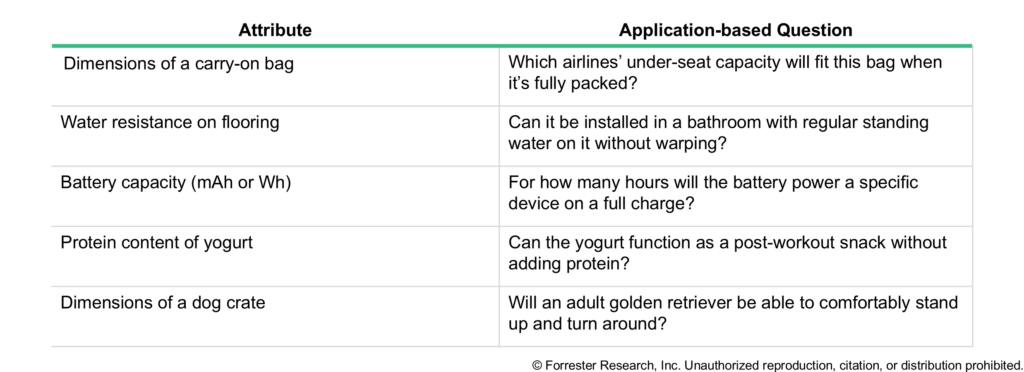
Conversational product discovery experiences occur in both owned environments, such as merchant sites and apps, as well as non-owned environments, including answer engines and other distributed channels. The same product content can improve experiences and outcomes in both locations but in different ways:
- On a merchant’s site/app. Strong product content gives a shopping assistant better material to answer specific product questions within the owned environment, keep customers on the site as they discover, and/or encourage future visits.
- In an answer engine. Agent-ready data gives the merchant more influence over how the product is represented when the merchant is no longer controlling the interface. Strong content improves discoverability, positioning, and brand authority.
Build product data around conversational shopping
For now, there’s still no way for merchants to see the actual conversation on an answer engine that led to a website visit (as there is with the search term that leads to a click). Until an answer engine exposes conversational referral data to merchants, merchants will need to work backward and:
- Identify the application questions that customers ask before buying. Look across site search, customer service, reviews, returns, and sales associates for recurring questions beginning with “Will it … ?” “Can it … ?” “Does it … ?” and “Will this work with … ?” as well as specific questions appropriate for your domain or vertical. Of course, we’re still guessing at the questions. But for now, continually gathering the intelligence that is available will bridge the gap until answer engines offer more transparency.
- Define the relevant product applications (not just attributes) by category. The length of time a fridge will stay on matters for battery backups. Diagonal depth matters for furniture. Compatibility and operating limits matter for cookware and electronics. And don’t apply universal rules across catalogs that might create inappropriate answers in conversational experiences. For instance, packed dimensions matter for bags but not for cookware. Keep data as relevant as possible for each product, even though it’s more work.
- Test against answers, not just attribute completion. Ask owned shopping assistants and external answer engines the same questions that you think your customers are asking. Document where the answer becomes a hedge, an unsupported inference, or a dead end. Ask answer engines themselves what types of application or usage questions your customers might ask about your products. Don’t take the response as gospel, but use the ideas to guide your product data optimization plans.
- Create a feedback loop to monitor progress and continually improve. Despite limitations in referral data from answer engines, certain metrics can still indicate successful progress to this goal. For instance, monitor referral traffic from answer engines to watch for bounces and abandoned carts. Optimize PDP layouts for quick reference. And watch for emerging functionality from providers that optimizes content on the fly based on shopper behavior.
The merchants best prepared for agentic commerce will adjust and broaden their focus to how many customer questions their product data can answer. Simply measuring how many attributes you maintain will lead to significant blind spots.
To continue the conversation and what it means for your organization, please reach out to Tony Plec to talk about product information management solutions and to Emily Pfeiffer to talk about search optimization in your owned environment and what’s coming in the near future. Also, stay on top of our CX events, which feature insights on the latest agentic commerce developments.
Categories