AI Is Forcing A Rethink Of Application Architecture – And That’s A Good Thing
For years, solution architects have worked to modernize application landscapes: decomposing monoliths, exposing business capabilities through APIs, and embracing event-driven design. That work is isn’t changing. But the rapid infusion of AI into application architecture fundamentally changes how solution architects orchestrate and design applications.
In my latest report, Rearchitecting Applications for the Age of AI, I explore why AI doesn’t just add another component to existing architectures. Instead, it pressures some long-standing architectural assumptions and rewards organizations that double down on others.
Three AI Forces Are Reshaping Application Architecture
Forrester has identified three converging forces that are already visible in the market:
- Adaptive process orchestration. AI-driven orchestration platforms increasingly use probabilistic decision-making – not just deterministic flows – to coordinate business services at runtime. This allows systems to pursue outcomes, not just execute predefined steps. It also challenges architectures built around rigid, linear process control.
- Natural-language application generation. App generation platforms let users create applications by describing what they want rather than how to build it. This accelerates software creation and enables far more bespoke and ephemeral applications built for specific business use cases. It also shifts architectural attention away from static applications toward reusable services that AI can assemble on demand.
- AI-led user experiences. Agentic interfaces deviate from traditional click- and tap-based interaction models. Instead of guiding humans through linear UX flows, AI agents interpret intent and act on the user’s behalf. That inversion – machines adapting to humans rather than the reverse – disrupts architectural patterns designed around linear frontends and their supporting backend-for-frontend services.
Taken together, these forces introduce a common theme: AI must be free to orchestrate business capabilities dynamically, within guardrails, rather than being constrained by linear application flows.
Where AI Breaks, And What It Reinforces
However, this doesn’t mean that “everything changes” with AI. In fact, some architectural foundations become more important, not less.
Where AI struggles is at the lowest levels of abstraction. Orchestrating low-level technical APIs or tightly coupled enterprise applications quickly overwhelms AI agents. Where AI excels is at working with clear, business-level services that encapsulate intent, rules, and outcomes.
As a result, architectures built around non-modular applications or fragmented technical APIs become liabilities. Conversely, enterprises that have invested in business APIs – those that reflect business capabilities and value streams – find themselves better positioned to let AI assemble new processes safely and effectively. Application architecture becomes less about designing rigid applications and more about designing the building blocks AI can reliably use.
Context Becomes An Architectural Concern
One of the most important implications of agentic AI is the need for real-time context. By “context,” I mean data and its semantic meaning. Some may call this the semantic layer. But focusing exclusively on semantics overlooks the importance of real-time delivery of data to the LLM. Both are vital. This drives the emergence of a new architectural layer focused specifically on context. Standards such as MCP point to how this layer may evolve, enabling agents to discover, understand, and securely invoke enterprise capabilities at scale.
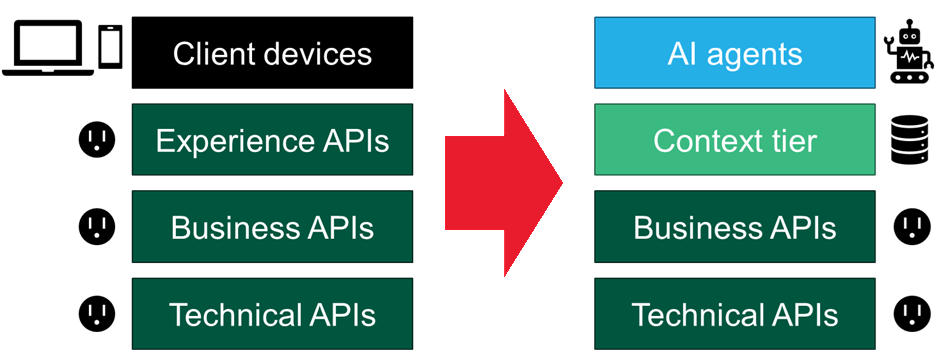
For solution architects, this reframes governance and design: Instead of controlling every path through an application via experience APIs, the goal becomes defining safe boundaries within which AI can operate autonomously, driven by real-time context.
The result is a shift away from the traditional API tier model of applications, with context replacing experience APIs.
The Architect’s Opportunity
Solution architects who cling to application-centric thinking will find themselves fighting AI’s natural operating model. Those who shift their focus to business capability design, orchestration boundaries, and real-time context will become essential guides for their organizations’ AI ambitions.
Forrester clients can read more about my analysis of where application architecture is going by reading Rearchitecting Applications For The Age Of AI. To discuss these concepts further, please schedule a guidance session with me.