B2B Social Media Influencers Have More Influence Than Ever
LinkedIn recently expanded its Creator Marketplace, making the arduous and often manual task of identifying and partnering with social media influencers much easier for B2B marketers. While creator tools have existed for years on platforms like YouTube, Facebook, and TikTok, LinkedIn dominates B2B. Its operationalization of creator partnerships is one of several recent developments that solidifies why working with social media influencers should no longer be treated as experimental.
Influencer Marketing Isn’t New, But Social Media Has Changed Everything
Digital natives (Gen Zers and millennials) make up the largest portion of the typical B2B buying group (which now consists of 13 members, on average), and these and other buyers increasingly turn to social platforms to learn, evaluate, and validate decisions. In fact, social media is now second only to conversational AI as the most common self-guided source of information that buyers cite as meaningful.
Social media influencers are no longer a side bet. They are a critical part of how buyers discover ideas, build confidence, and ultimately choose vendors.
Buying Influence Spans Visibility Through Validation
B2B marketers who still approach influencer programs as top-of-funnel awareness need to expand their thinking. Social media not only drives early awareness and preference — it also supports validation and trust-building later in the process. Our research shows that buyers now use social media to learn about new ideas, explore solutions, and gain perspective from credible voices well before engaging providers.
Roughly one-third of buyers expect social media to be impactful at each stage of the journey, with many citing it as one of the most meaningful sources of information.
Influence shows up across a wide spectrum of voices and behaviors. Creators with large and engaged followings play a critical role in making ideas visible and accessible in crowded feeds, accelerating discovery early in the journey. At the same time, experts, ambassadors, and practitioners help buyers interpret complex information, validate claims, and reduce risk as decisions progress. To be effective, influencer strategies must intentionally engage different influencer types and align to specific buyer needs and stages in the journey.
This is why the most effective influencer strategies balance reach with credibility. Programs that focus only on impressions miss the opportunity to shape how buyers think. Programs that ignore visibility miss the chance to enter the consideration set in the first place. B2B buying influence is about being trusted at every stage of the buying journey.
Social Media Influencer Partnerships Are Built On Shared Purpose And Cocreation
Marketing leaders seeing real impact with social media influencers have moved from transactional campaigns to partnership models. They recognize that influence is not something you rent for the short term. Influence is built through partnership, alignment, trust, and sustained collaboration.
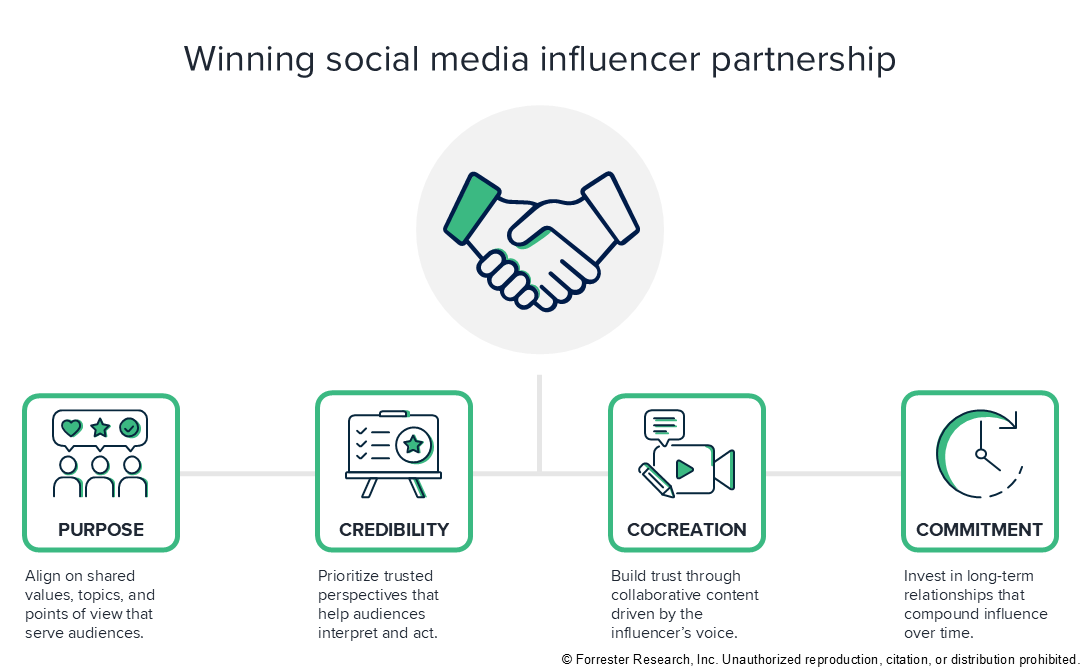
The most effective programs consistently align to four principles:
- Purpose over promotion. Influencers have built trust with audiences because they deliver value. They aren’t looking for transactional relationships with provider brands — they value partnerships grounded in shared perspective and aligned purpose. When there’s no alignment, credibility erodes.
- Trust credibility over reach alone. Reach still matters, especially for discovery, but the ability to interpret complex ideas and guide buyer thinking is also important to driving impact. Micro and nano influencers can have outsized influence with targeted audiences, where trust plays a critical role in derisking decisions.
- Cocreation over control. The strongest content feels native to the influencer, not scripted by marketing. That requires giving up control in exchange for authenticity. Influencers have already won trust with the audiences that marketers are targeting. That’s why ensuring alignment and trust when cocreating with influencers is critical to achieving the best outcomes.
- Commitment over short-term wins. One-off activations have limited influence on the high-consideration purchases typical in B2B buying. Long-term relationships compound trust and deliver higher ROI over time.
Forrester clients can access the full report, B2B Social Media Influencers Are Growth Catalysts In The AI Era, and schedule a call with Karen Tran or Daryl Wright to help optimize your influencer marketing strategy. You can also see Daryl discuss the topic live at this September’s B2B Forum EMEA in London, in a session titled “Influencing The Influencers — What Does It Take.”
Related Forrester Content