Build A Minimum Viable Data Framework For The Agentic Supply Chain
What Is An Agentic Supply Chain?
In earlier research, we described a vision for the agentic supply chain where agentic AI transforms the supply chain from laborious monitoring and reacting to autonomous, goal-driven agent orchestration that proactively delivers business outcomes while keeping humans in control of strategy, exceptions, and governance.
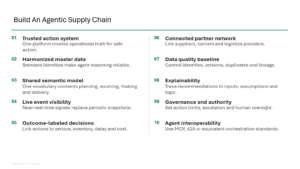
Harmonized master data and a shared semantic model are two of the 10 essential prerequisites for agentic success.
Agentic AI Exposes Any Data Weakness
Here’s why data harmonization matters. Agentic AI will not fix a weak supply chain data foundation; it will expose it faster. Before agents can recommend or execute decisions, they need a minimum viable data foundation (MVDF). This foundation lets them identify the entities involved, understand their current state, interpret what has happened, and determine which actions are permitted. At minimum, this requires an authoritative system of action; harmonized master data for products, locations, suppliers, customers, and resources; and a shared semantic model spanning planning, sourcing, manufacturing, logistics, inventory, and fulfillment.
An agent orchestra needs to keep time. It also requires event-driven visibility, because agents must respond to live operational conditions rather than stale planning snapshots. Connectivity must extend beyond the enterprise to suppliers, carriers, and logistics partners, while data quality controls provide identity resolution, lineage, versioning, freshness, and confidence. Explainability and governance are equally important.
An agent orchestra needs a conductor. Finally, interoperable orchestration standards enable agents to communicate and delegate reliably. This is the minimum to establish enough trusted, contextualized, and policy-controlled data for agents to act safely and consistently.
A Minimum Viable Data Framework Harmonizes Master Data
An MVDF helps harmonize master data and govern a shared semantic model, as well as layering in live event visibility and labeling decisions so that agents are aware of current events and can learn from decision outcomes. Recently, we described the minimum viable data framework for agentic product lifecycle management.
Types Of Data That An Agentic Supply Chain MVDF Manages
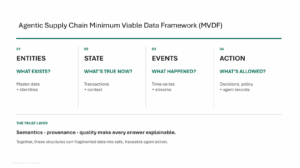
To enable an agentic supply chain, technology leaders must define entities through harmonized master data and persistent identities; represent state through current transactions, constraints, and operating context; preserve events as time-ordered records of what changed and when; govern actions through policies, permissions, thresholds, and decision records; connect all four layers through shared identifiers and canonical semantics; attach freshness, quality, confidence, version, and provenance metadata; and expose governed views that make every agent decision safe, consistent, and traceable.
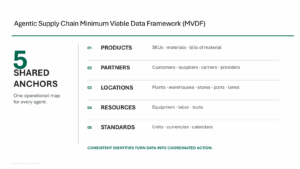
An MVDF standardizes five shared anchors — products, partners, locations, resources, and operating standards — and assigns an enterprise definition and persistent identifier to each anchor. It maps source-system records to these anchors and resolves duplicates through governed match-and-merge rules and stewardship. It connects anchors through product-location, supplier-item, and resource relationships, synchronizing changes across systems with version, lineage, and quality metadata. Standardized “anchors” published through a shared semantic model support coordinated agent action.
Please look out for our upcoming research on charting your course to agentic supply chain maturity. Better still, join our roundtable discussion at Technology & Innovation Forum EMEA.
We’re always interested in hearing your perspective on AI deployment patterns and AI governance. Please feel free to schedule a guidance session or inquiry call.