From Dread To Confidence: What A Live Experiment Revealed About Revenue Enablement’s Secret Powers
Revenue enablement leaders often tell me that doing their work isn’t their toughest challenge. Rather, it’s confidently measuring, defending, and communicating the work to executives that’s the hardest part of their job. That tension was on full display last week at Forrester’s B2B Summit, where we opened a hands-on workshop by asking a simple question:
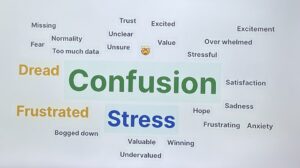
“What emotion comes to mind when you think about measuring and communicating enablement value?”
The resulting word cloud captured what Forrester research has been signaling for years: confusion, stress, frustration, and a sense of being undervalued. These are not signs of a capability gap. They’re signs of an influence gap, created when enablement teams default to measuring what’s easy instead of what matters most.
From Research Insight To Live Validation
Forrester research shows meaningful performance gaps between enablement teams that measure activity and adoption and those that focus on quality and impact. Additionally, we know that high-performing sales teams are 37% more likely to measure the impact of enablement on the greater organization (Forrester’s B2B Sales Survey, 2025). But research is only powerful when practitioners can see themselves in it. This workshop served as a live validation exercise, blending research models with real-world scenario analysis and in-the-room collaboration.
Rather than lecturing through frameworks, participants worked together to apply Forrester’s Revenue Enablement Measurement Model and the Periodic Table Of Revenue Enablement Metrics to common, problematic scenarios in sales onboarding, product launch, and tech tool rollout. The goal wasn’t to select more metrics but to answer three practical questions enablement leaders face every day:
- Should we measure this?
- Can we realistically measure this?
- How should we communicate it so that leadership understands and acts?
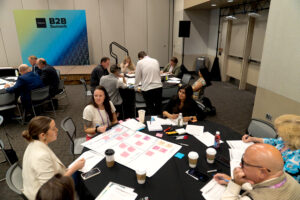
Each table assigned a facilitator and a scribe, instilling discipline, shared ownership, and clarity — the same conditions required for effective enablement measurement back at the office (though our coffee was better).
Why Collaboration Changed The Outcome
What stood out wasn’t just the rigor of the conversation, but how quickly confidence increased once participants stopped working in isolation. By reverse-engineering failed enablement initiatives and repairing the weakest link in the measurement chain, attendees shifted from defensive justification to proactive storytelling. Critically, the exercise moved beyond dashboards and into executive framing. In the final capstone, groups practiced articulating enablement value through the lenses executives care about most — the cost of inaction, organizational drag, and risk to strategic priorities — rather than about training completion or content volume.
The Before And After Told The Story
At the end of the session, we asked the same emotional question again. The contrast was unmistakable: Confident. Clear. Encouraged. Hopeful. Participants didn’t just say they felt better; they looked different. They left holding laminated models, prioritized metrics, and messaging they could immediately use.
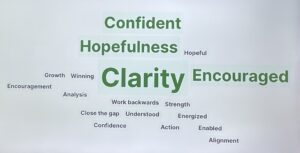
This transformation reinforced two truths. First, Forrester’s models work, not as theory but as practical tools when applied with intent. Second, confidence doesn’t come from consuming more content. It evolves through collaborative problem-solving that forces enablement leaders to think, decide, and message together.
B2B Summit is evolving, and this workshop illustrated why. When practitioners leave informed and measurably stronger, both viscerally and tangibly, that’s when insight turns into influence. We’ll see you in Phoenix in May 2027 for the next chapter.
Categories