Money20/20 Europe 2026: Intelligent Finance Takes Shape
In an earlier post, I argued that financial services are moving beyond AI experimentation into execution. After three days at Money20/20 Europe 2026, that shift feels tangible. What stood out was not just accelerating AI adoption but a deeper structural change: Firms are no longer layering AI onto existing systems — they are beginning to rearchitect the foundations of finance for an AI‑driven economy.
Across sessions, announcements, and executive debates, three converging themes emerged: the rise of agentic AI and agentic commerce, the evolution of money into programmable infrastructure, and the centrality of trust as a design principle.
These trends are not evolving in isolation — they are reinforcing each other, reshaping finance toward a model built for autonomous, AI‑mediated economic activity, where AI, data, and money become deeply interdependent.
Agentic AI Evolves From Capability To Economic Actor
Agentic AI dominated the agenda — not as a future concept, but as an emerging operating model.
Our research, The Future Of Digital Experiences, points to a clear shift beyond assistive chatbots toward AI systems that can initiate, optimize, and execute decisions. Banks and fintechs are already embedding AI in core journeys, from servicing and financial planning to claims and investment support. Some firms are moving faster. BBVA stands out as a bellwether, industrializing AI across the organization. As CEO Onur Genç emphasized, the challenge is as much cultural and operational as technological. ABN AMRO CEO Marguerite Bérard similarly pointed to the need for end‑to‑end process optimization rather than isolated innovation — a prerequisite for becoming truly AI-native.
This marks a step change: systems that can act, not just assist. Yet as many speakers noted, deployments remain early and tightly controlled, with explicit permissions and clear guardrails.
Architecture And Customer Models Are Shifting In Parallel
At the same time, agentic AI is driving an architectural rethink. Players like NVIDIA pointed to the emergence of transactional foundation models — such as Revolut’s PRAGMA — designed to orchestrate capabilities and create a unified intelligence layer across risk, growth, and product experiences. Delivering this requires deliberate choices around data, compute, and architecture, signaling a shift from experimentation to long‑term infrastructure investment.
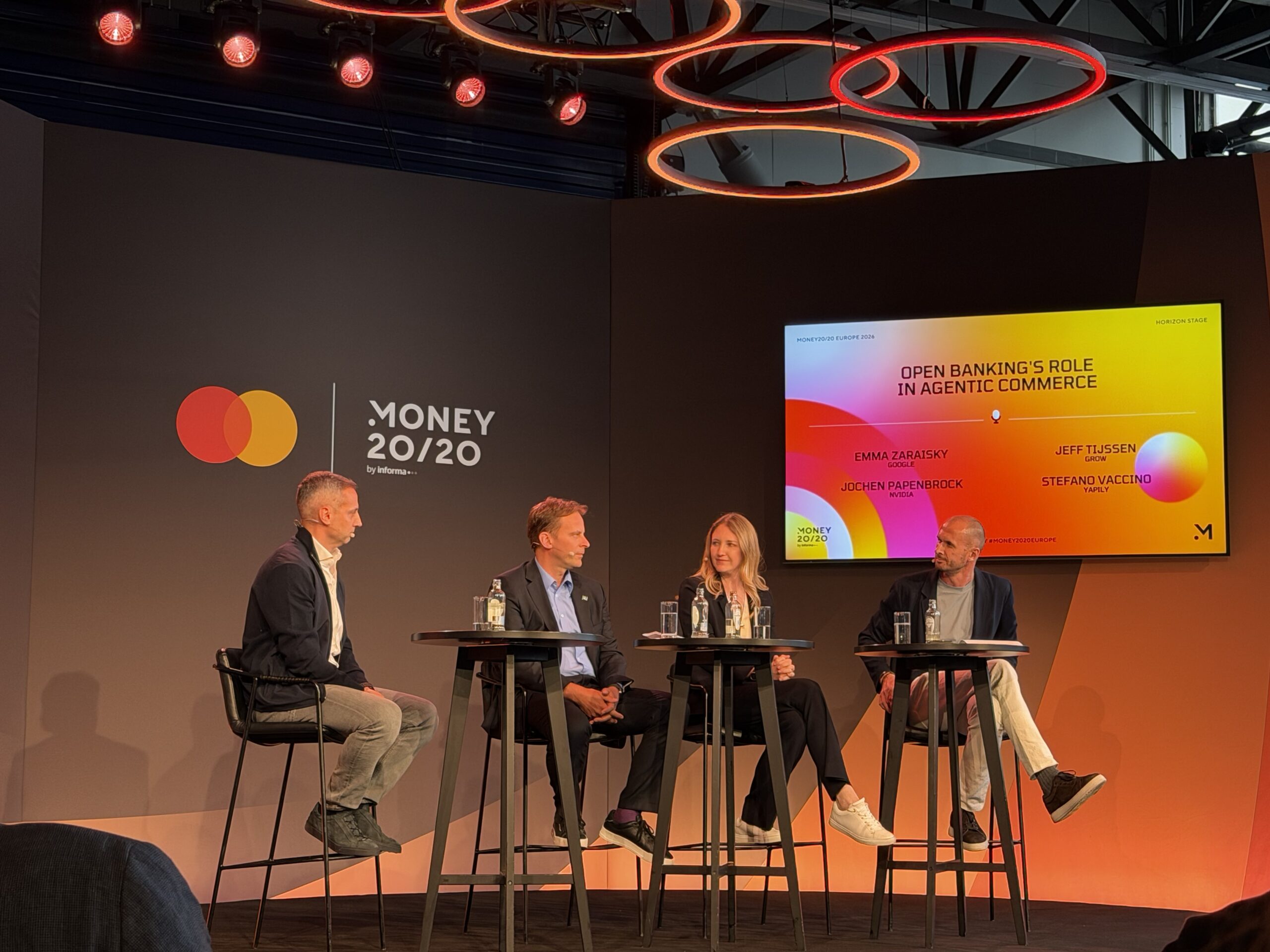
The customer model is evolving in parallel. AI agents are beginning to act on behalf of users — browsing, selecting, and initiating transactions — fundamentally reshaping interaction. Increasingly, the “customer” is an AI agent, prioritizing speed, logic, and structured data over traditional user experience. Discovery shifts from human browsing to machine selection, brand influence depends more on underlying value signals than interface, and customer relationships become more indirect.
Despite the momentum, the industry remains in its early stages. Most deployments rely on human oversight, explicit consent, and step‑by‑step validation. Familiar constraints persist: Fragmented data limits effectiveness, model economics are rising to board‑level scrutiny, and governance and explainability remain nonnegotiable.
Forrester’s research shows that while agentic AI has reached technical viability, most firms remain caught between promise and payoff. Delivering value requires moving beyond isolated use cases to build an integrated AI stack spanning data, models, orchestration, and governance.
From Stablecoins To Programmable Financial Infrastructure
Stablecoins were widely discussed, but the bigger story is the emergence of programmable financial infrastructure.
Across sessions, a consistent message emerged: Over time, stablecoins matter less than the rails they help to build. Their value lies in enabling new ways to move money, manage liquidity, and coordinate financial activity.
This is already playing out, with use cases moving from pilot to production — particularly in cross‑border payments (especially in underserved corridors), treasury and liquidity optimization, and B2B payments.
Tokenization is progressing in parallel, with banks and consortia exploring new settlement models — albeit unevenly. Three familiar barriers remain:
- Interoperability. Fragmented ecosystems risk limiting scale.
- Regulatory divergence. Regimes continue to evolve unevenly across regions.
- Commercial viability. Reaching sufficient volume remains critical.
Even so, a clear direction is emerging. Programmability is becoming the defining feature of the next‑generation money stack.
Embedding logic directly into money — linking transactions to conditions, events, or even AI‑driven decisions — unlocks new business models and operating paradigms. This is what will enable more automated, intelligent financial systems.
Trust Becomes The Foundation Of The AI-Native Financial System
As AI agents and programmable money reshape financial services, trust has emerged as both the industry’s greatest challenge and its most important differentiator.
Leaders at Money20/20 consistently emphasized that trust must be engineered into systems, not retrofitted. This marks a shift from compliance-led approaches toward models grounded on transparency, control, and verifiability.
Four dimensions stood out:
- Transparency and explainability. Customers must understand AI-driven decisions, especially in high-stakes contexts.
- Control and consent. Agentic commerce raises fundamental questions about authorization, accountability, and liability.
- Identity and security. Digital identity frameworks are becoming foundational — extending to AI agents (“know your agent”).
- Governance and regulation. Alignment across AI, payments, and digital assets is accelerating.
Trust is also becoming a competitive lever. Firms that combine responsible AI, aligned incentives, and seamless — yet secure — experiences will differentiate in an increasingly complex ecosystem.
Critically, trust is not just a customer issue — it is an ecosystem requirement. Agentic commerce and programmable infrastructure depend on coordination across banks, fintechs, big tech firms, and regulators. Interoperability emerged as a key enabler, reinforced by contributors including Experian and regulators such as the FCA.
In an AI-native financial system, trust becomes a form of currency. Firms must build “trust architectures” that integrate technology, governance, and customer experience by design.
From Digitization To Rearchitecture
Money20/20 Europe 2026 signals a structural shift: AI is becoming an economic actor, money is evolving into programmable infrastructure, and trust is emerging as a system‑level design requirement. These converging forces sit at the core of my research on intelligent finance, which explores how firms must design integrated AI, data, and financial ecosystems — moving beyond experimentation to build AI‑native, trust‑first operating models at scale. Clients interested in discussing these topics can chat with me via inquiry or guidance session.
Related Forrester Content
Categories