People Make The AI Reinvention Engine Work
A conversation with David Walker, former chief technology officer of Westpac and technology leader at DBS
AI models may increasingly provide the intelligence for how your workflows run, but people determine where AI is applied, which work should change, how risks should be assessed and prioritized, and how value will be measured. Those aren’t entirely new capabilities: Organizations have been developing and refining them throughout the digital era; AI, however, is testing them at a different speed and scale.
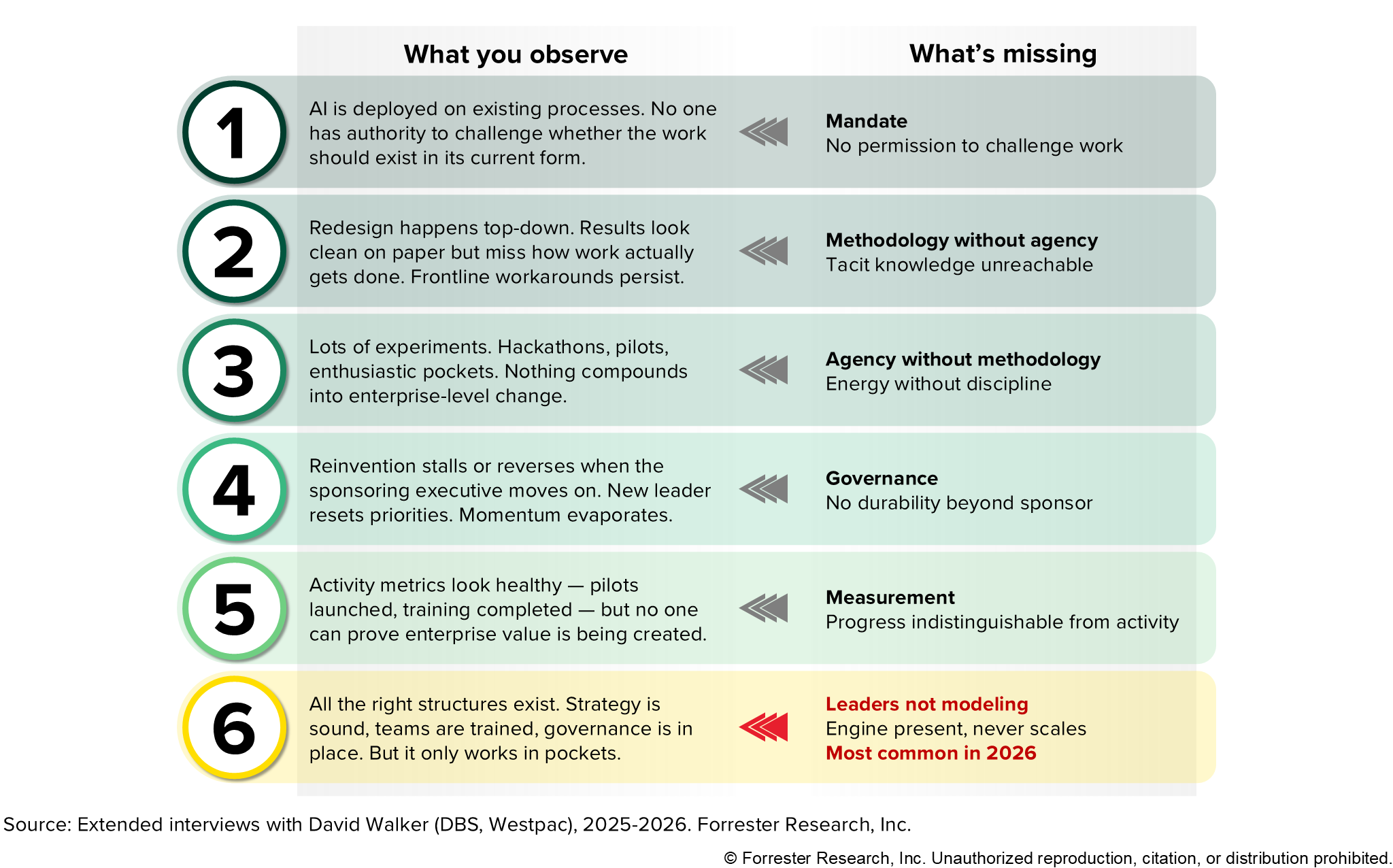
Few leaders have had a better opportunity to observe what carries over than David Walker, who held senior technology roles at DBS and Westpac. I spoke with him about the transformation practices that remain valuable in AI, the controls that become fragile, and why honest workforce conversations matter as much as technical ambition. The graphic below summarizes why reinvention stalls when a critical condition is missing. For the complete framework and recommendations, read the report, Your People Power The AI Reinvention Engine. In this blog post, I share selected parts of the conversations behind it.
Start With The Risk System You Already Have
Fred Giron: One of the questions we’re hearing most often from clients right now is how to set up AI governance. Some organizations are creating entirely new structures around AI, while others are adapting what they already have. How did you approach it at Westpac?
David Walker: The first thing I recognized was that AI governance would move very slowly if legal, compliance, regulatory, and security teams were treated as reviewers at the end of the process. So we brought them in from day one through a central group called the AI accelerator. Technologists and architects were part of it, but the weighting was clearly toward the risk and control functions.
That clearly changed the dynamic. The technology team understood how the systems worked, but legal, compliance, regulatory, and security leaders were the people who needed to own the risk decisions. If they sat outside the process, they would either slow everything down or struggle to see why a use case was acceptable. We had to bring them up the education curve quickly and make them accountable participants inside the accelerator.
Once that group was in place, we tested the question with regulators, the banking association, the board, and senior executives: Did AI change the risk profile of our existing controls? The answer was that AI scaled risk more than it created entirely new categories of risk. In other words, the risks were familiar, but they appeared at a higher rate and in more places.
That’s why we didn’t build a separate AI governance funnel. That would become too slow, especially because AI will be everywhere, like data and technology. Instead, we looked at how we already made technology decisions and mirrored the AI risk model onto those governance forums, so existing forums inherited the decision-making for AI.
Our frameworks already scored impact and likelihood on two scales, and every AI use case could be plotted onto that same matrix. The caveat is important: We were a bank, so we already had mature risk management in place. Not every organization starts from that position.
Human Review Becomes A Fragile Control
Fred Giron: Let’s talk about the “human in the loop” concept. My understanding is that your views on this have evolved a bit over the last couple of years. What’s changed?
David Walker: I was probably incorrect in how I had been saying this in the past. We would get asked a question about controls, and the answer would be, “We don’t need to worry, because we have a human in the loop, and therefore the human is still the accountable party.” That last part is still true — humans are still accountable. But the process of a human in the loop is flawed.
We had low-stakes internal use cases where humans still reviewed AI output. AI was accurate often enough that human reviewers quickly became complacent. After hundreds of correct outputs, review turned into routine approval. And by the time the system made an error, the reviewer was no longer scrutinizing the output with the same attention. The “human in the loop” control had become weaker precisely because AI was right most of the time.
That’s why automated controls matter. Manual controls were always going to be overwhelmed by the rate anyway. The answer was to make controls as electronic and digital as possible and then monitor whether the control itself was still working.
Teach Everyone To Change The Work
Fred Giron: One thing that stands out from DBS and Westpac is that reinvention didn’t sit inside a specialist transformation team. How did you create that sense of agency across the organization?
David Walker: The beautiful part of the system we created at DBS was that we didn’t have teams of people doing innovation, process improvement, or change on behalf of everyone else. We taught people how to do it. Paul Cobban was doing that around process improvement. Neal Cross was doing that around innovation. Instead of running an innovation department that took ideas into a queue, Neal turned it on its head and said, “I’m going to teach everyone innovation.” That’s where the idea of DBS as a 22,000-person startup came from.
It was all about embedding skills to create culture. Neal’s focus was mindset, the ability to innovate, and permission along the way. Paul’s process improvement events did something similar for work redesign. People learned how to look at a process, remove waste, and redesign it around the customer outcome. The magic wasn’t that a central team became good at reinvention — it was that the entire organization learned a repeatable way to reinvent itself at the edge.
Fred Giron: But how does that translate to AI, especially since many organizations are giving people tools and training but not seeing much change?
David Walker: Well, you can’t just give people AI tools, teach them how to use the tools, and expect them to go reinvent the company. You need to start with the why. What does this mean for me? What could change if I innovate in my area? And what happens if it doesn’t work? In a bank culture, those questions are really important. At DBS, people needed confidence that an experiment that proved something didn’t work would still be treated as a success. That gave people permission to move.
The same pattern showed up at Westpac. Other companies were rolling out thousands of hours of AI training and wondering why they weren’t seeing the cut-through. So before the AI training, we started with a mindset shift: Give people permission to disrupt themselves. The shark tank program was sponsored by the CEO, open to every employee, and designed to signal that different thinking would be valued. Then, we gave people the AI training. So agency came first and AI skills followed.
Give Agents The Outcome, Not The Process
Fred Giron: Another thing we’re hearing from clients is that they’re trying to figure out how work changes in an agentic environment. What have you learned from your own experience using agents?
David Walker: A good example is data migration at Westpac. We were in the middle of a large transformation of the technology stack, and data migration was one of the hardest parts of that work. The normal process required people to map data between two systems, build test files, create reconciliation mechanisms, and work through discovery, build, test, and rollout. For one set of data, a squad of six or seven people typically needed about six weeks to complete that end to end.
We came at it from a completely different direction. Instead of teaching agents to follow the processes humans were using, we gave them the outcome: Move the data from one system to the other. The agents then worked out which subagents they needed to achieve the outcome. It stopped being a linear migration process and became an outcome to orchestrate. We ended up with a master agent running four agents and two humans supervising them, doing roughly the same work in about four days.
Confidence Sustains Reinvention
Fred Giron: You spend a lot of time talking to employees and workforces about AI these days. What are people most concerned about?
David Walker: It’s much clearer to me from outside. Inside a corporation, it’s hard to stand up and have a genuine conversation about the good, the bad, and the parts we don’t know. But the absence of that conversation creates more skepticism and fear among people who are already nervous. People want to understand what AI means for them and their work, and they respond better when leaders are open and honest about both the uncertainty and the opportunity.
Fred Giron: That seems closely connected to employee agency. People can’t reinvent work if they don’t trust the direction of the change.
David Walker: Exactly. I saw the same pattern in earlier transformations. About 12 months in, the people driving transformation at DBS realized the “burning platform” wasn’t sustainable. These programs take years. That’s when the message shifted toward building the “best bank in the world.” The lesson for AI is similar: Urgency may start the journey, but confidence is what keeps people changing the work.
Categories