Search Will Force the First Major Change to Website Layouts in Decades
Read our fresh research: The Future of Search in Owned Channels to discover our ADVICE framework (public blog post here), as well as Best Practices for Conversational Search in Owned Channels for a deeper dive into our recommendations.
The traditional website search box has trained users to compress a need into a few keywords, and to expect a static set of results. Now, conversational interfaces (e.g., answer engines and AI assistants) train users to explain their need of the moment, refine it based on a response, compare options, ask for help, and complete a task. These new expectations will follow users as they use other channels.
An interface that flexes between full-page, embedded chat and a set of results will alter websites to a degree that we haven’t seen since the top-nav layout became standard decades ago.
Manage Expectations: Big Changes Are Coming To Websites
The currently isolated experiences for each of traditional search and chat will come together. In the next few years, websites will be transformed from the familiar layouts we know well to flexible and adaptive conversational interfaces.
The role of the search box will expand as owned digital experiences combine direct retrieval, guided discovery, and service in one interaction that adapts to the customer’s goal.
Traditional Search Still Works When The Answer Is A Result
The shift to conversations isn’t a blanket change to every search experience. Many queries are already precise. A user who enters a product name, SKU, part number, or exact article title usually needs a direct result. Generating a long response adds cost and delays the answer. Organizations should employ conversations only as appropriate, and:
- Keep direct retrieval fast. Preserve precision matching, strong ranking, filters, facets, product data, content structure, and relevance controls for precise queries.
- Apply AI where it improves the result. Shift to conversational experiences when the user requires it, such as when queries are lengthy questions or requests for information, or if they trigger support flows. Build experiences that flex, shifting from conversations to results as the context changes, even in the same session.
Conversations Will Support All Activities, Unifying The Experience
A conversational experience can gather context, interpret requests, explain recommendations, and support follow-up questions across discovery, service, and logistics to:
- Guide product/service discovery. Help customers translate needs such as an occasion, application, compatibility requirement, budget, or performance goal into relevant choices. Conversational discovery moves beyond attributes to real life applications.
- Support selection decisions. Support comparison processes to compare options, explain differences, answer questions, and retain the context that customers provide as they refine their request. Access inventory and cost data to support questions about availability and timing.
- Continue into service. Help customers assemble or use a product, locate an order, start a return, troubleshoot a problem, or reorder a previous purchase, all using natural language.
Become Experience-First With Three New Operating Imperatives
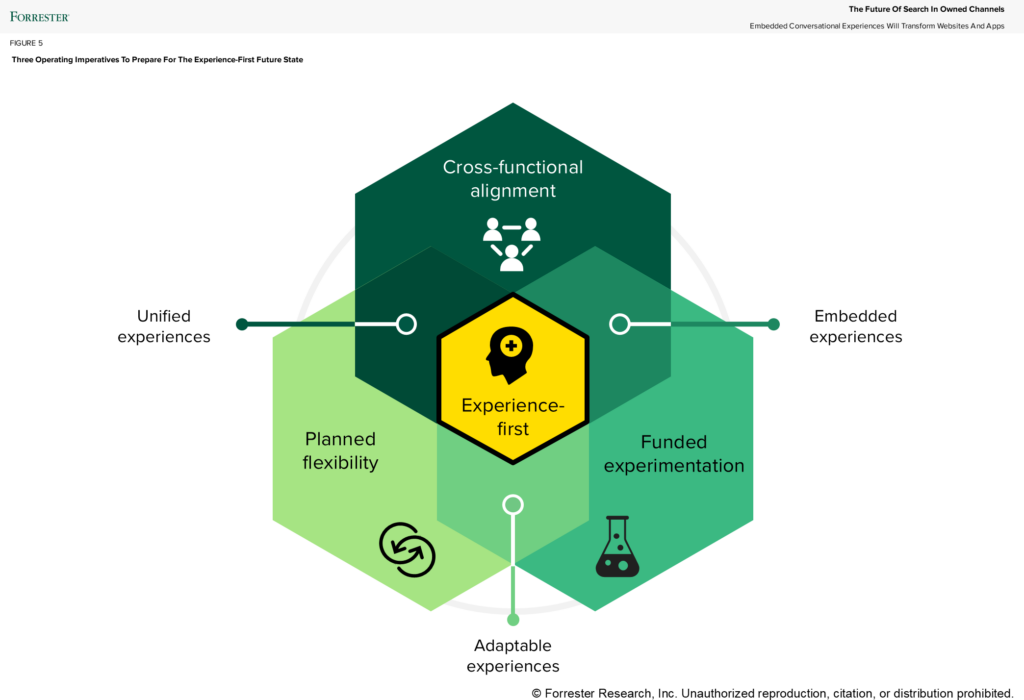
Alignment, experimentation, and flexibility are the three operating imperatives that must guide digital leaders’ search strategy:
- Cross-functional alignment. Customers will see one interaction, but tech solutions spanning search, customer service, content management, order management, identity, and other systems contribute significantly behind the scenes. Historically, these systems were siloed from one another, to the detriment of users’ experiences. Work now to align both your tech and your teams so you’ll be prepared to provide a single experience that supports search, discovery, service, and other customer activities.
- Funded experimentation. Dedicate some budget to as-yet unproved practices and hypotheses to learn what works for your users. Our vision of the future of search notwithstanding, that future is still evolving – including users’ expectations and the technology and interfaces.
- Planned flexibility. Help your teams develop a willingness to adapt. Their flexibility in the face of ongoing changes will create resiliency moving forward. Your experiences, too, will need to flex with your users’ needs, flowing in and out of conversations, services, and results.
Read the full Future of Search Vision report with our ADVICE framework to understand the near-future state of owned search. Follow that with the Best Practices deep-dive to see how to execute on the framework as you evolve your search and conversational experiences.
Schedule a Guidance Session with me to discuss how to prepare for the future to come. We’ll work on your plan for search and how it contributes to your complete strategy for 2027.
Related Forrester Content
Categories