The Real AI ROI Problem Isn’t Technology — It’s Measurement
AI investment is accelerating faster than enterprises’ confidence in its returns. Boards want clarity, CFOs want numbers they can defend, and technology leaders want to scale what works. Yet many AI conversations still end the same way: “We know it’s valuable — we just can’t prove it.”
That disconnect isn’t caused by weak models or immature platforms. It’s caused by outdated ways of measuring value. AI’s ROI problem is not a technology problem, it’s a measurement problem.
Why AI ROI Feels Harder Than It Should
GenAI use has moved rapidly from experimentation into production across marketing, sales, service, product, and operations. But most organizations still evaluate AI using business cases designed for automation or analytics: isolated KPIs, siloed dashboards, and aggressive payback expectations.
This approach breaks down because the value of AI must be assessed not only by traditional financial metrics but also by the means and timing of how that value is delivered. More so than cloud, mobile, or big data in the past, AI holds the potential to change your customers, your business, and the world. But these changes won’t happen all at once. When leaders expect all AI investments to translate to the bottom line quickly, disappointment is inevitable. That’s what we are seeing right now.
The Real Issue: There’s No Shared Language For AI Value
Organizations fail to scale AI impact because they lack a consistent way to describe, compare, and measure outcomes across use cases and functions. Finance looks for revenue, cost, and risk signals. Business leaders look for experience and growth. Technology leaders look for capability and reuse.
Without a shared language, business cases lose credibility, AI portfolios fragment into pilots, and ROI discussions become political rather than analytical. Until leaders agree on what kind of value AI is designed to deliver, debates about ROI will persist regardless of model performance.
This is Figure 1 from our report, Introducing The Forrester AI Value Matrix: A Framework For Measuring What Matters.
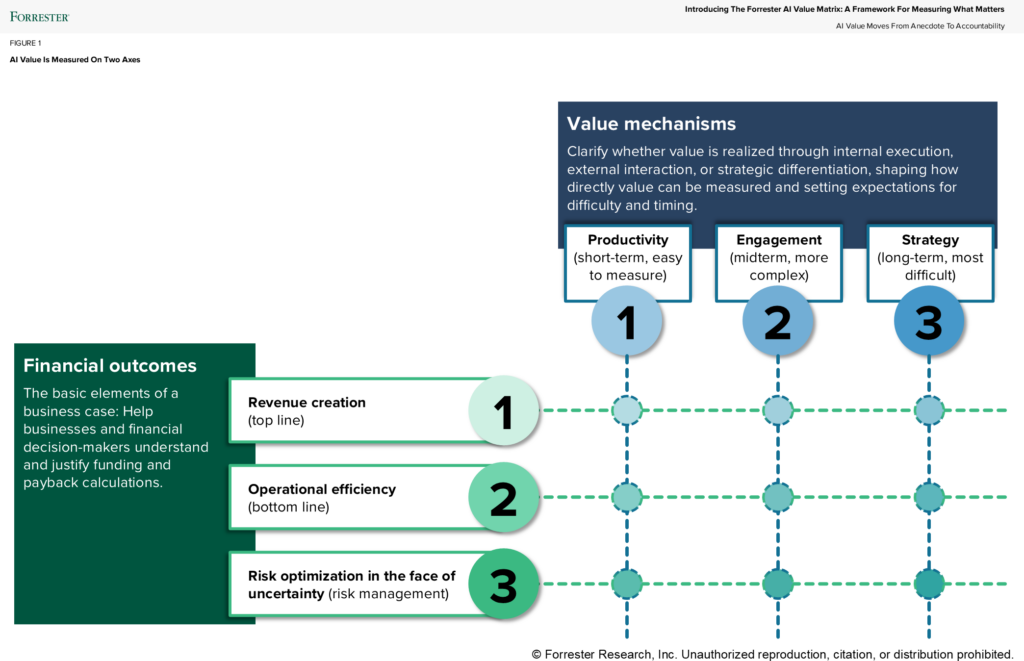
To help clients solve their AI value problem, our newly published value matrix framework describes nine instances of value across two axes:
-
- Financial outcomes: where AI’s impact appears (e.g., revenue creation, cost and efficiency improvement, risk mitigation)
- Value mechanisms: how AI creates that impact (e.g., productivity, engagement, strategy)
This distinction matters because it separates where value shows up from how value is created. Productivity‑driven value is fast and visible. Engagement value takes more time and the belief that AI does indeed drive better customer outcomes. And strategic value — like market repositioning or adaptive response to competitions — is slower and even harder to attribute but more durable. Treating all three as if they should deliver identical ROI timelines is what makes AI returns feel inconsistent.
Make Your ROI Conversation Easier With The AI Value Matrix
By crossing three financial outcomes with three value mechanisms, Forrester’s AI Value Matrix defines nine distinct ways AI creates value. This adds three things most organizations have been missing:
-
- It makes AI value comparable. Leaders can evaluate very different AI initiatives using the same structure instead of arguing over incompatible metrics.
- It sets realistic expectations. Teams know whether an investment is designed for fast productivity gains, improved engagement, or long‑term strategic advantage — and can measure success accordingly.
- It improves investment discipline. Portfolios can intentionally balance near‑term payback with compounding strategic value instead of defaulting to the easiest win.
Most importantly, the matrix replaces storytelling with structure. AI ROI stops being something leaders defend after the fact and becomes something they design for up front.
What Leaders Should Do Next
AI is no longer an experiment. But scaling it responsibly requires abandoning one-size-fits-all ROI thinking.
Leaders should:
-
- Define AI success by value type, not just financial outcome.
- Set different targets and timelines for productivity, engagement, and strategy.
- Use a unified framework like ours to align business cases, governance, and measurement.
When organizations do this, ROI becomes a guide for smarter investment decisions rather than a post‑hoc justification exercise. That’s how AI value moves from anecdote to accountability. Tech leaders, email me or book a guidance session at bhopkins@forrester.com. Product leaders, connect with Lisa Singer at lsinger@forrester.com.
Categories