Two-Tier ERP Is Back, And Sage Has A Role To Play
Our ERP strategy on a page template describes the decades-old enterprise yearning for ERP standardization. The logic is compelling: common processes, common data, common controls and fewer applications to support.
The reality of the multinational enterprise is considerably messier. A billion-dollar company running SAP or Oracle at headquarters may comprise scores, or hundreds, of much smaller operating businesses. It acquires companies, establishes joint ventures, enters new countries, opens plants and runs businesses whose requirements bear little resemblance to those of the corporate center.
I was reminded of this at Sage Future for Partners in Amsterdam.
Sage’s more purposeful portfolio, centred on Sage Intacct and Sage X3 offers an opportunity for multinationals to migrate heterogeneous local applications to standardized global midmarket solutions. That was one of my most useful takeaways from the event, alongside Sage’s thinking about how AI changes the economics and role of its partner ecosystem. But there is a bigger enterprise story here.
Don’t Confuse Standardization With Uniformity
Consider what happens when a multinational running SAP or Oracle at corporate headquarters or across its larger business units acquires a €50 million manufacturer in Belgium or Spain that runs Sage.
The instinctive enterprise-architecture response has often been: When can we migrate it to SAP or Oracle?
But that may be the wrong first question.
The acquirer bought the business because it possessed something valuable: customers, products, expertise, intellectual property or a route to market. Replacing its ERP system immediately may impose cost and disruption while doing little to preserve or increase that value.
The better questions are:
- Which processes genuinely need to be common?
- Which master data and financial controls must the parent standardize?
- Where do the two businesses buy from common suppliers or sell to common customers?
- How quickly must the parent consolidate financial and operational information?
- And which local processes should remain local because they are part of what makes the acquired business successful?
That is the architectural problem that two-tier ERP ought to solve.
Many Forrester clients run SAP or Oracle at headquarters or larger business units, but must decide what to run in smaller countries, acquired subsidiaries or plants. The challenge is making those businesses participate in the multinational’s common terms and processes without needlessly ripping out systems that work.
Sage X3 And Intacct Could Complement Rather Than Compete With Tier-One ERP
This changes the competitive question for Sage.
It is the Sage X3 and Intacct’s ability to complement tier-one ERP implementations that makes Sage strategically relevant to multinationals.
There is evidence of precisely this use case around X3. In a recent Sage X3 stakeholder interview, Sage described a large customer that is an SAP shop but uses X3 for joint ventures because a new X3 instance can be deployed in approximately six months and retired when the project finishes. The same interview positioned X3 for organizations that require enterprise-level capability but cannot justify the budget or deployment model of a tier-one SAP solution.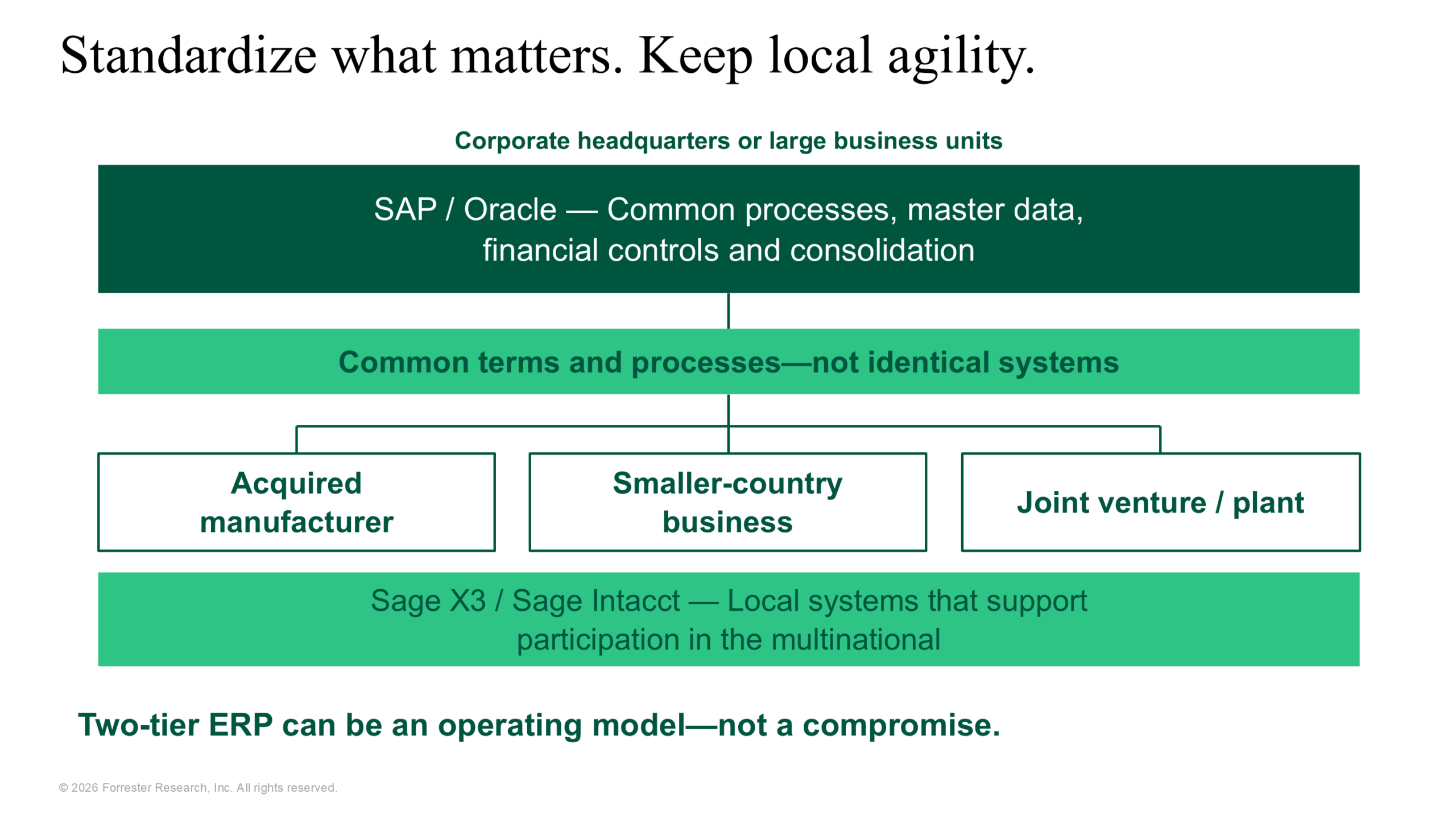
We are always interested in hearing your perspective on multinational applications portfolio evolution. Please feel free to schedule a guidance session or inquiry call.