What Should You Do When AI Disrupts The Tech You Rely On?
The SaaSpocolypse was a sham. Or was it? The original story carried in the press quoted investment analysts worried that if a vendor had a seat-based pricing model or involved software it was toast. They didn’t factor in a vendor’s pivot potential, protective moats, or collateral acceleration.
It was time for some evidence-based analysis. My colleague and co-author Craig LeClair and I identified and scored nine drivers of disruption, acceleration, and protection for over 200 technology and service markets.
The verdict is more nuanced than a simple Gladiator thumbs up or down. Some technology markets will accelerate, while others will have to reinvent themselves, merge into stronger platforms, or sell off aging assets and business models.
Only three categories at the bottom of the AI computing stack won’t be disrupted. The other 80% are at risk and 23% sit directly in the line of fire. Some will disappear. Most will pivot. As Craig aptly reminds us: If AI can perform a capability, it eventually will. What does AI disruption mean for technology executives?
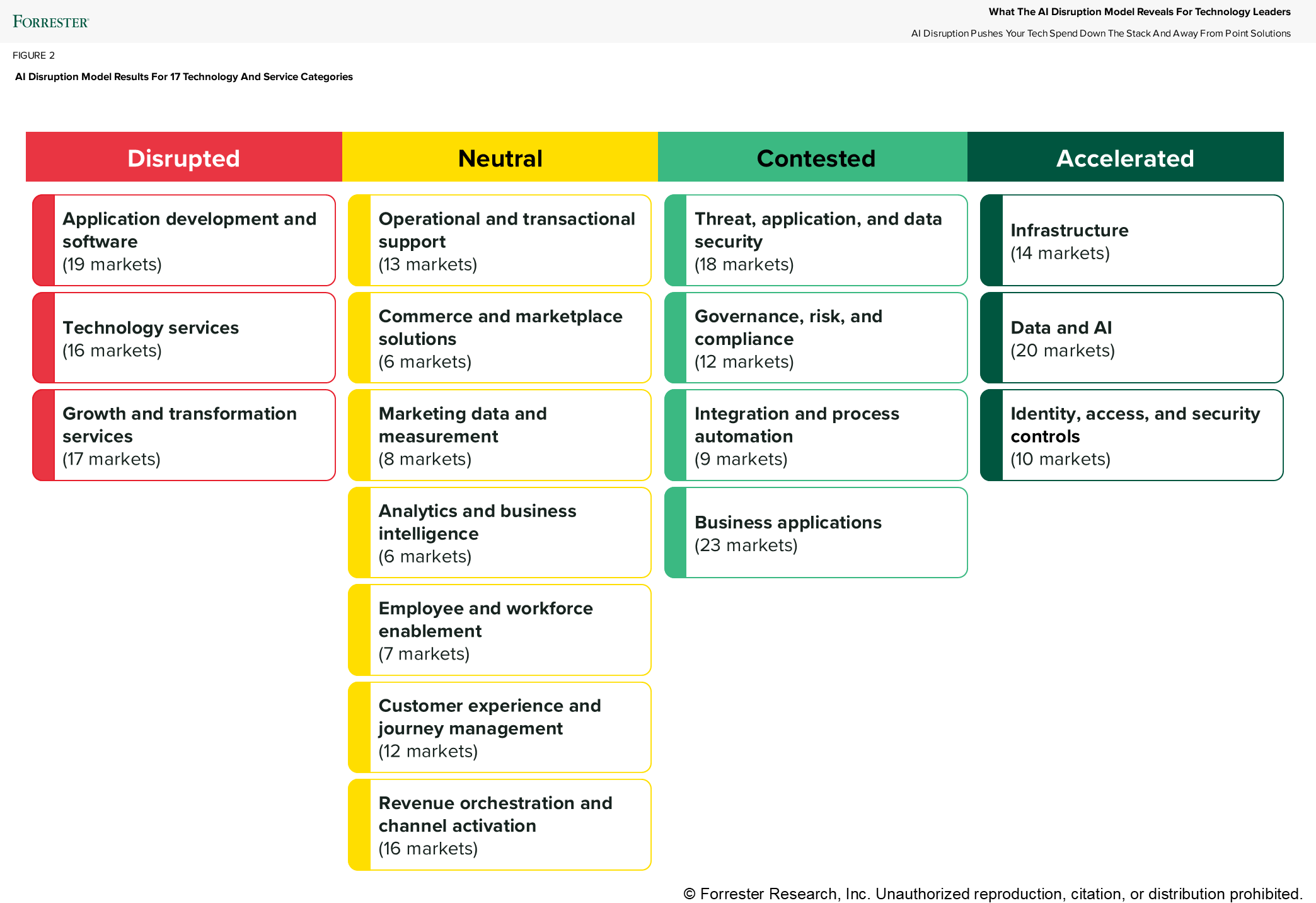
AI disruption analysis hands tech leaders a portfolio planning and procurement tool
The detailed scorecard for each market reveals the impact of AI on the technologies and services firms rely on. As they ramp up AI-powered everything and overhaul their software portfolios, tech leaders will invest more in technologies down the stack – infrastructure, data, AI, and security – and be cautious of overcommitting to software or point solutions at the top of the stack. Collectively, this analysis shapes a playbook for managing the portfolio:
- Disrupted markets face the greatest risk. Disrupted markets are those whose core value proposition will be reproduced by AI. This is the AI substitution driver: If AI can do it instead of a person or an existing software product, it will. Tech leaders should assess their ongoing commitments to providers in these markets and incorporate AI disruption into their negotiating strategies.
- Neutral markets remain relatively insulated. Neutral markets are insulated because their value isn’t primarily informational. If the provider offers capabilities that are physical, legal, or risk based, they are neither disrupted nor accelerated. Tech leaders should assess their neutral-category provider lineup and insist that providers bring in AI ecosystems and capabilities.
- Contested markets face both opportunity and pressure. Contested markets are positioned to move to the accelerated territory. Contested vendors are less exposed to physical, legal, or risk-based revenue. Tech leaders should prioritize providers that respond adeptly to AI disruption in features, integration, and pricing.
- Accelerated markets benefit directly from AI adoption. Accelerated markets sell the picks and shovels for AI workloads. Demand for these scales directly with AI adoption. Tech leaders should expect to spend more money in these categories and have lower negotiating power in these markets.
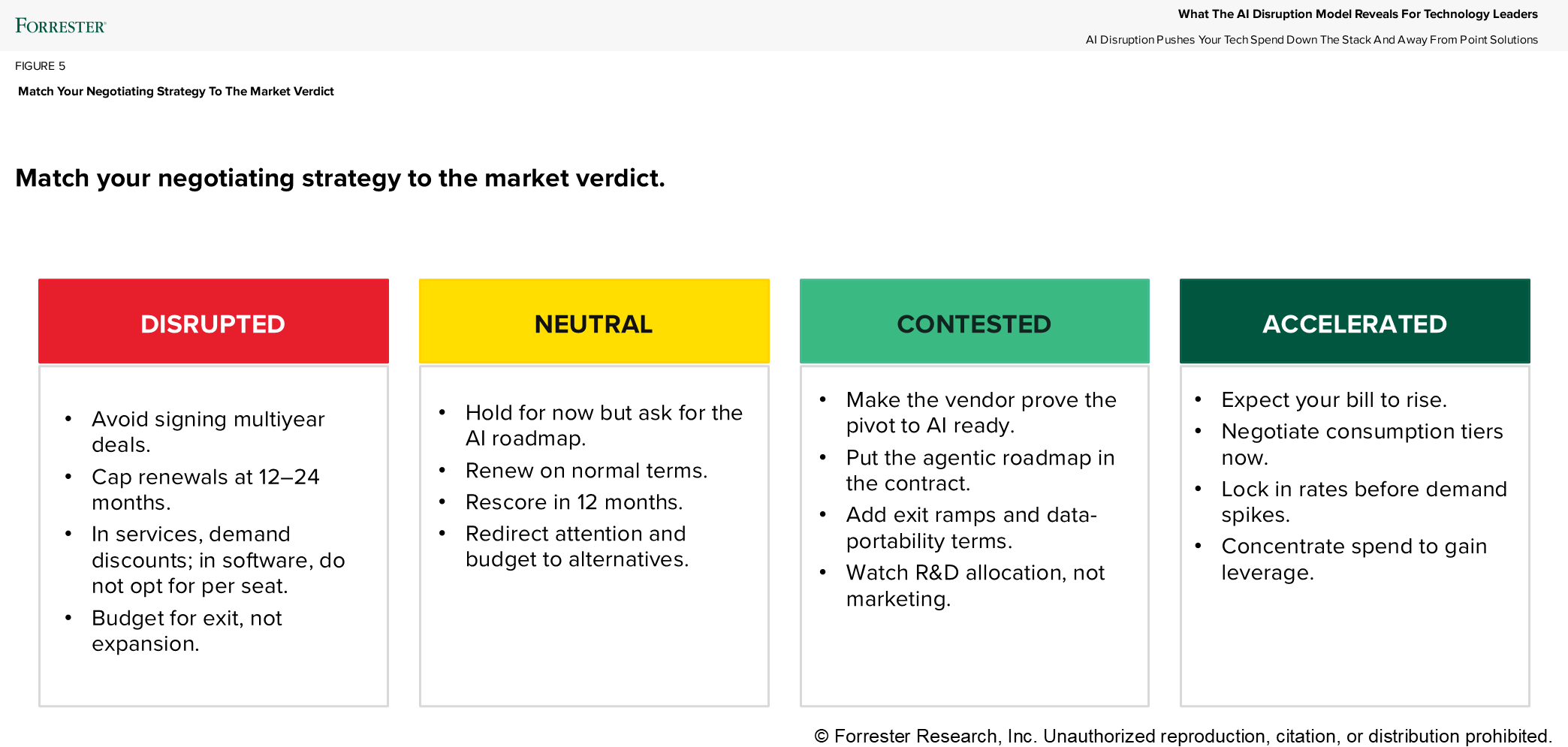
Update your negotiation strategy based on the market verdicts
The four verdicts map cleanly onto four buying postures. Sort your top 20 contracts by annual value, determine a verdict at the market level, (and ask Forrester for a vendor level analysis) and apply the corresponding posture:
- Accelerated markets: Invest in and reserve capacity.
- Contested markets: Renegotiate and demand proof.
- Neutral markets: Monitor and reconsider budgets.
- Disrupted markets: Rationalize and reduce lock-in.
And, oh, the verdict on systems of record, the original SaaSpocolypse hysteria? As repositories of core business operations as well as critical data, providers of these systems are already reinventing them for the AI future.
Categories