Will AI Fix Your CX Measurement Or Make It Worse?
Customer experience (CX) metrics are everywhere, but better customer experiences aren’t. AI could help — but it could also make the problems worse. AI can accelerate analysis, reporting, insight generation, and decision support. That’s a huge opportunity, but it won’t automatically fix the system underneath. A dysfunctional measurement system running at AI speed doesn’t become stronger — it simply becomes faster.
Is Your Measurement System Worth Scaling?
Before organizations use AI to generate more metrics, analyze more data, and automate more reporting, CX leaders need to confront two fundamental problems: They don’t measure CX well enough, and they misuse metrics as a substitute for management. AI can scale both.
Is “Stop Measuring And Start Acting” Really The Answer?
No — the problem starts earlier. Acting more isn’t possible if the metrics being produced aren’t decision-worthy in the first place. And even good metrics become problematic when used as substitutes for management. The problem starts with two kinds of shortcuts.
Measurement Shortcuts: Measuring A Lot But Not Measuring Well
CX teams default to standard metrics instead of choosing metrics that measure the CX outcomes they actually want to improve. They produce dashboards that show what happened but not why it happened or whether it matters; set targets without evidence that they’re achievable or desirable; and launch improvement actions without establishing causality or testing whether they worked. If your measurement practices are flawed, AI will scale those flaws.
Score Obsession: Using Metrics As A Shortcut For Managing People
Assign someone a numeric target, and call it accountability. Reward them when the number rises; penalize them when it doesn’t. That’s accountability for the score, not accountability for improving performance.
People often defend this approach with supposed wisdom from Peter Drucker or W. Edwards Deming: “What gets measured gets done” or “You can’t manage what you can’t measure.” Neither said that. Deming instead warned that assuming you can’t manage what you can’t measure is “a costly myth.” Yet organizations continue turning measures into targets despite Goodhart’s warning: “When a measure becomes a target, it ceases to be a good measure.” If you already manage around the score, AI can give you more scores to manage.
The Predictable Result: Score Manipulation
When improving the experience is hard but pressure to improve the score remains, people find ways to improve the number instead. According to Forrester research, 81% of CX decision-makers report at least one form of score manipulation in their organization, including employees asking customers for higher ratings and leaders changing measurement practices to improve scores.
This isn’t simply cheating: It’s a predictable response when organizations hold people accountable for hitting a metric rather than for understanding and improving the performance that the metric is supposed to represent.
The Consequence: Metrics Start Working Against You
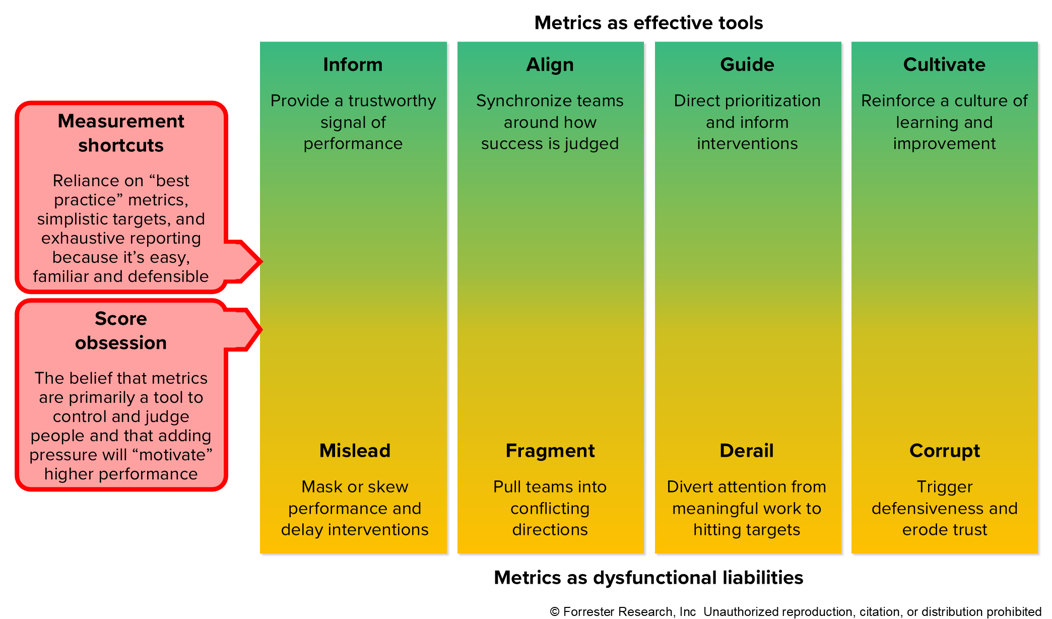
Your CX metrics become liabilities. They:
- Mislead rather than inform. Reported performance becomes disconnected from reality when score manipulation inflates scores.
- Fragment rather than align. Everyone hits their own metric, but the customer loses. At one international retailer, managers prioritized processing returns while customers needed employees on the shop floor, leaving staff caught between competing performance expectations.
- Derail rather than guide. Teams focus on hitting targets rather than solving problems and neglect important work that doesn’t “count” toward a metric. At a pharmacy chain, employees pushed back when asked to smile at customers because they “weren’t paid to do that.”
- Corrupt rather than cultivate culture. Employees become defensive and want to avoid blame. United Airlines removed internal delay codes because, as CEO Scott Kirby explained, they encouraged employees to avoid blame rather than doing the right thing for customers.
How Can CX Leaders Keep AI From Scaling Measurement Dysfunction?
When you introduce AI into a score-addicted organization — or layer it on top of a measurement system built on shortcuts — you’re more likely to industrialize dysfunction than end it. Metrics aren’t bad, but they’re terrible substitutes for strategy, judgment, and leadership.
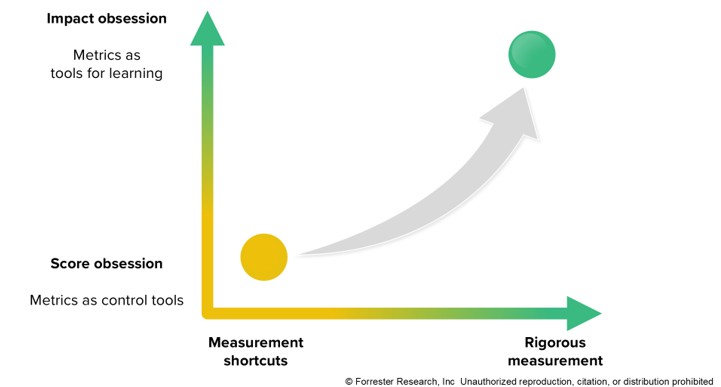
The answer isn’t to measure less or abandon accountability. Instead, measure more rigorously and shift accountability from hitting the score to improving the performance that the score is supposed to represent. Hold people accountable for using metrics to understand performance, identify intervention opportunities, coordinate improvements, and assess progress — and not simply for making a number go up.
Fix The Measurement Practices You Control
Kill reports that confuse rather than inform. Stop searching for the next hot metric after Net Promoter Score℠ (NPS) — the right metric is one that measures the CX performance objective you actually need to improve.
Then, Tackle The Management System Around Those Metrics
Change how people use metrics to manage performance. Think back to United Airlines: Removing internal delay codes wasn’t just changing a metric — it was changing what the organization expected metrics to do.
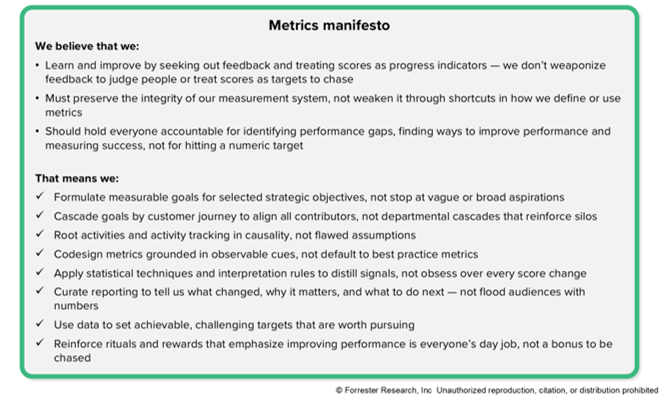
For a quick summary of what this should look like, use our metrics manifesto. It distills the principles for using metrics to learn and improve, rather than simply control and reward.
What’s Next On Your Journey To Making Your Metrics Work For You Again?
This blog is the first in a series. Others will unpack dysfunctional practices, such as signal-less data that turns metrics into liabilities, along with recommendations on how to restore metrics as tools for learning and improvement.
If you have Forrester Decisions access:
- Read our recommendations for how to make your metrics work for you again:
- Request an analyst call with me.