Six Essentials For Managing Platforms And Portfolios
Products Are Evolving To Platforms And Portfolios: Are You Ready?
For years, Forrester’s Product Marketing And Management (PMM) Model has helped vendors bring individual products to market efficiently and effectively. But today’s realities are different: Buyers expect integrated solutions that span workflows, deliver measurable outcomes, and scale with their evolving needs. Sellers need to provide more than incremental improvements — they need a model that orchestrates multiple offerings under a unified vision to drive scalable efficiencies and growth for their customers.
Platforms integrate modular capabilities on a common SaaS-based architecture, enabling shared services like security, data management, and APIs. They deliver seamless workflows and scalability across multiple use cases and users. Portfolios combine related products, services, and solutions into cohesive packages that address broader business challenges and allow flexible packaging for different customer segments. These new methods of deployment enable vendors to simplify complexity, expand market reach, and create stronger customer relationships — delivering real results for customers and sustainable growth for providers.
Introducing The Portfolio Model
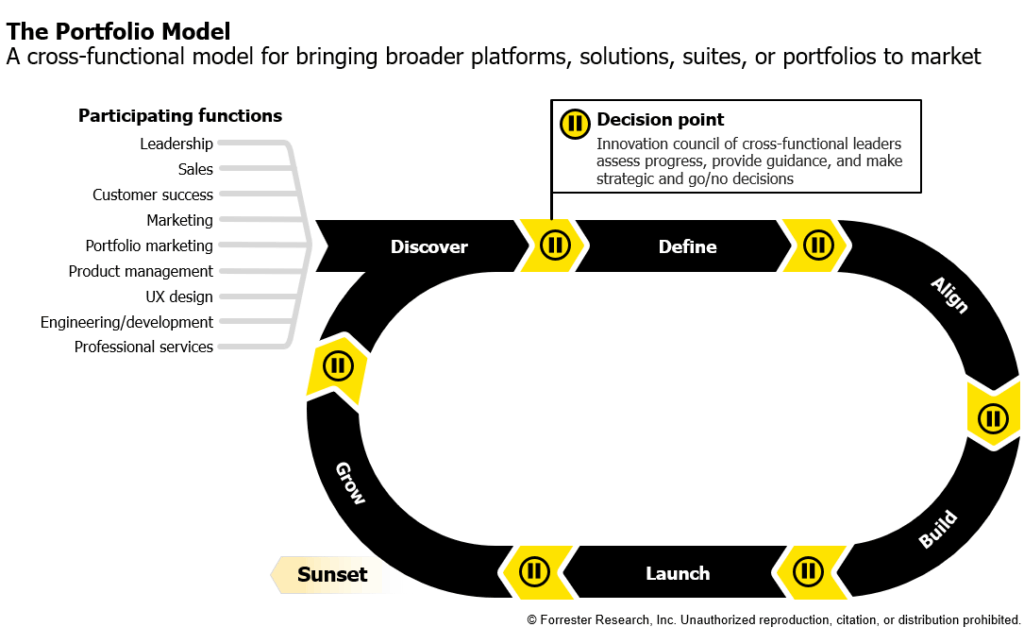
Creating and delivering these broader solutions is more complicated than individual products. That’s why Tony Plec and I created the Portfolio Model — a lifecycle and commercialization framework designed for platforms and portfolios. The Portfolio Model brings together the many functions and activities that are needed for delivering and deploying these broader solutions across seven lifecycle stages and decision points. See the figure below for a high-level view of the model.
Six Steps To Getting Started On Managing Platforms And Portfolios
Switching to platforms and portfolios isn’t just a process change — it’s a strategic transformation. Here’s how to make it work:
- Start with a shared vision. Define the opportunity and the problems you aim to solve. A clear vision aligns product, marketing, and go-to-market teams on common goals.
- Adopt a formal lifecycle framework. Use a structured process — discover, define, align, build, launch, grow, sunset — with clear deliverables and decision points to maintain alignment and momentum.
- Create an innovation council. Governance matters. A cross-functional council ensures strategic oversight, resource allocation, and alignment between strategic vision, portfolio roadmaps, and marketing campaigns.
- Align product management and portfolio marketing. Product managers and portfolio marketers must work hand in hand to harmonize roadmaps, messaging, and launch plans for a unified market story.
- Enable extended teams early. Sales, customer success, marketing, and professional services teams need early involvement to avoid last-minute chaos and ensure smooth adoption.
- Plan for growth and simplification. Post-launch, optimize and expand based on customer feedback and market insights. Sunset underperforming components to maintain relevance and keep complexity in check.
Embrace The Switch To Integrated Solutions
Making this switch is a competitive imperative. Vendors that embrace platforms and portfolios gain greater market share, higher deal sizes, and stronger retention. Those that don’t risk falling behind as buyers choose to consolidate vendors and prioritize integrated solutions.
Ready to make the shift? Start by assessing your current portfolio, identifying integration opportunities, and building your innovation council. Schedule a guidance session with me or Tony Plec to explore these strategies in depth, or reach out via LinkedIn. Current Forrester clients can read more about this evolution in our latest reports: Making The Transition From Products To Platforms And Portfolios and Introducing The Portfolio Model.
Categories