Agentic Software Development Takes The Lead: From Code Assistants To Orchestrated SDLC Agents
So far in 2026, software development has already crossed a clear threshold. GenAI is no longer just helping developers to write code faster; it is reshaping how software is planned, built, tested, and delivered. Forrester’s recent report on The State Of Agentic Software Development, 2026 shows that TuringBots are now becoming agentic, not just AI assistants embedded in individual tools. The new norm is agentic software development, where autonomous agents collaborate across the entire software development lifecycle (SDLC), toward more end-to-end automation.
The shift matters because isolated individual productivity gains are no longer enough. Tech leaders are under pressure to deliver faster and safer results, without scaling headcount or increasing risk. Agentic approaches are emerging as the only credible way to do both.
From TuringBots To Agentic SDLCs
The evolution is best understood as three phases (see figure below). Throughout 2023 and 2024, TuringBots focused mainly on coding and unit testing. By 2025, these capabilities expanded into adjacent tasks like documentation, design assistance, and test generation. Now in 2026, we see the real inflection point: agents now operate across analysis and planning, design, build, test, and delivery — and are increasingly orchestrated together.
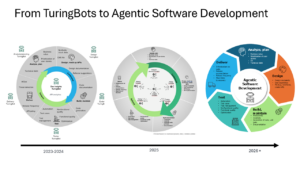
Instead of asking one tool to generate code, teams can now delegate intent (“build this feature”), while agents decompose work, generate artifacts, run tests, and prepare releases. Humans stay accountable, but AI does more of the execution.
Without End‑To‑End AI Adoption, Productivity Gains Will Disappoint
Many firms are disappointed by early results because they apply AI too narrowly. Coding may improve by 30% to 40%, but if planning, testing, and release remain manual, overall team productivity often increases by less than 10%. The bottlenecks simply move. Agentic software development changes the math. When AI is applied consistently across the SDLC, gains compound instead of canceling each other out. This is why leading adopters are shifting from point tools to agentic platforms that orchestrate multiple specialized agents, rather than doubling down on code generation alone.
Software Developer Roles Won’t Disappear, But They Will Evolve
Agentic development will not eliminate developers, testers, or architects, but it will change what “good” looks like in each role.
- Product managers/owners vibe prototypes and features for the rest of the team to productize. They also generate specs, enabling spec-driven development.
- Developers write less code and spend more time reviewing, guiding, and orchestrating coding agents. As AI gets better and trust increases, they’ll write and review minimal code, if at all.
- Testers move from scripting tests to setting quality goals and supervising testing agents, including testing AI systems themselves.
- Architects and senior engineers focus more on system design, constraints, and context engineering — ensuring that agents work within the right boundaries.
Across all roles, the critical skill is no longer just technical depth, but the ability to provide clear intent, context, and constraints to AI peers.
Testing And Governance Will Become More Critical, Not Less
As autonomy increases, trust becomes the limiting factor. Agentic systems can hallucinate, introduce subtle defects, or propagate errors faster than humans ever could. This is why testing becomes more important in an agentic SDLC, not optional.
Leading organizations are investing and shifting from TuringBots to agentic software development and are now treating AI‑generated artifacts with the same, or higher, rigor as human‑written code. At the same time, governance must scale with adoption. Guardrails, auditability, and clear human accountability are essential before expanding agent autonomy in production systems.
What Tech Leaders Should Do Now
For CIOs, CTOs, and VPs of engineering, 2026 is the year to move from experimentation to intentful adoption. Here are four key steps you should take now:
- Pilot across multiple SDLC stages, shifting AI left and right in the SDLC, not just coding, to expose real bottlenecks and benefits.
- Evolve operating models and roles, explicitly defining how humans and agents collaborate.
- Invest in testing and AI governance early, including testing AI‑infused applications and agents themselves.
- Focus on agentic development platforms, not tools, favoring platforms that coordinate and enable agents orchestration end to end.
Agentic software development is no longer a future concept. It is becoming the dominant model for high‑performance software teams. The leaders who succeed in 2026 will be those who treat agents not as clever assistants, but as first‑class participants in a redesigned collapsed SDLC — with humans firmly in control.
If you found this blog interesting and you’d like to dig deeper to see how you could (and should) embrace the use of agentic software development, you can reach out to me by scheduling a guidance session or an inquiry. If you have a product that fits this space, please consider scheduling a briefing.
Related Forrester Content