AI Won’t Save Your Transformation
… and it was never supposed to.
Speed Isn’t A Substitute For Direction
The hype would have you believe that AI has rewritten the rules of enterprise transformation, it hasn’t. It has sped them up, dressed them in new jargon, and (briefly) convinced a few executives that the fundamentals no longer apply.
Autonomous agents can execute work at machine speed, forcing CIOs to manage value, risk, and alignment in near real time. While this is significant, it’s an old playbook under pressure and nothing fundamentally new.
The Critical Ingredients Of Transformation Success Remain In Place
Strategy still comes first; it’s just that bad strategy now fails faster. Measurable outcomes still determine credibility, except now they’re expected to arrive at increased speed. Capability assessments still matter, except that enterprises now include generative AI and its enablers in their repository of tools. In short: The language has changed but the exercise hasn’t.
The Seven Essential Steps To Establish An Enterprise Transformation Program
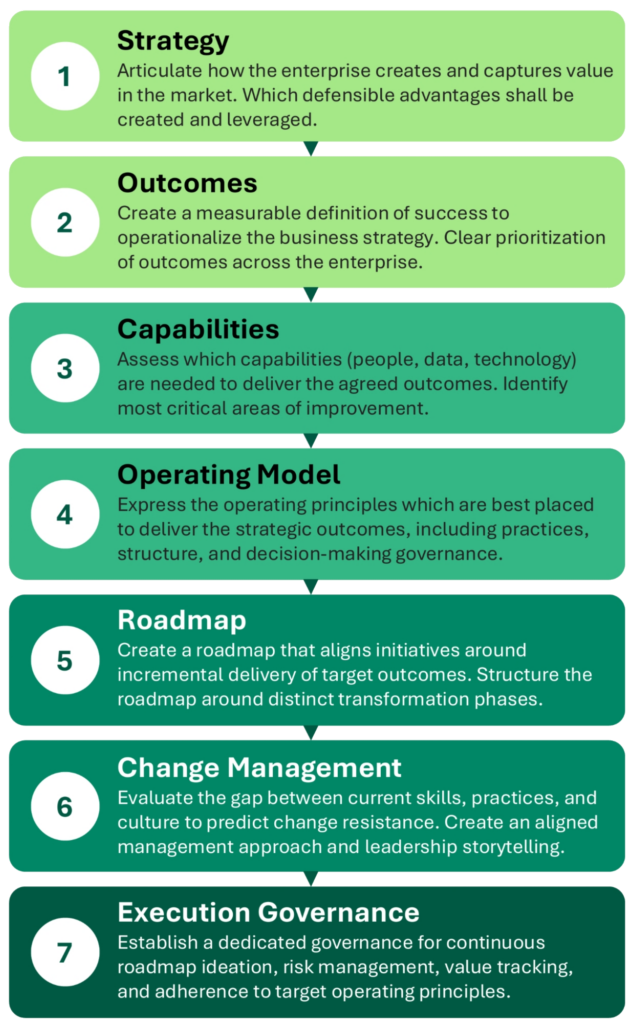
- Step 1: Strategy. First and foremost: AI is a powerful tool, but it’s not a strategy. To call it the former is to confuse corporate ambition with state-level industrial policy. Governments may choose to win at AI. Companies must still decide how they differentiate, which includes differentiating on cost, speed, experience, or something harder to copy.
- Step 2: Outcomes. Every strategy needs a measurable definition of success. Until desired outcomes are clearly defined, strategy remains an aspiration rather than an operational construct. Unless you can measure and report strategically relevant results, transformation buy-in will wither away. As the number of possible initiatives, use cases, and technology choices expands with AI, clearly defined outcomes provide the strategic focus that distinguishes genuine business value from experimentation and innovation theater.
- Step 3: Capabilities. Corporations still need to assess and assemble the capabilities that support their strategy choices and articulated outcomes. AI joins cloud, data, and automation in the toolbox but it doesn’t replace the toolbox itself. AI may collapse the gap between decision and execution, but it doesn’t relax the need to prove value. If anything, it raises the bar.
- Step 4: Operating Model. Operating models are enjoying a moment of reinvention. The idea of blended human-machine workforces sounds radical. But work has always been redistributed when new tools arrive. The difference is that this time, the redistribution is cognitive. Routine judgment is automated and residual judgment becomes more valuable. Someone, however, must still own the decision. AI governance, for now, can’t be solved technically, it remains an operating model problem.
- Step 5: Roadmap. AI changes the speed of transformation, not the fundamentals. And it certainly doesn’t bring big-bang transformations within reach. More technologies, more choices, and more interdependencies make execution harder, not easier. Incremental, outcome-driven roadmaps become even more valuable as a means of reducing complexity and managing risk. The cycle runs faster and failures travel further. The answer isn’t to relax discipline. It’s to double down on it.
- Step 6: Change Management. Through it all, one truth still applies: Technology changes quickly, people move slowly, and organizations barely move at all. As long as humans remain in the loop (hint: they will), transformation remains a people-first endeavor. Skills must shift, practices adjust, incentives align, and resistance must be managed. No model, however sophisticated, will do that for you.
- Step 7: Execution Governance. There’s an uncomfortable truth about productivity. Even in more controlled environments like technology modernization, systems integrators we speak with report AI-driven gains of roughly 20%. Useful? Certainly. Transformational? No. As of now, AI isn’t the silver bullet that transformation laggards were hoping for.
What, Then, Is New?
- Trust or lack thereof. Every AI problem is a data problem? Certainly but not primarily. First and foremost, it’s a trust problem. When asked about barriers to AI adoption, the top three responses in Forrester’s State Of AI Survey, 2026 relate to security, risk, and lack of trust in agentic systems. The core challenge for enterprises is designing the decision-making and accountability structures within their operating models that address the trust problem.
- Pace and pace expectations. AI forces decisions, execution, and value measurement into a tighter loop. It raises the penalty for vagueness and lowers the tolerance for poor governance. As we’ve outlined in our recent report on the AI CIO, AI will enable (and organizations will expect) unprecedented levels of observability, continuous execution feedback loops, and near autonomous portfolio rebalancing. Instead of simplifying it, AI makes transformation less forgiving.
As exciting as genAI is, the playbook for successful transformation still applies: Decide where to play, define outcomes, understand your capabilities, design decision-making within the operating model, execute in increments, and bring the organization with you.
The winners will be those who do ordinary things extraordinarily well — only faster and with fewer excuses.
Related Forrester Content