Build Bridges To Customers With Digital Product Passports
In less than nine months, millions of batteries sold into Europe will require something called a battery passport. These battery passports are one instance of a broader idea called a digital product passport (DPP), and more jurisdictions will require DPPs for more product classes over the next few years. Batteries may get a lot of attention right now, but even lower-value (and higher-volume) items like clothes will soon be issued passports. We’ve just published my new report, The Digital Product Passport Is A Bridge To Your Customer, and I’ll be digging deeper into some of the learnings in a client webinar on September 8.
What Is A DPP For?
Most executives who’ve heard about DPPs assume (not incorrectly) that they’re a sustainability and compliance thing. That’s not unreasonable, especially given the way that Europe’s battery passport is being talked about. But it would be a mistake to leave your company’s DPP thinking to an intern in the compliance department, as there are real opportunities to make the DPP do so much more. DPPs support several (sometimes all) of these five broad use cases:
- Encourage reuse of data within the supply chain. As goods move along the supply chain, one company’s output (and the data about what it is, where it’s from, and what was done to it) becomes the next company’s input.
- Unlock authoritative product information. The most authoritative source of information about a product will probably be one of the companies involved in making, shipping, or selling it.
- Improve product traceability. Where’s it from? What’s in it? Under what conditions were the people who made it employed?
- Support sustainable choices. By shining a light on the environmental costs associated with each product, DPPs encourage manufacturers to make sustainable decisions and help consumers make sustainable choices.
- Enhance sovereign manufacturing. In the current global environment, circular economy initiatives are being adapted to place more emphasis on ensuring that materials used in a particular region can be recycled, repurposed, and reused there — gradually reducing that region’s dependence on other countries. Although this was afterthought when DPPs first entered the legislative landscape, I’m pretty sure this may end up becoming one of the key use cases.
How Is A DPP Built?
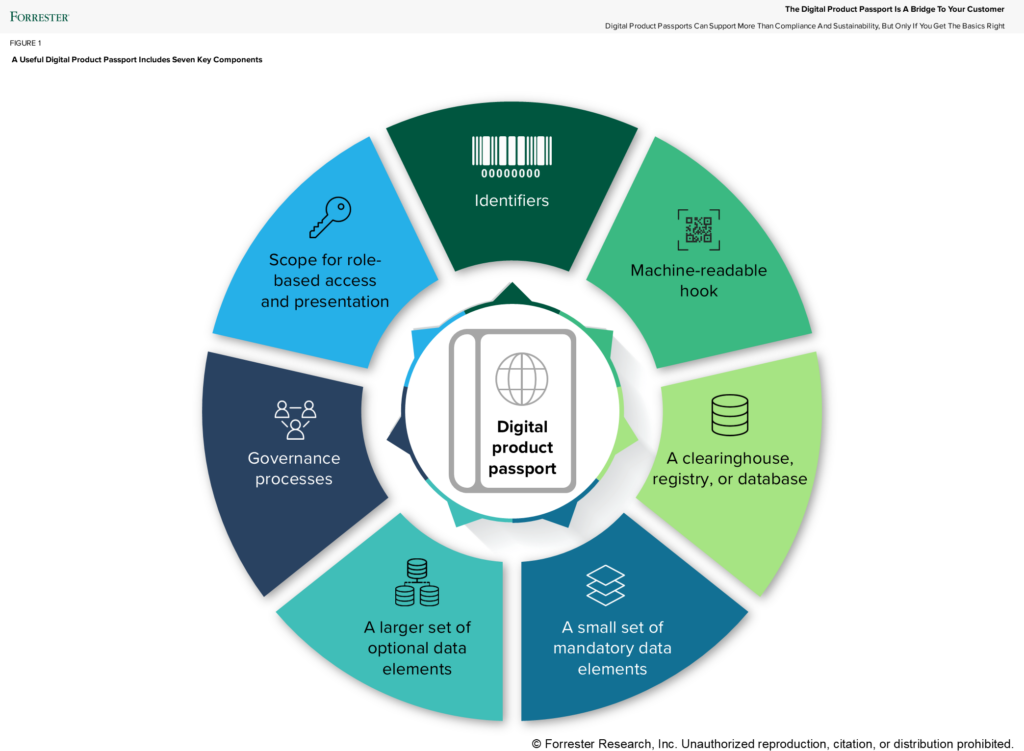
Vendors, researchers, and legislators often discuss the concept of a DPP without explicitly defining what a passport could, should, or must include. Although the specifics necessarily differ from one program or product to the next, most DPPs include seven key components:
- Identifiers. What does the passport describe? Valuable products like EV batteries will normally be identified at the item level, but it may only be feasible to identify lower-value items like T-shirts or tubes of toothpaste at the level of a model or production batch.
- A machine-readable hook. How do you access the passport? This is often a QR code that you simply scan with a smartphone, but other options exist.
- A clearinghouse, registry, or database. The passports need to live somewhere. Some system needs to reliably direct people who scan QR codes on the doors of cars to a secure, reliable, and persistent thing containing the information they expect to see. In a lot of vendor-specific passport use cases, this isn’t a particularly complex undertaking. In Europe, the Commission is meant to launch a registry of identifiers over the summer: It will probably be quite complex.
- A small set of mandatory data elements. Passports for batteries record aspects like capacity, proportions of recycled materials, etc. Passports for T-shirts record things like the source of the cotton. A minimal set of these elements will be mandatory to make the passport both useful to the reader and cost effective to the producer. One German proposal for mandatory elements in the European battery passport suggests over 80% of its elements should be mandatory, which probably fails the “cost-effective to the producer” test!
- A larger set of optional data elements. This is where things get interesting. If the infrastructure is in place, and if consumers have been trained to expect a passport to do useful things for them, then why stop with the mandatory stuff? Want to know when a product was manufactured or where its raw materials came from? Scan the QR code. Need to fix a fault or order spare parts? Scan the QR code. Interested in seeing if there’s a new version of the product or feeling ready to recycle an old product? Scan the QR code.
- Governance processes. As DPPs become sources of information for customers, regulators, and partners, the importance of aligning checks, balances, and incentives all along the supply chain grows. Determine who’s responsible for each piece of the whole, which processes they claim to follow, and how much you trust them and their workflow to deliver believable data.
- Scope for role-based access and context-based presentation. An electric vehicle’s battery has one QR code. A maintenance engineer scanning that code wants to see very different things from the car’s new owner; same goes for the recycling technician who will disassemble the battery at some point in the future. DPP solutions must keep sensitive information away from those not authorized to see it. Just as importantly, DPP solutions need to prevent anyone scanning a passport from drowning in a sea of information and possibilities that have nothing to do with them, their role, or the task they’re trying to accomplish. Most DPP demonstrators fail dismally at this bit, reveling in the cleverness with which they retrieve every possible data element from across multiple back-end databases rather than thinking carefully about the user and their experience. We’ll get there {fingers-crossed emoji}.
Are We There Yet?
Not really. Volvo announced “the world’s first EV battery passport” back in 2024, and the company’s EX90 electric SUV now ships all over the world with a QR code inside the driver’s door: Scan it and see a real live battery passport! I did on a recent visit to Stockholm, and I’m still not sure whether my wife or the salesperson were the more bemused when I whipped out my smartphone to start scanning QR codes instead of photographing Scandinavian design excellence …
Inside Europe and out, most DPPs remain dependent on the interest and enthusiasm of individual companies: A high-end maker of Italian shoes might use a DPP to build a relationship with its customer, but a competitor’s shoe elsewhere in the shop offers nothing comparable. To meet bold targets over the next few years, regulators, manufacturers, and software providers still have quite a lot to do. Explicitly lifting the whole conversation above sustainability reporting would help.
As always, if you have your own perspectives to share, please schedule a briefing and tell me all about them. If you’re a Forrester client and want to discuss (or challenge) my thinking on these topics, schedule an inquiry or guidance session.
Related Forrester Content