Can Automotive Brands Win Loyalty By Competing On Price Alone?
Affordability pressures remain prominent across the automotive industry. As the cost of vehicle ownership rises, manufacturers and dealerships are under pressure to offer competitive prices along with attainable payment and ownership propositions. But while price is key to winning first-time customers, automotive brands cannot rely on it to generate loyalty, advocacy, or repeat purchases.
In our latest report, How To Win And Keep Vehicle Buyers Without Competing On Price Alone, we share insights from our data on vehicle purchase decisions, ownership experiences, and loyalty outcomes across the car-buying lifecycle. Three findings from across the vehicle buying lifecycle stand out for CX teams at automotive OEMs and dealerships:
- Trust turns first-time buyers into repeat customers. For most car buyers, getting the right price is the main reason for choosing a brand. Yet when it’s time to look for a new vehicle, for most returning customers, trusting a manufacturer is the strongest reason to choose them again. Customers who trust an automotive brand are significantly more likely to purchase from that brand in the future (83%) than when they don’t trust it (17%). Build trust through positive experiences across the customer lifecycle.
- Age influences who buyers consult. Friends and family are the most important resource for buyers under 55, while buyers aged 55 or older also consult dealership sales associates and managers. Younger buyers are also much more likely to identify social media as an important resource for their purchase decisions. Tailor purchase decision support to your audience: Equip dealership staff to effectively guide older buyers and prioritize digital and social channels for younger customers.
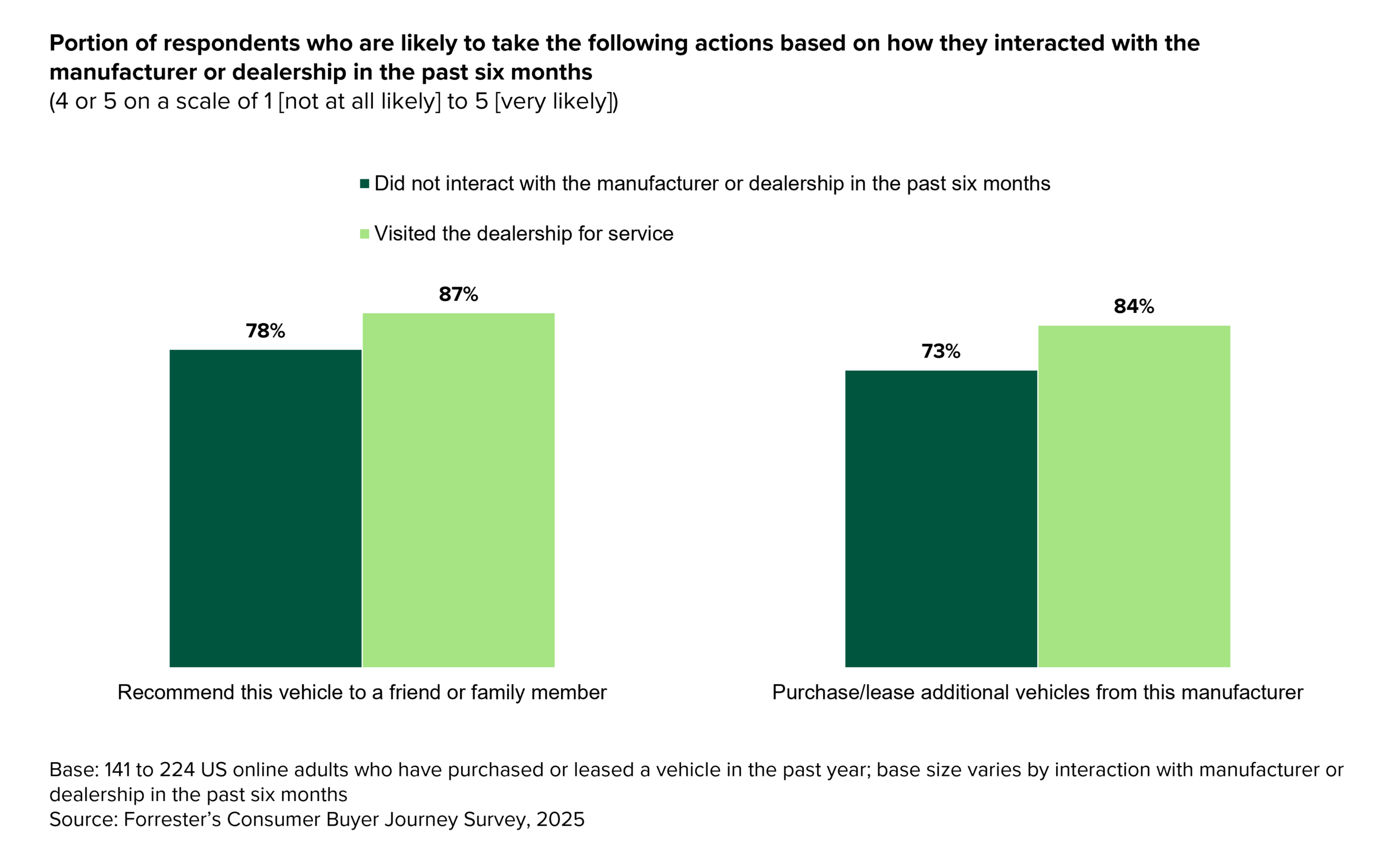
- The sale is not the final destination for building loyalty. Customers who visited the dealership for service in the past six months are more likely to recommend their vehicle (87%) or to purchase additional vehicles from the same manufacturer (84%) than customers who did not interact with the manufacturer or dealership during this time, at 78% and 73%, respectively (see figure below). Resolve vehicle and service issues quickly, make servicing easy, and provide a welcoming dealership environment to strengthen the experiences associated with advocacy and future sales.
The strongest automotive brands increasingly recognize that value is created across the entire customer lifecycle, not with a single transaction. For example, Nissan reorganized around customer journeys that span the lifetime of the customer; Ford expanded into software, services, and insurance to deepen engagement beyond the vehicle sale; and Mercedes-Benz aligned employees, dealerships, and customer experience initiatives around a shared customer-centric vision. Organizations that connect purchasing, ownership, support, and service experiences will be better positioned to strengthen trust, foster confidence, and earn future business.
For more findings from the car-buying lifecycle, Forrester clients can read our new report, How To Win And Keep Vehicle Buyers Without Competing On Price Alone, and schedule an inquiry or a guidance session for a deeper discussion.
Categories