Consumers Rethink Value As Uncertainty And Inflation Persist
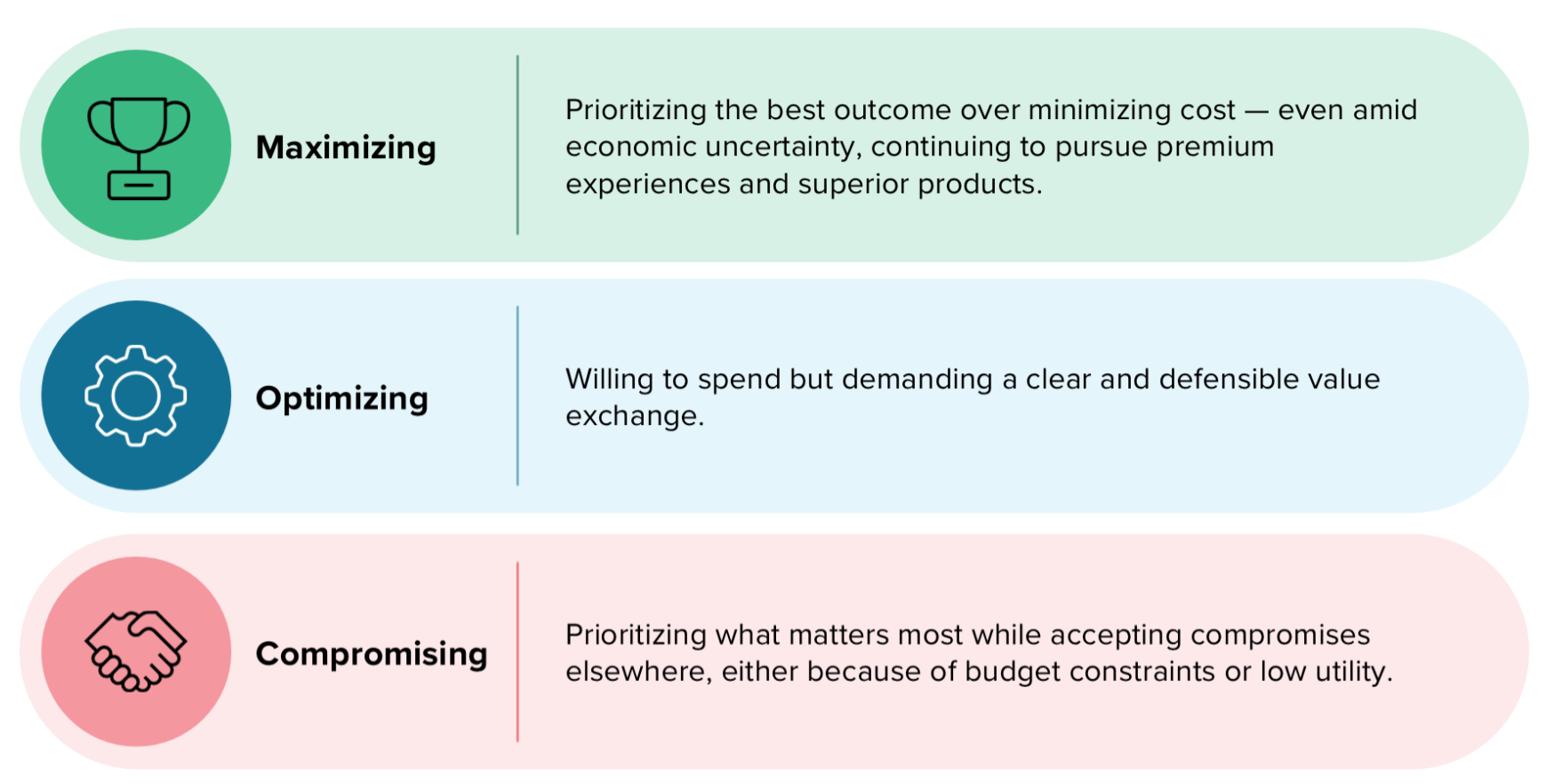
As Americans battle economic uncertainty and persistent inflation, they aren’t simply trading down; they’re choosing what is worth paying for. As pessimism peaks but spending remains resilient (a phenomenon we call the pessimism paradox), three distinct consumer value behaviors are emerging.
1. Maximizing to get the best — and paying for it
When consumers exhibit this behavior, they prioritize the best possible outcome over minimizing costs. Even amid economic uncertainty, they continue pursuing premium experiences, superior products, and differentiated services. They’ll pay more for demonstrably better performance, convenience, exclusivity, expertise, or status. They’ll choose the BMW M Series over the standard model and carry both the American Express Platinum and Chase Sapphire Reserve cards to maximize airport lounge access.
2. Optimizing to ensure the highest return on every dollar
Consumers who are optimizing are willing to spend but demand a clear, defensible value exchange. Rather than simply choosing the cheapest option, they balance quality, convenience, reliability, and price. They pay to remove friction and avoid disappointment. They’ll opt for the premium Netflix tier to eliminate ads and pay the Delta Comfort+ upcharge for JFK to LAX because the extra legroom will matter on a coast-to-coast flight (but not on a short one).
3. Compromising to preserve what matters under tight constraints
Consumers often prioritize what matters most while accepting trade-offs elsewhere. Many operate within tighter budgets and seek the lowest-cost acceptable option. Others are less financially constrained but see little payoff in spending more for a particular category or occasion. They increasingly turn to private-label products, promotions, and lower-cost channels — while protecting spending on the things they value most. At Target, they may choose its lowest-priced private-label tier, Dealworthy, and, at McDonald’s, items from the sub-$3 McValue menu.
Look Beyond Affordability To Understand Customer Value
The important point is that these aren’t consumer segments. Affluence may influence the choices, but it doesn’t determine them. Context, occasion, and category matter just as much. The same person can maximize in one category, optimize in another, and compromise in a third.
To understand consumer value, brands must look beyond price sensitivity and ask what the consumer is trying to maximize, optimize, or protect in a particular purchase. That distinction has significant implications for product portfolio, promotion, and value architecture strategy.
To learn more, Forrester clients can read my research report: Understanding Consumer Value In The Pessimism Economy.
—————————————————————————————————————————
Follow my research: Go to my Forrester bio and click “Follow.”
Chat with me: If you’re a Forrester client interested in discussing these topics, please schedule time with me for an inquiry or a guidance session.
Book an onsite workshop or advisory session: If you’re a Forrester client interested in a session on a related topic, please contact your account team or email me at dchatterjee@forrester.com.
Categories