Forrester’s Top 10 Emerging Technologies For 2026: Beyond Chat
AI has left the chat — literally. After years of living inside screens and digital workflows, artificial intelligence is stepping into the physical world in 2026. It is moving into robots, vehicles, and ambient experiences that sit above the apps and websites you use today. Our annual top 10 emerging technologies list reflects that shift and introduces a new way to think about how our technologies connect.
Interact, Build, And Fuel: A New Way To Read The List
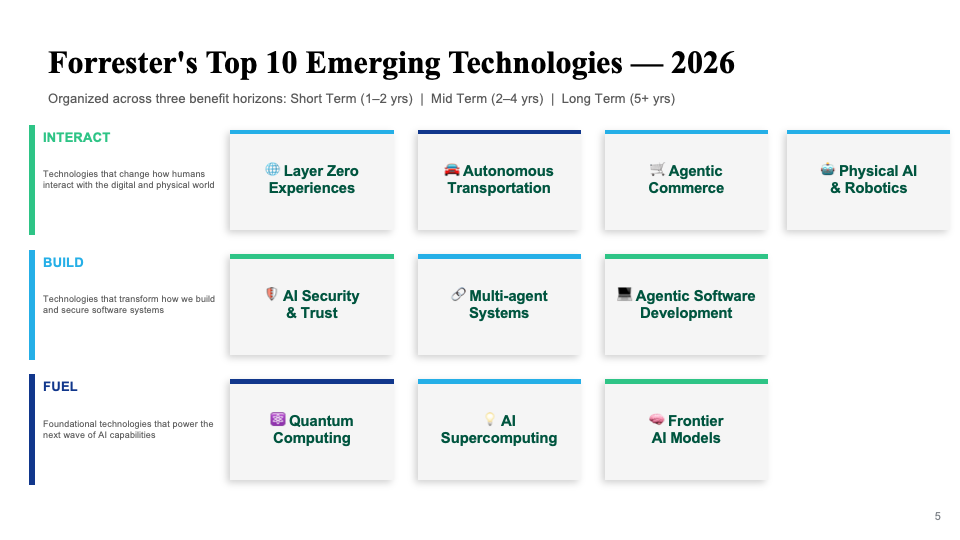
This year, I’m encouraging clients to think about our top emerging technologies in three layers:
-
-
- Interact technologies are the ones people will experience directly: layer zero experiences, physical AI and robotics, autonomous transportation, and agentic commerce.
- Build technologies give innovators the tools to design that future: agentic software development, multi-agent systems, and AI security and trust.
- Fuel technologies provide the raw power underneath: frontier models, AI supercomputing, and quantum computing.
-
Here is a closer look at four that tell the story of 2026:
-
-
- Layer zero experiences: the beginning of the end of the app as you know it. The boldest idea on this year’s list might be the hardest to see. That’s the point. Layer zero experiences are an AI-driven intelligence layer that floats above today’s rigid apps and websites, interpreting what you want and assembling actions across services. Imagine planning a family vacation in a group chat: A layer zero assistant pulls dates from the conversation, surfaces flights and hotels, builds a shared itinerary, and distributes it to the apps and devices that each family member is using. Early patterns are showing up in OpenAI’s Apps SDK and Google’s agent-to-UI (A2UI) protocol, but broad adoption is a few years out. Cross-brand APIs, agent standards, and real privacy concerns still need sorting. When it matures, layer zero won’t just change the interface — it will change the world.
- Physical AI and robotics: from screen to street. If layer zero is AI becoming invisible in digital spaces, physical AI is AI becoming visible in the real world. These are AI systems embedded in machines that perceive, reason, and act in physical environments — adapting, not following, scripts. Early deployments already report 20–50% efficiency improvements in warehouses, factories, and hospitals. Google Gemini Robotics uses models like RT-2 to turn language and vision into robotic actions. Meta’s V-JEPA learns physical dynamics by watching the world. Broad enterprise value is still two to four years out. Firms still have integration, safety, and workforce hurdles to clear, but the dirty, dangerous, and dull jobs go first; everything else follows.
- Multi-agent systems: the operating system for agentic AI. Layer zero and physical AI are big ideas, but neither one scales with a single chat-based agent. This year, we introduce multi-agent systems, the next advancement in agentic AI: networks of specialized agents that plan, delegate, and execute across complex workflows. They bring intelligence into scalable patterns for real operations, including long-horizon work like multi-day case handling and escalation chains. Early adopters show measurable gains in customer support resolution, incident triage, and software delivery. Broad adoption needs better orchestration, governance, and security first. When autonomous agents start talking to each other, things can also get unpredictable fast. The technology is real — the guardrails are still catching up.
- Quantum computing: practicality and Q-day are right around the corner. Quantum computing is our only long-horizon technology, still five or more years from delivering expected value for most firms. So why include it? Because after years of plodding and “maybe someday” opining, the technology is nearing practicality. But along with it comes Q-day, the point at which quantum computers can break current encryption. Practical value and Q-day may arrive as early as 2030. That demands preparation now, even while the commercial upside stays confined to narrow pilots in portfolio optimization, molecular simulation, and supply chain routing. Financial services, pharma, and manufacturing are leading the experiments. Everyone else needs to start planning: Overinvestment today and underpreparedness tomorrow are both real dangers.
- AI privacy and trust: not just important but finally unifying. Trust remains crucial for AI. New threats like prompt injection, data leakage, and model theft have led to specialized solutions such as firewalls and monitoring tools. These tools are now consolidating into integrated platforms, covering prompts, apps, and models. As with past tech evolution, threats drive tool creation and eventually unify into broader systems. AI security delivers short-term value even as a hodgepodge of individual tools, and all AI technologies rely on it.
-
Get The Full Picture
All our top 10 tell one arc, from the experiences people will have to the systems that build them to the foundations that fuel the accelerating future. Welcome to 2026, where AI steps further onto the main stage of information technology, moving from chat into every knowledge task and from the realm of digital into things we can see and touch.
-
-
- Read the full report, The Top 10 Emerging Technologies In 2026, to explore them all, their benefit horizons, and where to look first.
- Also, Forrester Decisions and Market Insights clients can check out our emerging technology research hub.
- Forrester AI users can get answers about these technologies by having a conversation with our research.
-